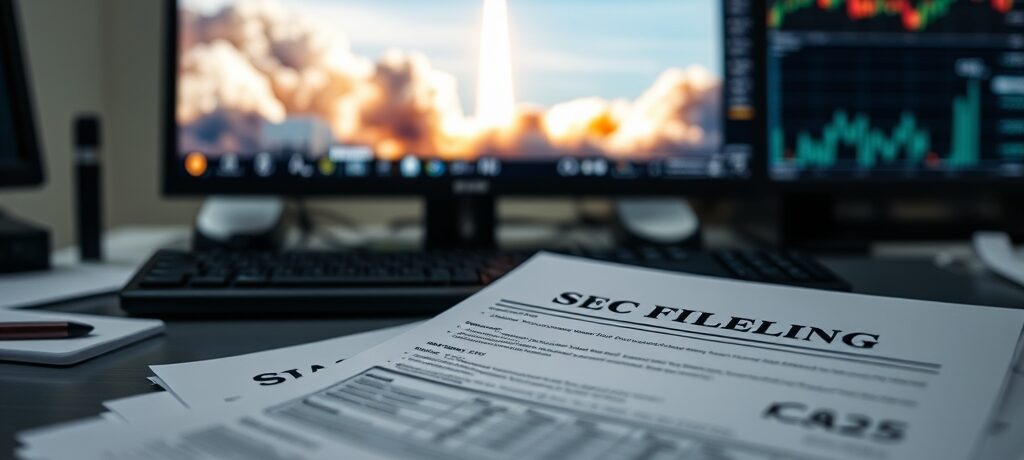
Elon Musk’s aerospace venture, SpaceX, has initiated the process to become a publicly traded company, filing confidentially with the US Securities and Exchange Commission (SEC) for an initial public offering (IPO). This move is anticipated to culminate in one of history’s most significant market debuts, with the company’s valuation projected to exceed $1 trillion (£751bn) upon listing. Such a valuation could position Musk to become the world’s first trillionaire, largely due to his substantial holding in the company.
IPO Mechanics and Ambitious Fundraising
The confidential IPO filing, submitted on Wednesday, allows SpaceX to engage with the SEC and receive feedback without immediately disclosing full details to the public. Following this initial stage, company executives are expected to conduct “roadshows,” a series of meetings with major institutional investors, to garner interest and secure commitments for share purchases. According to reports from Bloomberg, Reuters, and the New York Times, SpaceX is targeting an official public listing sometime in June.
The primary objective of going public is to secure a substantial capital injection, with the company aiming to raise $50 billion or more through the sale of its shares. This considerable fundraising target underscores the company’s aggressive expansion plans and the significant financial resources required to fuel its future endeavors.
Strategic Consolidation and Valuation Milestones
SpaceX’s journey towards public listing has been marked by strategic corporate maneuvers, most notably its acquisition of xAI, Musk’s artificial intelligence venture, earlier this year. This all-stock merger propelled SpaceX to become the most valuable private company globally, achieving an internal valuation of $1.25 trillion. This consolidation is viewed by analysts as a deliberate step to streamline operations and present a more cohesive investment proposition to potential shareholders.
Emily Zheng, a senior analyst at Pitchbook, highlighted the strategic rationale behind this integration. She noted that by bringing xAI under the SpaceX umbrella, Musk is able to demonstrate to investors a clear strategy for consolidating costs and facilitating resource sharing across his diverse portfolio of companies. Zheng further explained that SpaceX requires a “massive cash infusion” that an IPO can provide, particularly to keep pace with the “sheer cost of compute, infrastructure, and energy” essential for its ambitious expansion.
Musk’s Interconnected Technological Empire
The integration of xAI into SpaceX is part of a broader trend of increasing interconnectedness among Musk’s various enterprises. Last year, xAI, known for its chatbot Grok, acquired X, the social media platform formerly known as Twitter, which Musk purchased in 2022. This web of affiliations extends to Tesla, Musk’s electric vehicle company, which earlier this year revealed an investment exceeding $2 billion in xAI.
Musk has indicated a strategic shift within Tesla, with a significant portion of its manufacturing capacity slated to pivot towards building robots. These robots are expected to leverage xAI technology, including Grok, which is already integrated into some Tesla vehicles as an AI assistant. Furthermore, SpaceX, Tesla, and xAI are set to collaborate on a massive chipmaking initiative Musk unveiled last month, dubbed Terafab. During a March presentation discussing Terafab, Musk articulated his vision, stating, “Tesla, xAI and SpaceX have all done amazing things that people did not think could be done before.”
Core Business and Grand Ambitions
Founded by Elon Musk in 2002, SpaceX’s initial mission was to revolutionize space travel by significantly reducing launch costs, primarily through the development of reusable rockets. The company secured its first contract with Nasa in 2006, marking its entry into mainstream space operations. Today, SpaceX’s core activities largely revolve around rocket manufacturing and launches, alongside the operation of Starlink, its extensive fleet of satellites providing global internet connectivity.
Beyond its current operational scope, Musk frequently articulates grander, long-term ambitions for SpaceX. These include pioneering the placement of data centers for artificial intelligence in space and the audacious goal of establishing a self-sufficient city on Mars. While many experts view the latter as a potentially impossible undertaking, these visions underscore the company’s forward-looking and transformative aspirations.
The impending public debut of SpaceX represents a pivotal moment, not only for Elon Musk’s burgeoning conglomerate but also for the global financial markets and the future of space technology. With a projected valuation that places it among the world’s most valuable companies, and a strategic integration with cutting-edge AI and robotics, SpaceX’s IPO is poised to reshape investment landscapes and accelerate the pursuit of humanity’s most ambitious technological frontiers.