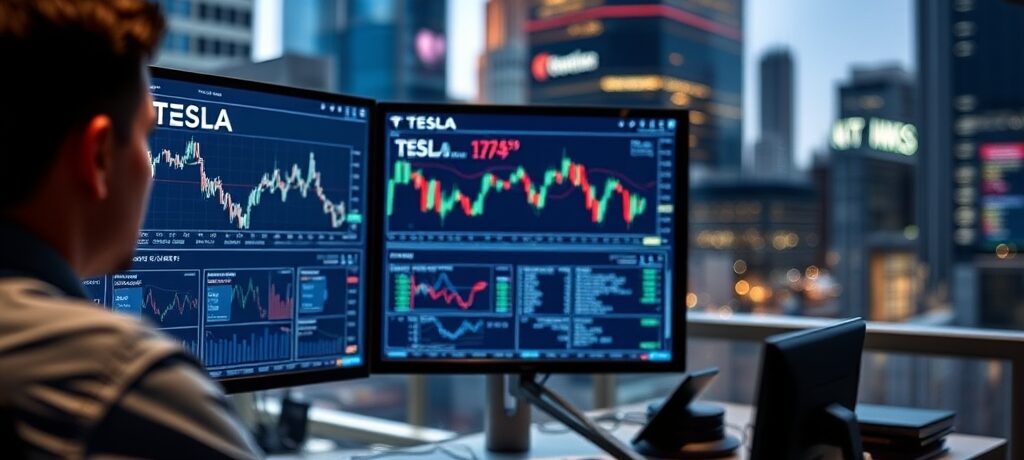
A prominent Wall Street analyst from JPMorgan Chase has issued a stark warning for Tesla investors, forecasting a potential 60% decline in the electric vehicle giant’s stock. Ryan Brinkman, a JPMorgan Chase analyst, released a ‘brutal note’ on Monday, stating that expectations for Tesla had ‘collapsed for all financial and performance metrics’ through the end of the decade, assigning a price target of $145 for the stock. This comes as Tesla, despite its $1.3 trillion market capitalization and status within the ‘Magnificent Seven,’ faces significant headwinds and a valuation that appears increasingly disconnected from its recent financial performance.
JPMorgan’s Bearish Outlook on Tesla
JPMorgan Chase’s analyst, Ryan Brinkman, delivered a sobering assessment of Tesla’s future, indicating a profound shift in market sentiment. According to his analysis, expectations for Tesla have ‘collapsed for all financial and performance metrics’ extending to the close of the decade. This revised outlook is reflected in more modest growth projections from analysts, who anticipate only a 9% revenue growth in 2026, reaching $103.1 billion, followed by a 17% increase to $120.5 billion in 2027. These figures represent a significant deceleration compared to the high-growth narrative that has historically fueled Tesla’s valuation.
The Valuation Discrepancy Amidst Shrinking Business
A central point of concern highlighted by the analysis is Tesla’s elevated valuation, particularly when contrasted with its recent operational performance. While other ‘Magnificent Seven’ tech giants trade at valuations generally within the range of the S&P 500, Tesla’s price-to-earnings (P/E) ratio based on generally accepted accounting principles (GAAP) stands at more than 300. This implies investor expectations for growth several times faster than the broader market index.
However, the company’s core electric vehicle (EV) business has experienced a decline in volume during 2024 and 2025. Total revenue for 2025 reached $94.8 billion, a figure slightly below its 2023 mark of $96.8 billion. Concurrently, operating income plummeted by half during this period, settling at just $4.4 billion in GAAP operating income, as margins compressed due to intensified competition in the EV sector. Despite these ‘ugly numbers,’ Tesla’s stock has paradoxically surged by 40% since the end of 2023, even as its underlying business has ‘literally shrunk.’
Operational Headwinds and Market Skepticism
Tesla’s recent performance has been further hampered by a confluence of operational and market-wide headwinds. The first quarter saw a 6.3% increase in vehicle deliveries, totaling 358,023 units, yet this still fell short of analyst estimates. A significant factor weighing on demand has been the expiration of the $7,500 EV tax credit in the U.S. last year. Beyond policy changes, broader consumer demand for EVs has not met prior forecasts, with gas-powered vehicles continuing to dominate auto sales.
Consumer skepticism persists, driven by concerns such as ‘range anxiety,’ diminished battery performance in colder climates, and the increasing scarcity of free EV charging stations. These factors collectively contribute to a challenging environment for sustained growth in Tesla’s primary market segment.
Elon Musk’s Vision Versus Financial Reality
The sustained, elevated valuation of Tesla has largely been attributed to CEO Elon Musk’s ability to captivate investors with his ambitious vision for robotaxis and autonomous robots. While Tesla has initiated a limited robotaxi service in two metropolitan areas, Austin and the San Francisco Bay Area, and continues development of its Optimus autonomous robot, these ventures have yet to translate into significant financial results. The analysis points to a ‘Musk premium’ embedded in the stock, reflecting the additional value investors place on his leadership and transformative ideas.
However, Musk also represents a considerable risk factor. His public actions, such as an alliance with President Trump, have alienated some Tesla owners and potential buyers. Furthermore, a history of making ambitious promises that are not delivered on, or are significantly delayed, adds to investor uncertainty. For instance, Musk’s 2021 goal of 50% compound annual growth for several years was only met for two years before the target was abandoned in 2024, despite initially boosting the stock.
The Overvaluation Argument Persists
Given the confluence of these factors, the consensus from the analysis suggests that Tesla stock appears ‘significantly overvalued.’ The company has struggled with growth for more than two years, yet its market capitalization and P/E ratio reflect the valuation of a ‘high-growth, disruptive company.’ With interest rates remaining elevated and competitive pressures in the EV market unlikely to abate, the bull case for Tesla increasingly relies on breakthrough innovations, which, according to the assessment, ‘seem to be more than priced in.’
The analysis concludes that even if Tesla’s stock were to fall to the $145 price target set by JPMorgan Chase, it ‘would still be overvalued at its current growth rate and profit level.’ This perspective underscores the deep skepticism regarding the stock’s current market pricing relative to its fundamental performance.
The market appears to be recalibrating its outlook for the EV leader, suggesting a potentially turbulent period ahead for its stock as financial expectations collapse and operational challenges persist against a backdrop of an already demanding valuation.