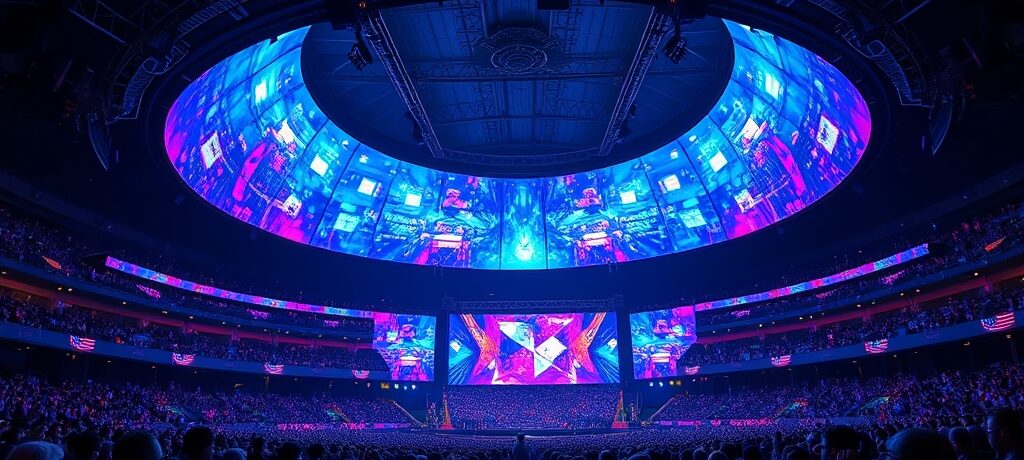
The Las Vegas Sphere, a monumental $2.3 billion (£1.72 billion) entertainment venue, has defied initial skepticism by reporting a net income of $57.6 million for the 2025 calendar year, as announced in February 2025 by Sphere Entertainment. This financial turnaround suggests a potential shift in the immersive entertainment landscape, even as new competitors like Cosm emerge with their own visions for dome-like facilities.
Since its grand opening in September 2023, the Sphere has hosted a diverse array of shows, from a U2 residency to a reimagined version of The Wizard of Oz. Tickets for these experiences generally start at $100, often exceeding that price point. Mortgage loan officer Danielle Renee, of Washington State, recounted her awe-inspiring visit to the Sphere in early February, where she witnessed a Backstreet Boys performance augmented by a 15,000 sq m concave screen. “Oh my gosh, it was incredible,” Renee stated, adding that “nothing compares” to the new show, which transported her into a virtual space with millions of stars and a spaceship.
Financial Viability and Market Reception
For years, financial commentators questioned the Sphere’s economic prospects, debating whether it represented a groundbreaking entertainment form or a costly misadventure. Early in 2025, observers highlighted the venue’s ongoing struggle to generate profit, with one critic expressing confusion and dismay after a visit. However, the subsequent report of a $57.6 million net income indicates a significant positive shift in its financial trajectory.
Despite this success, not all analysts are convinced of the universal appeal or scalability of such venues. Manel González-Piñero, a creativity and innovation researcher at the University of Barcelona, who experienced The Wizard of Oz at the Sphere, commented, “For me, watching a movie is enough of an experience. I don’t need to complement the experience with something new.” He views the Sphere as a “prototype” that effectively delivers unique content. Sphere Entertainment had previously announced plans for “mini Spheres” with 5,000-seat capacities in other locations, but González-Piñero expressed doubt about their suitability for cities like Milan or Amsterdam, suggesting the Las Vegas Sphere might remain a unique, location-specific attraction.
Conversely, Ben Wood, chief analyst at FDM/CCS Insight, described his visit to the Sphere as “jaw-dropping.” Wood, whose hotel room overlooked the Sphere’s massive exterior screen, noted its dynamic displays, including a winking eye, calling it “an amazing, futuristic metaphor for the way people consume content.” He expressed dismay over the withdrawal of plans for a sister Sphere in East London in 2024, following London Mayor Sadiq Khan’s refusal of planning permission.
Emerging Rivals and Technological Advancements
The Sphere’s financial success comes as rival companies are also pushing the boundaries of immersive entertainment. Cosm, for instance, is developing dome-like facilities across multiple US cities. Emerging from a merger involving Evans & Sutherland, a company with a legacy in digital projection technology for planetariums, Cosm leverages its expertise in display tech software.
Devin Poolman, Cosm’s chief product and technology officer, emphasized the company’s software-centric approach, stating, “We are very much a software company.” He noted that their LED screens are custom-designed for “doubly curved, effectively domed displays.” Cosm currently operates venues in Los Angeles, Dallas, and Atlanta, with two more planned for Cleveland and Detroit. Poolman outlined an ambitious goal of establishing “more than 100 worldwide” venues, though he refrained from disclosing current profitability figures, asserting confidence in their business model.
These new ventures face the persistent challenge of proving their long-term viability, a hurdle that past immersive technologies, such as 3D cinema, repeatedly failed to overcome. Proponents argue that the visually overwhelming nature of these domes offers a more immersive and experiential form of entertainment, akin to augmented or virtual reality without the need for headsets.
A Historical Perspective on Dome Entertainment
The concept of dome-shaped entertainment venues is not entirely novel. The 1960s saw Cinerama construct dome cinemas in the US, with Imax following suit in subsequent years. James Lanier, founder and president of Absolute Hollywood, a company that has deployed temporary inflatable domes for projected shows since the late 1990s, highlighted the unique appeal of fully illuminating a dome’s interior. Unlike the fixed seating of the Las Vegas Sphere, Lanier’s installations often allow visitors to move freely or even lie down to view the presentation. He recalled a “very surreal experience” at a royal wedding in the Middle East, where performances were beamed into a central dome for guests.
While the immersive dome experience may not appeal to everyone, its capacity to captivate a dedicated audience is evident. Danielle Renee, for example, is already planning a return visit to the Las Vegas Sphere to see the Backstreet Boys again, actively seeking tickets for their upcoming shows. The Sphere’s recent financial performance, coupled with the expansion efforts of rivals like Cosm, suggests that these visually rich, experiential venues are carving out a significant niche in the evolving entertainment industry, prompting a re-evaluation of their future potential.