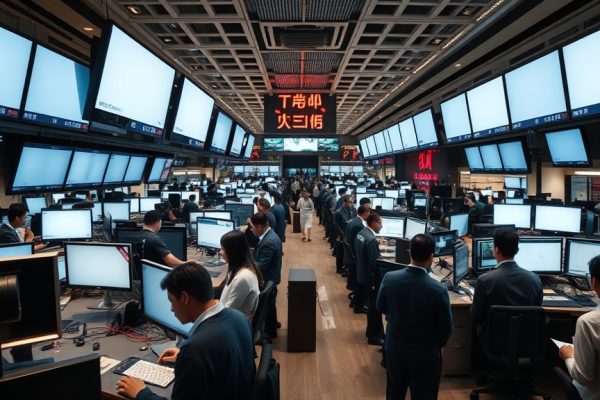
Asian stock markets recorded substantial gains on Wednesday, propelled by a significant de-escalation of tensions in the Middle East. The rally follows an agreement between the United States and Iran for a two-week ceasefire, coupled with Iran’s commitment to temporarily reopen the critical Strait of Hormuz. This geopolitical development has led to a notable drop in crude oil prices, subsequently alleviating global inflation and broader economic growth concerns.
Geopolitical De-escalation Drives Optimism
The breakthrough agreement, announced on Wednesday, saw the U.S. and Iran commit to a temporary cessation of hostilities and Iran consent to reopen the Strait of Hormuz for a limited period. This diplomatic success was partly facilitated by Pakistani Prime Minister Shehbaz Sharif, who reportedly appealed to US President Donald Trump to extend his initial deadline for Iran to reopen the Strait by two weeks, ‘allow[ing] diplomacy to run its course.’ Sharif also urged Iran to reciprocate by reopening the Strait as a ‘goodwill gesture,’ and called upon ‘all warring parties to observe a ceasefire everywhere for two weeks to allow diplomacy to achieve conclusive termination of war, in the interest of long-term peace and stability in the region.’
Australian Equities See Broad-Based Gains
Australian shares experienced a sharp ascent on Wednesday, building on gains from the prior session. The benchmark S&P/ASX 200 index climbed 2.47 percent, or 215.50 points, to close at 8,944.30. The broader All Ordinaries Index also advanced 2.59 percent, or 231.20 points, to 9,152.40. The rally was broad-based, with mining and technology sectors leading. Major miners like BHP Group (+4%), Rio Tinto (+3%), Mineral Resources (+7%), and Fortescue (+2%) saw robust performance. In technology, Afterpay owner Block (+2%), Zip (+11%), Appen (+5%), Xero (+4%), and WiseTech Global (+5%) all gained. Financials contributed positively, with the big four banks advancing 3-4 percent each. Gold miners, including Evolution Mining and Genesis Minerals, jumped over 7 percent each, Northern Star Resources surged over 5 percent, Newmont gained over 4 percent, and Resolute Mining advanced almost 6 percent. Conversely, energy stocks were the sole weak spot, with Origin Energy losing over 3 percent, Woodside Energy plunging over 10 percent, and Santos and Beach Energy tumbling over 7 percent each. The Australian dollar traded at $0.706 on Wednesday.
Nikkei Leads Japanese Market Surge
Japan’s Nikkei 225 index also recorded a substantial rally, extending gains for a fourth consecutive session. The benchmark surged 4.96 percent, or 2,649.27 points, closing the morning session at 56,078.83. Gains were widespread across all sectors, led by index heavyweights, exporters, and technology stocks. Market heavyweight SoftBank Group surged over 6 percent, and Uniqlo operator Fast Retailing gained almost 5 percent. Automakers Honda (+2%) and Toyota (+4%) also advanced. Technology firms like Advantest (+10%), Screen Holdings (+8%), and Tokyo Electron (+9%) posted strong gains. In banking, Sumitomo Mitsui Financial and Mizuho Financial advanced over 4 percent each. Among major exporters, Mitsubishi Electric (+4%), Panasonic (+5%), and Sony (+3%) all saw increases. Notable other gainers included Furukawa Electric, soaring almost 14 percent, and Kioxia Holdings, jumping over 13 percent. Conversely, some energy and shipping stocks saw declines, with Inpex down over 5 percent, and Mitsui O.S.K. Lines losing over 4 percent. In economic news, Japan reported a current account surplus of 3.933 trillion yen in February, exceeding forecasts and significantly up from January’s revised 931 billion yen surplus, according to the Ministry of Finance. Exports rose 2.8 percent year-on-year to 9.372 trillion yen, while imports increased 9.7 percent to 9.104 trillion yen. The U.S. dollar traded in the higher 158 yen-range on Wednesday.
Broader Asian Markets Follow Suit
The positive sentiment extended across the broader Asian region. South Korea’s market surged 5.9 percent, while Taiwan saw a 4.3 percent increase. Hong Kong and Indonesia recorded gains of 2.4 percent and 2.9 percent, respectively. New Zealand and China each advanced 1.6 percent, and Singapore and Malaysia posted more modest gains of 0.6 percent and 0.9 percent, respectively.
Global Backdrop and Oil Price Dynamics
Globally, the Asian rally contrasted with mixed to negative performances in Western markets during the preceding trading session. On Wall Street, stocks closed narrowly mixed on Tuesday, with the Nasdaq inching up 0.1 percent to 22,017.85 and the S&P 500 creeping up 0.1 percent to 6,616.85, while the Dow dipped 0.2 percent to 46,584.46. European markets moved to the downside on Tuesday; the German DAX Index slumped 1.1 percent, the U.K.’s FTSE 100 Index slid 0.8 percent, and the French CAC 40 Index fell 0.7 percent. Crude oil prices had inched higher on Tuesday, up $0.65 or 0.58 percent to $113.06 per barrel, as Iran remained unresponsive to U.S. threats prior to the ceasefire agreement. However, the subsequent agreement and reopening of the Strait of Hormuz are expected to exert downward pressure on oil prices, a key factor in Wednesday’s Asian market optimism.
The widespread gains across Asian markets underscore the profound impact of geopolitical stability on investor confidence. The temporary ceasefire and the reopening of a vital shipping lane have not only eased immediate concerns over energy supply and inflation but have also opened a window for further diplomatic efforts towards long-term peace in the Middle East, a prospect that global markets are clearly welcoming.