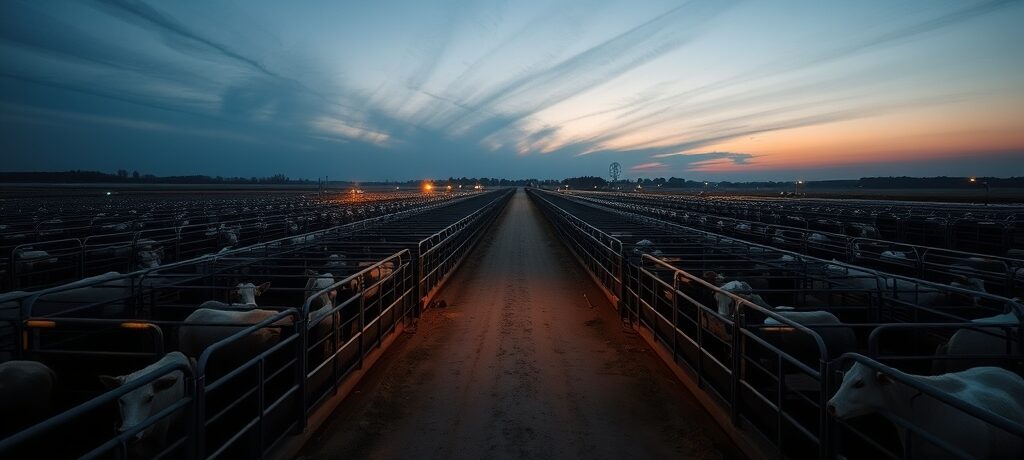
Cattle futures experienced a notable downturn on Monday, with live cattle contracts posting losses ranging from 32 cents to $1.27 across the board. This decline was mirrored in feeder cattle futures, which slipped lower by $2.45 to $4.37 by the close of trading, signaling a bearish sentiment in the livestock markets as reported by Austin Schroeder for Barchart on April 21, 2026.
nn
Futures Market Performance and Cash Trade Dynamics
n
The live cattle market saw broad-based declines, with specific contract performances illustrating the day’s retreat. The April 2026 Live Cattle contract closed at $249.600, down $0.350. Further out, the June 2026 Live Cattle contract registered a more significant drop of $1.275, settling at $246.075, while the August 2026 Live Cattle contract fell $1.225 to close at $241.600. These movements reflect a market reacting to various supply and demand signals.
n
Feeder cattle futures followed a similar trajectory, exhibiting even steeper declines. The April 2026 Feeder Cattle contract ended the day at $368.875, down $2.450. The May 2026 contract saw a substantial decrease of $4.175, closing at $361.100, and the August 2026 Feeder Cattle contract posted a $4.325 loss, finishing at $361.350. This downward pressure extended to the broader index, with the CME Feeder Cattle Index declining $1.98 to $375.69 as of April 17. In the physical market, the OKC feeder cattle auction reported an estimated 6,000 head sold, with prices holding steady to $2-4 lower, indicating some stability in immediate cash transactions despite the futures market’s slide. Last week, cash trade across the country was picked up at $248.
nn
USDA Cattle on Feed Report Reveals Supply Adjustments
n
Adding context to Monday’s market movements, the USDA’s Cattle on Feed report, released last Friday, provided key insights into the supply side. The report indicated a reduction in March Placements, which were down 7.67% from a year ago, totaling 1.709 million head. This figure closely aligned with market estimates, suggesting that feedlot inventories are being managed in line with expectations.
n
Marketings in March were also lower, decreasing 5.5% compared to last year, reaching 1.62 million head. This reduction in marketings, alongside lower placements, contributes to the overall supply picture. The total number of cattle on feed as of April 1 came in at 11.576 million head, a marginal decrease of 0.53% from a year ago, again closely matching analyst estimates. This data suggests a slightly tighter supply of cattle in the pipeline compared to the previous year.
n
Further details from the report highlighted trends in the heifer inventory. Heifers on feed stood at 4.32 million head, representing a 1.37% decrease compared to April 1, 2025. The ratio of heifers on feed to the total inventory was reported at 37.32%. These figures are crucial for understanding future herd expansion or contraction potential, as a reduction in heifers on feed could imply a slower pace of herd rebuilding or even continued contraction, impacting long-term supply dynamics.
nn
Wholesale Beef Prices and Slaughter Activity
n
In the wholesale market, the Monday afternoon report indicated that Boxed Beef prices were lower overall. However, specific price movements showed an interesting divergence. Choice boxes experienced an increase of $2.50, reaching $383.56, while Select boxes saw a more significant rise of $7.01, closing at $383.61. The Choice/Select spread was noted at a 5-cent premium for Choice over Select, according to the report.
n
Federally inspected cattle slaughter for Monday was estimated by the USDA at 97,000 head. This represents a reduction of 7,000 head from the previous week’s slaughter volume and is notably 6,945 head below the slaughter recorded during the same week last year. The decrease in slaughter activity could be a response to various factors, including current market conditions, processing capacity, or available cattle supply. Reduced slaughter numbers typically imply less beef entering the supply chain in the short term, which could influence wholesale prices, although the immediate report showed mixed signals with overall lower prices but increases in specific box categories.
nn
The confluence of declining cattle futures, a slightly tighter supply picture from the USDA’s Cattle on Feed report, and reduced slaughter volumes paints a complex market landscape. While futures markets reacted with significant losses on Monday, the underlying supply adjustments and mixed wholesale beef price movements suggest a nuanced environment for producers and consumers alike. The market will likely continue to monitor these key indicators closely for further direction, particularly as the grilling season approaches, as noted in related Barchart analysis.