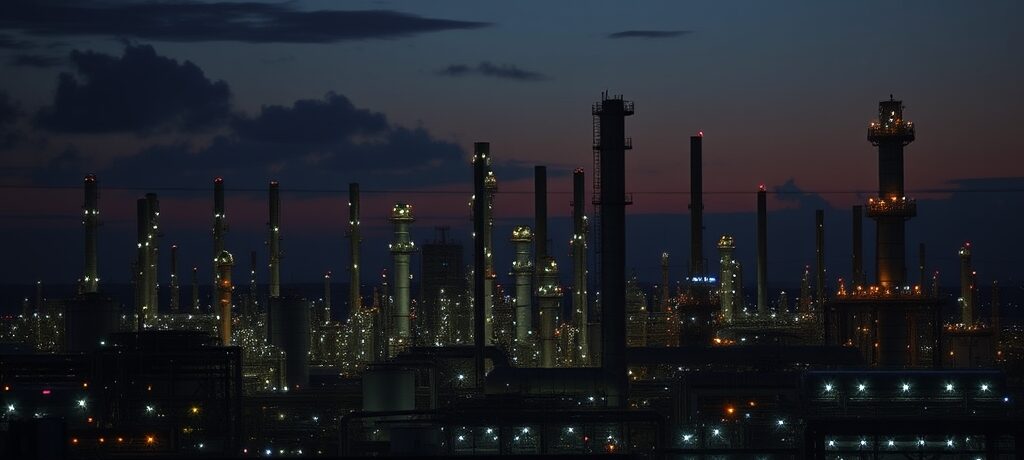
Crude oil prices continued their upward trajectory on Wednesday, advancing for a third consecutive session despite the United States extending a two-week ceasefire in the ongoing conflict with Iran. The gains are primarily attributed to persistent concerns over supply disruptions, particularly the continued blockade of the critical Strait of Hormuz.
West Texas Intermediate (WTI) Crude Oil for June delivery was last observed trading up by $3.54, a 3.95% increase, reaching $93.21 per barrel. This surge underscores the market’s sensitivity to geopolitical tensions impacting global energy flows.
Escalating Tensions and Strait Blockade
The conflict between the U.S. and Iran, which ignited on February 28, led Iran to initially shut down the Strait of Hormuz, a move that significantly propelled oil and energy prices. U.S. President Donald Trump announced a two-week ceasefire on U.S. attacks against Iran on April 8, with the truce set to expire on April 22. During this interim period, diplomatic efforts were made, with U.S. and Iranian delegations meeting in Pakistan to discuss a framework for ending the conflict. However, these talks reportedly failed to yield progress, with both sides maintaining their entrenched positions. President Trump subsequently characterized the negotiations as a “failure” and ordered U.S. forces to interdict ships transiting to and from Iranian ports via the Strait of Hormuz.
The blockade on traffic through the Strait of Hormuz has been a significant driver of inflationary pressures. Energy experts have voiced concerns about potential “demand destruction” in crude oil markets, exacerbated by the prevailing conditions of stagflation.
Diplomatic Setbacks and Continued Blockade
Last weekend, President Trump indicated a willingness for a second round of negotiations, which initially offered some reassurance to markets regarding a potential diplomatic resolution. However, the situation took a turn when Trump announced the capture of an Iranian-flagged vessel, prompting Iran to refuse further participation in talks. President Trump then issued a threat, warning of bombing Iran’s power and energy infrastructures if a deal was not struck before the ceasefire’s expiration. Iran, in response, stated it possessed “new cards on the battlefield” and would not engage in negotiations under duress.
These developments fueled global jitters over further oil price escalations. As the initial deadline approached, President Trump announced an extension of the truce without setting a new expiration date. Crucially, he affirmed that the U.S. blockade would persist, with forces remaining near Iran, “ready and able” for any necessary responses.
Iran’s Actions and Market Reaction
Adding to the market’s unease, Iran’s semi-official media outlet Tasnim reported that Iran’s official stance would be announced later. In parallel, Iran seized two ships in the Strait of Hormuz and escorted them to its shores. Further compounding the transit concerns, Britain’s maritime security agency, the UKMTO, reported that three container ships had been hit by gunfire in proximity to the strait.
Traders appear to have discounted the impact of the ceasefire extension, with crude oil prices continuing their ascent. The Strait of Hormuz has now been closed for over 50 days, resulting in an estimated 600 million barrels of crude oil being blocked and over 10 million barrels per day of production remaining offline. Reports indicate that approximately 20,000 seafarers are stranded on their vessels in the Persian Gulf, facing increasing security threats from Iran’s Islamic Revolutionary Guards Corps.
Inventory Data and Broader Energy Crisis
Experts suggest that demand and supply concerns are unlikely to abate until traffic through the Strait of Hormuz resumes. On the inventory front, data from the American Petroleum Institute revealed a substantial draw of 4.40 million barrels in crude oil inventories for the week ending April 17, significantly exceeding the 1.00-million-barrel draw anticipated by markets. Conversely, according to the U.S. Energy Information Administration, U.S. crude oil inventories rose by 1,925,000 barrels for the same period. At the Cushing, Oklahoma delivery hub, inventories increased by 806,000 barrels. In terms of refined products, gasoline inventories saw a notable drop of 4,570,000 barrels, while distillate inventories decreased by 3,427,000 barrels, and heating oil inventories fell by 328,000 barrels.
The broader energy landscape remains precarious. Fatih Birol, Executive Director of the International Energy Agency, recently stated in an interview with France Inter Radio that the current energy crisis is the most severe in history and could surpass previous global energy shocks. He highlighted the simultaneous pressure on both oil and gas supplies, compounded by the ongoing repercussions of the war in Ukraine.
The market’s reaction to the extended ceasefire, juxtaposed with the ongoing blockade and escalating geopolitical rhetoric, indicates that immediate supply concerns are currently outweighing diplomatic assurances. The continued closure of the Strait of Hormuz remains the dominant factor influencing crude oil prices, with traders closely monitoring any further developments that could impact global energy flows.