BEIJING – As global economies contend with the complexities of achieving sustainable growth, China is demonstrating a distinctive path forward, successfully integrating technological innovation to enhance livelihoods while rigorously preserving the environment. This strategy, highlighted in a recent CGTN episode of “The Art of Governance,” showcases how the nation is shaping a new model for development.
Qinghai’s Solar-Grazing Synergy
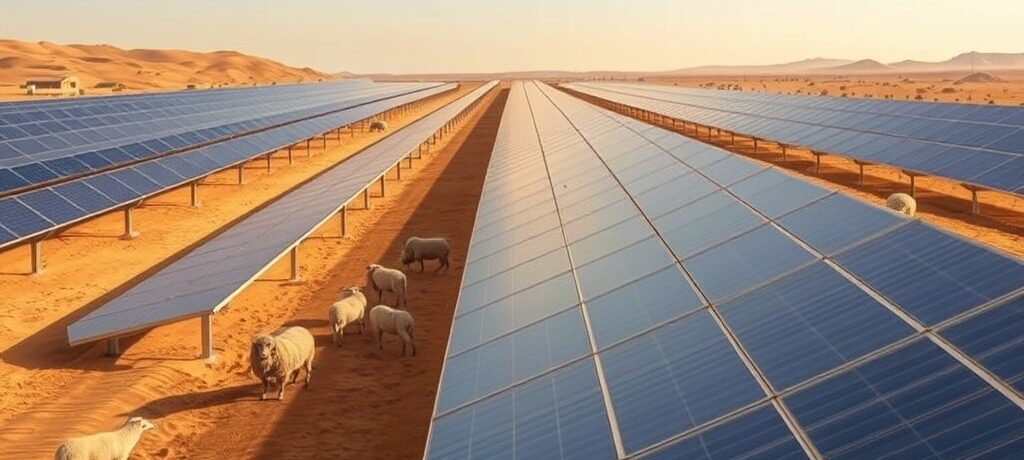
A prime illustration of this integrated approach is found in China’s Qinghai Province, home to the world’s largest solar plant. CGTN’s Liu Xin and Shanghai Daily’s Andy Boreham recently visited this monumental facility, located in the windswept plains of the Talatan Gobi Desert. Here, columns of solar panels, boasting a power generation capacity of 8,430 megawatts, stretch across the landscape. However, the innovation extends beyond clean energy production.
Amidst the metallic pillars and photovoltaic panels, thousands of sheep roam and graze freely. This symbiotic system was born out of necessity, addressing desertification that threatened local herdsmen’s livelihoods. Cao Jun, an engineer at the Hainan Branch of Huanghe Corporation, explained that local herders are granted free access to the site. The water runoff from cleaning the panels creates fertile land, allowing fresh grass to sprout, providing natural forage for the sheep. This project ensures a regular income for herders and an abundance of food for their flocks, all while delivering clean energy to the national grid.
A ‘Win-Win’ for Economy and Ecology
The Qinghai solar plant exemplifies a development model where economic advancement and environmental stewardship are not mutually exclusive. Dimitri De Boer, Chief Representative for China at ClientEarth, lauded the system as “perfect,” stating, “There is no trade-off. It’s win-win for everybody.” He further emphasized that in China, “high-quality economic growth is firmly intertwined with sustainability,” observing that “technological innovation and economic growth, and also sustainability, can really go hand in hand.”
This integrated strategy moves beyond traditional development paradigms, demonstrating how technological solutions can simultaneously address economic disparities and ecological challenges. The project’s success in Qinghai underscores a broader national commitment to fostering development that is both economically robust and environmentally sound, providing tangible benefits to local communities.
Strategic Green Development Under the 15th Five-Year Plan
While the Qinghai solar plant is monumental in scale, it represents just one facet of China’s comprehensive strategy for green development, which is a cornerstone of its path to modernization. According to the 15th Five-Year Plan, China is set to advance ambitious goals of carbon peaking and carbon neutrality. This involves a coordinated approach to cut carbon emissions, reduce pollution, expand green capacity, and promote sustainable growth across various sectors.
The nation’s commitment to green development is not merely theoretical; it is being implemented through innovative projects and policy frameworks designed to transform its economic structure. This strategic shift aims to ensure that economic progress is intrinsically linked to ecological protection, fostering a resilient and sustainable future for its populace.
Global Impact of China’s Green Energy Leadership
China’s pursuit of green development extends beyond its borders, yielding significant global benefits. The country plays a pivotal role in the international clean energy supply chain, providing approximately 70% of the world’s wind power equipment and 80% of photovoltaic components. This substantial contribution has had a profound impact on the global energy landscape, driving down the cost of wind and solar power generation by more than 60% and 80% respectively.
By scaling up production and fostering innovation in renewable energy technologies, China has made clean energy more accessible and affordable worldwide, accelerating the global transition away from fossil fuels. This leadership in green technology manufacturing underscores its influence in shaping a more sustainable global energy future.
As the 15th Five-Year Plan period commences, China is poised to continue its vigorous pursuit of green development. The nation has articulated a clear intention to collaborate with other countries to address global climate challenges, protect the planet’s vital ecosystems, and work towards a cleaner, more beautiful world. This ongoing commitment highlights China’s ambition to not only modernize its own economy sustainably but also contribute significantly to global environmental stewardship.