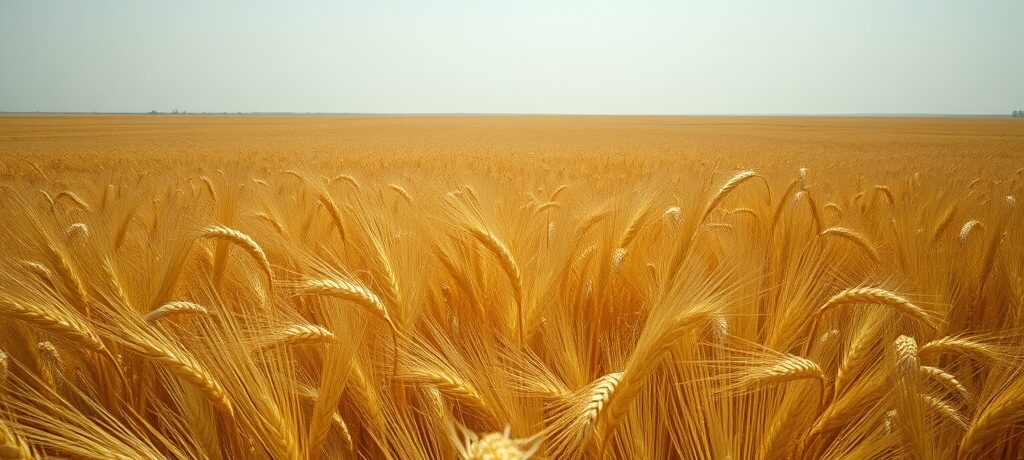
Wheat prices extended their upward trajectory on Tuesday, reaching fresh highs across the three major exchanges. The wheat complex saw a broad double-digit rally, underscoring growing market sentiment around supply-side factors.
Broad-Based Gains in Wheat Futures
Chicago Soft Red Winter (SRW) futures led the advance, with contracts trading 17 to 28 1/4 cents higher. Kansas City Hard Red Winter (HRW) futures followed suit, climbing between 18 and 29 1/2 cents across most of their listed contracts. Minneapolis spring wheat futures also participated in the surge, with gains ranging from 12 1/2 to 21 1/2 cents on the day.
Planting Progress Trails Historical Pace
Recent Crop Progress data from the U.S. Department of Agriculture highlighted a lag in spring wheat planting. Nationally, 19% of the U.S. spring wheat crop was reported as planted, placing it 3 percentage points behind the average pace of the last five years, which stands at 22%. Regional data indicated more significant delays in key growing areas. Minnesota’s planting progress was 10 percentage points behind its normal schedule, while North Dakota lagged by 6 percentage points. South Dakota was only 1 percentage point behind its typical planting pace. Emergence of the spring wheat crop was pegged at 5%.
Winter Wheat Conditions Show Mixed Signals
In contrast, the winter wheat crop is ahead of schedule in its development. The winter wheat crop was reported at 34% headed, which is 13 percentage points ahead of the normal progression for this time of year. However, condition ratings for the winter wheat crop remained unchanged, with 30% rated as good or excellent. The Brugler500 index, a more granular measure of crop health, saw a decline of 3 points to 287. This decrease was attributed to a 2% shift from fair to poor and very poor categories. Only a handful of the 18 reporting states saw any improvement in their Brugler500 index scores, including Arkansas (+35), Illinois (+2), Indiana (+1), and Oklahoma (+1). More substantial drops were observed in Colorado (-13), Montana (-18), Nebraska (-26), North Carolina (-16), and Oregon (-19). Kansas experienced a slight slip of 2 points, and Texas declined by 3 points. The average Brugler500 index for the main HRW states was recorded at 244, marking the second-lowest figure for the week dating back to 2000.
Precipitation Outlook and Export Data
Looking ahead, the NOAA forecast for the next seven days indicates dry conditions across much of Kansas. Parts of Oklahoma and Texas are expected to receive between 1 to 2 inches of rain. However, with Oklahoma at 43% headed and Texas at 65% headed, this precipitation may arrive too late to significantly benefit the crops.
On the international front, European Union soft wheat exports from July 1 to April 24 totaled 19.28 million metric tons. This figure represents an increase of 1.18 million metric tons compared to the same period last year, according to data from the European Commission. This export activity from a major global supplier could also be a factor influencing market dynamics.
Specific Contract Closures
The trading session on Tuesday saw the following closing prices for key wheat contracts:
- May 26 CBOT Wheat closed at $6.49, up 27 1/2 cents.
- Jul 26 CBOT Wheat closed at $6.57 3/4, up 28 cents.
- May 26 KCBT Wheat closed at $6.96 3/4, up 29 1/2 cents.
- Jul 26 KCBT Wheat closed at $7.02 1/4, up 27 cents.
- May 26 MIAX Wheat closed at $6.98 1/2, up 21 1/2 cents.
- Jul 26 MIAX Wheat closed at $7.13 1/4, up 18 3/4 cents.
The sustained upward momentum in wheat prices reflects a complex interplay of delayed planting, concerns over crop conditions, and ongoing export activity. Traders will be closely monitoring weather patterns and further planting progress reports in the coming weeks to assess the potential impact on global wheat supplies.