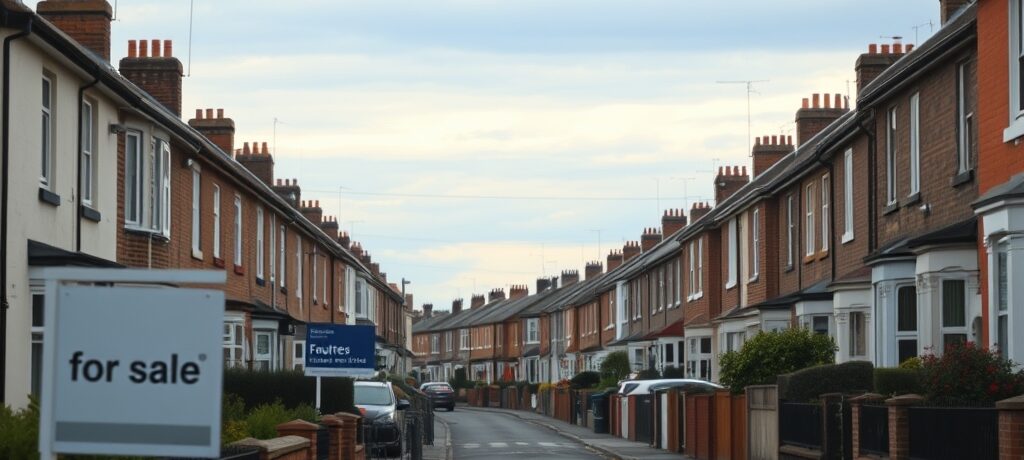
UK home values unexpectedly strengthened in April, according to Nationwide Building Society, one of the country’s largest lenders. The report suggests a surprising resilience in the housing market, even as geopolitical tensions, specifically the Iran war, have pushed up mortgage rates and introduced uncertainty into the economic outlook.
Nationwide reported that average house prices increased by 0.4% in April, reaching £278,880 ($379,000). This rise extended a 0.9% gain seen in March, which itself marked the largest monthly increase since 2024. Significantly, April’s uplift defied economists’ expectations, who had largely predicted a 0.3% decline for the month. On an annual basis, house prices were up 3%, indicating an acceleration from the previous month’s pace.
Market Resilience Amidst Rising Borrowing Costs
The unexpected increase in home values suggests that homebuyers have been relatively unfazed by a recent jump in borrowing costs. The Middle East conflict has shifted market sentiment, replacing earlier hopes of interest rate cuts with concerns that rates may need to rise again to prevent a price shock. While the Bank of England voted to keep borrowing costs on hold recently, officials have signaled the potential for rate rises over the summer if energy disruptions persist.
Robert Gardner, Nationwide’s chief economist, attributed the market’s strength to underlying financial stability. “The market is likely being supported by the relative strength of household finances,” Gardner stated. He elaborated, noting that “In aggregate, household debt is at its lowest level relative to income for around two decades, and sizeable savings buffers have been built up in recent years.” Despite these supporting factors, Gardner described the April increase as “surprising,” highlighting the mixed signals within the market.
Conflicting Indicators and Future Outlook
Indeed, evidence regarding the Middle East conflict’s impact on the UK housing market has been varied. While Nationwide’s report points to resilience, other data suggests a more cautious picture. A recent survey of agents indicated that both new buyer enquiries and sales experienced a significant plunge in March, with expectations for near-term deals becoming considerably more pessimistic. Furthermore, lender Halifax reported a decline in home values during the first month of the Middle East conflict, contrasting with Nationwide’s findings.
Broader economic indicators also reflect a degree of consumer apprehension. Consumer confidence has fallen to its lowest level since 2023, with households increasingly prioritizing saving to build up emergency funds. This cautious approach is particularly pertinent as approximately half a million households are preparing for a sharp rise in borrowing costs as they come off ultra-low mortgage deals. The British Retail Consortium has also noted that weak demand is compelling retailers to offer heavy discounts to attract shoppers, underscoring a broader softness in consumer spending.
Rob Wood, chief UK economist at Pantheon, commented on the Nationwide figures, calling them “a sign that consumers weathered the initial storm well.” However, he cautioned against over-optimism, stating it’s “unlikely that house prices can keep up this pace.”
The overall impact on the housing market and the wider economy will largely depend on the duration of the energy shock and its influence on interest rates. Bank of England Governor Andrew Bailey, in an interview with Bloomberg TV’s Francine Lacqua, stressed that a key question for rate-setters is whether the energy price shock will feed through given the “softer backdrop” of the jobs market and consumer demand. Despite recent increases, fixed-rate mortgage costs remain below their 2023 peak. Moreover, homes are considered relatively more affordable than a few years ago, primarily because wages have grown faster than house prices in recent years, providing some underlying support to buyer capacity.
The unexpected uptick in April house prices, as reported by Nationwide, presents a complex picture of the UK housing market. While strong household finances and accumulated savings appear to be providing a buffer against rising borrowing costs and geopolitical uncertainties, the sustainability of this resilience remains a subject of debate among economists, particularly given the conflicting market signals and the potential for future interest rate adjustments.