Soybean futures posted broad gains on Monday, driven by robust domestic planting progress and strong weekly export figures, even as market participants anticipate fresh supply and demand insights from the upcoming USDA WASDE report. Prices across the board climbed between 2 ¼ and 5 ½ cents by midday, reflecting a positive sentiment in the agricultural commodities sector and signaling underlying strength in demand and favorable early-season conditions.
Market Performance Overview
The commodity market saw soybeans making notable advances across various contracts. The cmdtyView national average Cash Bean price registered an increase of 5 1/4 cents, settling at $11.46 1/2. This upward movement was consistently reflected in futures contracts. May 26 Soybeans closed at $11.99 3/4, marking a gain of 5 1/2 cents, while July 26 Soybeans reached $12.13, an increase of 5 cents. Further out, November 26 Soybeans and New Crop Cash also saw significant gains of 5 1/4 cents, closing at $11.94 3/4 and $11.33, respectively. These widespread gains underscore a bullish sentiment permeating the soybean complex.
In related markets, soymeal futures experienced significant appreciation, with prices rising by $1.90 to $5.40. This upward trend in soymeal suggests strong demand for protein feed components. Conversely, soy oil futures traded lower, declining between 2 and 58 points. This divergence in performance among soybean derivatives indicates specific market dynamics at play, potentially influenced by factors such as biofuel demand or competing vegetable oil supplies.
Domestic Crop Progress Outpaces Averages
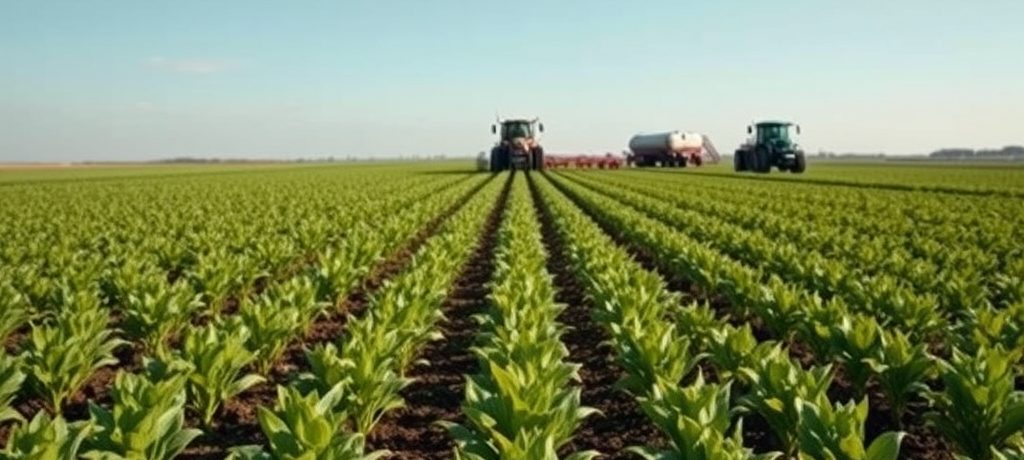
Recent data from the National Agricultural Statistics Service (NASS) highlighted an accelerated pace in the U.S. soybean crop development, providing a fundamental support for Monday’s price increases. The weekly Crop Progress report, covering the period up to May 10, showed that 49% of the U.S. soybean crop had been planted. This figure stands notably above the 36% average pace typically observed for this time of year, suggesting favorable weather conditions and efficient fieldwork by farmers. Such an advanced planting schedule often contributes to expectations of a healthy and timely crop, potentially influencing future supply outlooks positively.
Furthermore, soybean emergence also demonstrated a faster-than-average trajectory, with 20% of the crop having emerged, compared to the 12% average. This early and robust emergence is a critical indicator of crop health and establishment, setting a strong foundation for the growing season and reinforcing the optimistic outlook for the domestic supply.
Strong Export Activity Fuels Optimism
Export Inspections data for the week ending May 7 revealed a significant uptick in soybean shipments, further bolstering market confidence. A total of 655,294 metric tons (24.08 million bushels) of soybeans were shipped, marking a substantial 29.6% increase from the previous week. This volume was nearly double the amount shipped during the same week last year, underscoring robust international demand and effective logistics.
Key destinations for these substantial shipments included China, which received the largest share at 336,638 metric tons. China’s consistent position as a top importer remains a crucial driver for U.S. soybean exports. Egypt followed with 105,016 metric tons, and Indonesia accounted for 75,399 metric tons, highlighting diversified global demand. Despite the strong weekly performance, marketing year shipments to date have totaled 33.98 million metric tons (1.248 billion bushels), which represents a 22.7% year-over-year decrease. This overall slower pace compared to the previous marketing year suggests that while recent weeks have been strong, the cumulative export volume still lags.
Anticipating the USDA WASDE Report
Market attention is now firmly shifting towards the upcoming World Agricultural Supply and Demand Estimates (WASDE) report from the U.S. Department of Agriculture (USDA), scheduled for release on Tuesday. This comprehensive report is highly anticipated for its updated projections on global and domestic agricultural markets, and its findings are expected to significantly influence trading decisions in the short to medium term.
According to a Bloomberg survey of estimates, analysts are forecasting old crop U.S. soybean stocks to remain largely stable at 349 million bushels, a marginal decrease from the 350 million bushels reported in April. For new crop data, traders are looking for September 1, 2027, stocks to be around 366 million bushels, with estimates ranging from a broad 308 to 479 million bushels. The initial World Agricultural Outlook Board production number for the U.S. is projected at 4.447 billion bushels, with an estimated yield of 53 bushels per acre. These figures will be closely scrutinized for any deviations that could signal shifts in the supply-demand balance.
Global Demand Insights from China
Further supporting the demand side of the equation, China’s soybean import figures for April showed a significant surge, reinforcing the global appetite for the commodity. The world’s largest soybean importer brought in 8.48 million metric tons during the month. This represents a substantial 40% increase compared to the same period last year and is notably higher than China’s total imports in March. This robust and increasing demand from China continues to be a critical factor influencing global soybean prices and trade dynamics, as its purchasing power can swiftly absorb available supplies and dictate market sentiment.
The confluence of accelerated domestic planting progress, strong weekly export volumes, and robust Chinese demand provided a firm foundation for soybean gains on Monday. These factors collectively paint a picture of healthy underlying market conditions. As market participants digest these developments, the forthcoming USDA WASDE report will offer crucial, official guidance on the supply-demand balance, setting the tone for price movements and strategic positioning in the coming weeks and months.