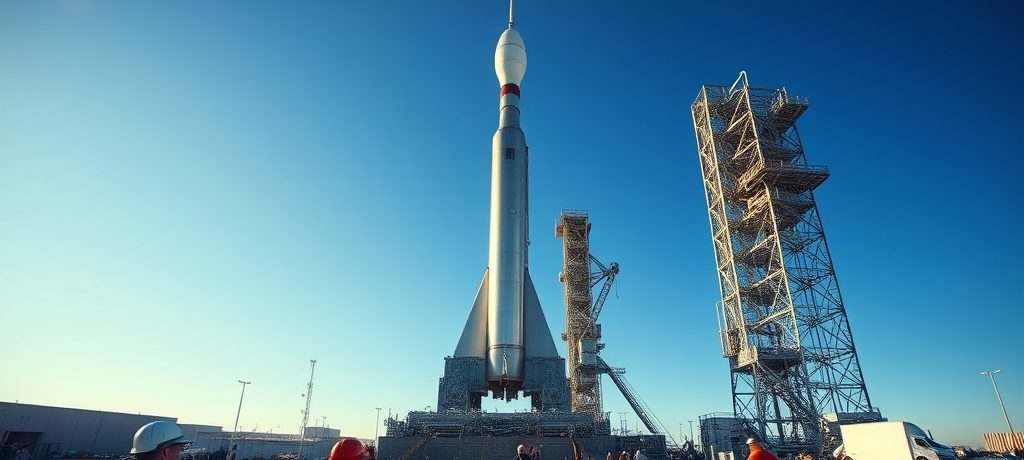
As SpaceX hurtles towards a highly anticipated initial public offering, the company is set to conduct a pivotal test flight of its colossal Starship rocket. Scheduled for Thursday, this launch is more than just a technological milestone; it’s a high-stakes gamble with the company’s projected valuation of up to $1.5 trillion on the line.
IPO Pressure Mounts for SpaceX
With investors expecting SpaceX to raise as much as $75 billion in its upcoming IPO, the performance of its Starship program is under an intense spotlight. Analysts, such as Franco Granda, a senior researcher at PitchBook, emphasize the critical nature of this test. ‘The launch is super important for the IPO,’ Granda stated, warning that a significant failure could ’cause investors’ excitement for the IPO to diminish quite dramatically.’ While acknowledging that tests are inherently experimental, Granda added, ‘I think SpaceX will want to get this one right.’
Financial Disclosures Reveal Starship’s Cost
Recent financial disclosures underscore the immense investment SpaceX has poured into Starship. The company is expending billions annually on its development, a cost that is currently outpacing profits from its established launch business. In the first quarter of 2026, SpaceX reported a $662 million loss for its launch operations, highlighting the financial burden of the Starship program. In 2025 alone, the company spent over $3 billion on Starship development, with an additional $930 million allocated in the first quarter of 2026.
Starship: An Ambitious Redesign Takes Flight
The Starship rocket, standing approximately 400 feet tall and constructed from robust stainless steel, represents a significant departure from conventional rocket designs. It is propelled by the ‘Super Heavy’ booster, equipped with 33 Raptor engines. Following separation, Starship’s six engines are designed to carry it into orbit. The booster itself is engineered for a return and landing at the launchpad, a crucial element for SpaceX’s vision of rapid reusability and drastically reduced launch costs.
This latest iteration features a heavily redesigned rocket, incorporating dozens of new Raptor 3 engines powered by an advanced fuel system in the booster. It also boasts upgraded avionics, new satellites, and test ports for a future in-orbit refueling system, a capability envisioned to enable missions to the Moon and Mars. Engineer and YouTuber Scott Manley, who closely monitors Starship’s progress, described the current version as more refined, noting improvements in heat tile placement and the integration of previously temporary fixes into the core design. ‘It looks more like a rocket and less like a bunch of grain silos welded together,’ Manley observed.
Unproven Technology Faces Rigorous Testing
Despite the design enhancements, success is far from guaranteed. Previous Starship test flights have encountered significant challenges. The first launch in April 2023 ended in an explosion after failing to separate from its booster. It took multiple attempts for the rocket to eventually reach space. While the second version saw improved performance in its final two launches of 2025, the new Raptor 3 engines, though extensively tested on the ground, have yet to prove their capabilities in flight. ‘We don’t know how they’re going to perform under flight circumstances,’ Manley noted.
Even a successful flight faces further hurdles. Starship’s heat shield has not yet demonstrated the durability required for multiple atmospheric re-entries, and the spacecraft has yet to attempt a landing at its Brownsville, Texas, launchpad. Tim Farrar, president of TMF Associates, a firm specializing in mobile satellite services analysis, highlighted the complexity of the Starship program. ‘Starship is a multidimensional problem that they haven’t actually solved yet,’ Farrar said. He added that justifying a valuation ‘well in excess of a trillion dollars’ requires more than current capabilities, suggesting that investors are betting on future innovations from Elon Musk.
The financial disclosures also explicitly link Starship’s development to SpaceX’s strategic future. Any ‘failure or delay in the development of Starship at scale or in achieving the required launch cadence, reusability and capabilities thereafter would delay or limit our ability to execute our growth strategy,’ the document states. This emphasizes that the success of this giant rocket is not just about reaching space, but about enabling SpaceX’s broader ambitions, from expanding its Starlink internet service to serving as a lunar lander for NASA and a potential vehicle for Mars colonization, and even, as recently proposed by Musk, launching data centers into orbit for AI processing.
The upcoming test flight is therefore a critical juncture, not only for demonstrating technological progress but also for bolstering investor confidence as SpaceX prepares to enter the public markets. The outcome of this launch will undoubtedly shape perceptions of the company’s ambitious future and its multi-trillion-dollar potential.