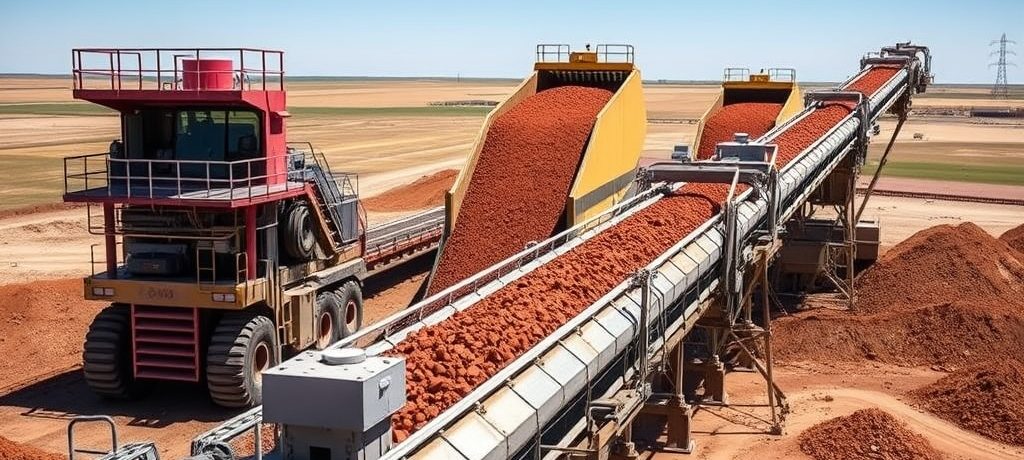
Canada solidified its position as the world’s leading potash producer in 2024, with its output climbing by more than 11 percent compared to the previous year. This surge occurred as the global potash market navigated significant volatility, influenced by geopolitical tensions, supply constraints, and fluctuating demand. While the market experienced some stabilization in the first half of 2024, lower production costs and improved crop yields exerted downward pressure on potash prices in the latter half of the year, according to the Investing News Network.
Global Potash Market Dynamics and Outlook
The potash sector faced a complex environment in 2024, marked by price fluctuations. Global consumption of potash increased to 38.8 million metric tons (MT) in 2024, with Asia and South America identified as top consuming regions, according to the 2025 Mineral Commodity Summary from the US Geological Survey (USGS). Consumption is projected to rise further to 40.9 million MT in 2025.
The World Bank anticipates fertilizer prices to average lower in 2025 before stabilizing in 2026, though remaining well above 2015-2019 lows due to strong demand and ongoing supply constraints, including export restrictions from China and sanctions on Belarus and Russia. The World Bank also projects a significant rise in fertilizer prices in 2026, citing conflict-related pressures from the Middle East and the potential closure of the Strait of Hormuz.
Global annual potash production reached 48 million MT in 2024, with world potash reserves estimated at greater than 4.8 billion MT of potassium oxide equivalent. The USGS projects world potash production capacity to increase from 65.2 million MT in 2024 to 76 million MT by 2028. This expansion is primarily expected from new muriate of potash (MOP) mines and project expansions in Laos and Russia, with further developments anticipated past 2028 in Belarus, Brazil, Canada, Ethiopia, Morocco, and Spain.
Top Potash Producing Nations in 2024
The Investing News Network, citing the US Geological Survey, provides a detailed look at the leading countries by potash production in 2024:
1. Canada
Canada led global production with 15 million MT in 2024, holding reserves of 1.1 billion MT. Its output grew by over 11 percent from 2023, making it the world’s largest potash producer. All of Canada’s potash production is concentrated in Saskatchewan. The USGS noted Canada’s output growth was among the largest globally, second only to Belarus. Canada was also the leading exporter of potash in 2024. Notably, 79 percent of US potash imports in 2024 originated from Canada, a factor creating concern for the US food industry in 2025 due to potential 25 percent tariffs threatened by US President Donald Trump on Canadian imports, including potash.
Major players include Nutrien (TSX:NTR,NYSE:NTR), valued at over C$35 billion, operating six facilities in Saskatchewan. The Mosaic Company’s (NYSE:MOS) Esterhazy K3 operation, the world’s largest potash mine, is capable of producing nearly 8 million MT annually with a mine life extending to 2054. Additionally, BHP’s (NYSE:BHP,ASX:BHP,LSE:BHP) Jansen potash project is slated to begin Stage 1 production in 2026, with Stage 2 expected to double capacity by the end of the decade.
2. Russia
Russia produced 9 million MT of potash in 2024, consistent with the previous year, and holds reserves of 920 million MT. Uralkali, Russia’s premier potash company, accounted for approximately 20 percent of global supply pre-war. Following Russia’s invasion of Ukraine, the EU imposed import quotas and the US sanctioned specific companies. While restrictions were eased in late 2022 due to global food insecurity concerns, Russia implemented fertilizer export quotas and duties. In 2025, EU countries are again considering tariffs as cheap Russian fertilizer impacts European competitors.
3. Belarus
Belarusian potash production surged to 7 million MT in 2024, a 56 percent increase from an estimated 4.5 million MT in 2023, marking the largest production jump globally. Its output nearly returned to pre-2022 levels, prior to EU and US sanctions on state-run Belarusian potash-exporting companies in 2021. Belaruskali is the country’s largest operator. Despite increased production, Belarus’s exports remained below pre-2022 figures after Lithuania terminated its contract for potash exports via the port of Klaipeda. In 2024, Belarus rerouted exports through Russian ports and by rail to China.
4. China
China ranked fourth, producing 6.3 million MT in 2024, a slight increase from 6 million MT in the prior year, and possesses reserves of 180 million MT. As the largest consumer of potash, accounting for approximately 20 percent of world consumption, China’s domestic demand outstrips its supply, making it heavily reliant on MOP imports. The Qinghai Salt Lake Potash Company (SZSE:000792) is the country’s largest producer.
5. Germany
Germany’s potash production reached 3 million MT in 2024, up from 2.7 million MT in 2023, with reserves of 150 million MT. Germany holds historical significance, with the world’s first deposits discovered in Staßfurt in 1856. K+S (ETR:SDF) is a leading German potash miner, operating six mines. DEUSA International also contributes to the country’s output.
6. Israel
Israel produced 2.4 million MT of potash in 2024, maintaining its annual production within the 2 million to 2.5 million MT range since 2017. The country recovers potash from the Dead Sea. Israel Chemicals (NYSE:ICL,TLV:ICL) is one of the world’s largest potash-producing companies. Concerns over potash supply disruptions arose with the outbreak of war between Israel and Hamas in October 2023, but a major price shock was averted due to lower demand compared to the Russia-Ukraine conflict period.
7. Jordan
Jordan’s potash production marginally increased to 1.8 million MT in 2024 from 1.7 million MT in the previous year. Like Israel, Jordan recovers potash from the Dead Sea. Arab Potash Company, based in Jordan, stands as the seventh-largest producer of potash by volume.
The global potash market remains a critical component of agricultural supply chains, with the performance of these key producing nations directly impacting fertilizer availability and prices worldwide. As new projects come online and geopolitical factors continue to evolve, the sector is poised for ongoing shifts, requiring close monitoring by investors and agricultural stakeholders alike.