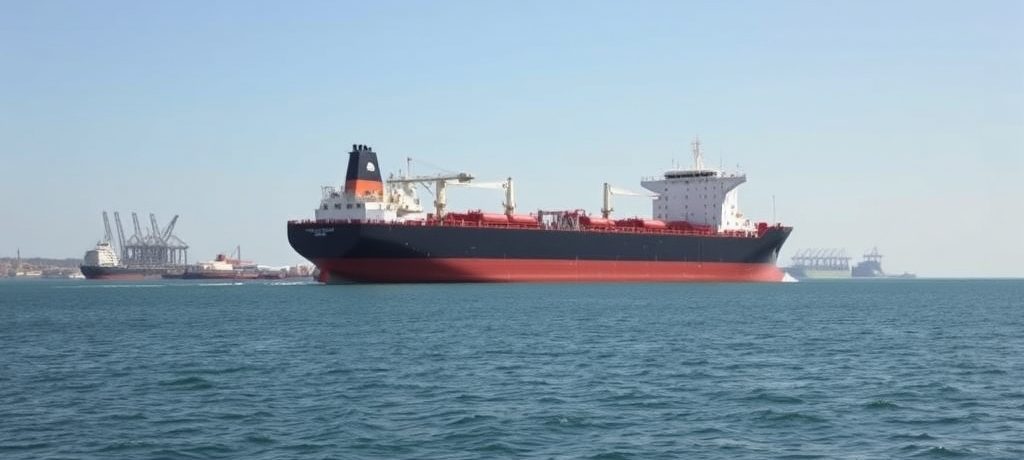
An Abu Dhabi National Oil Co. (Adnoc) liquefied natural gas (LNG) tanker, the Umm Al Ashtan, has successfully exited the Strait of Hormuz, marking another energy shipment destined for India. This transit contributes to a recent uptick in energy flows through the critical waterway, which has seen significant disruption since the war in Iran began in late February.
The Umm Al Ashtan, managed by Adnoc Logistics & Services, reappeared northwest of Muscat, Oman, loaded with cargo and listing its destination as India, according to ship-tracking data compiled by Bloomberg. The vessel had ceased sending a signal around May 2, at which point it was empty and idling near the eastern entrance of Hormuz. Satellite images subsequently indicated the ship likely loaded its cargo at Adnoc’s Das Island export plant, situated in the Persian Gulf behind Hormuz, during the period it was not broadcasting its position. These visual confirmations are notable, as pictures show LNG tankers consistently docking at Das Island even when no vessels broadcast their positions near the plant, a practice that suggests a deliberate strategy for managing sensitive transits.
This movement is part of what analysts describe as a mini-flurry in energy transits through Hormuz, signaling a cautious but discernible increase in activity. Alongside the Adnoc LNG shipment, at least two non-iranian oil supertankers have also exited the Persian Gulf recently. The Strait of Hormuz has been largely inaccessible to LNG traffic since the conflict commenced, a situation that has severely constrained approximately a fifth of the global supply of the super-chilled fuel. This significant choke point has had profound implications for global energy security, contributing to volatility in international markets and challenging the supply chains of major energy-consuming nations.
Adnoc has previously exported three other shipments from the Persian Gulf using tankers that similarly ceased broadcasting their positions when traversing the waterway. The most recent of these prior shipments is currently docking in western India, underscoring a pattern of discreet but consistent supply to the subcontinent, a crucial market for LNG. Despite these recent movements, the current volume of LNG transiting Hormuz represents only a fraction of pre-war levels. Before the conflict, roughly three tankers carrying LNG, predominantly from major exporter Qatar, exited the strait on a daily basis, highlighting the dramatic reduction in throughput and the ongoing challenge to restore full capacity.
The resumption of even limited LNG flows by Adnoc through the Strait of Hormuz offers a critical, albeit small, relief valve for global energy markets grappling with persistent supply constraints. While these specific shipments do not signal an immediate return to pre-war volumes, they underscore the persistent demand from key importers like India and the strategic importance of maintaining any viable transit through the volatile region for global energy stability.