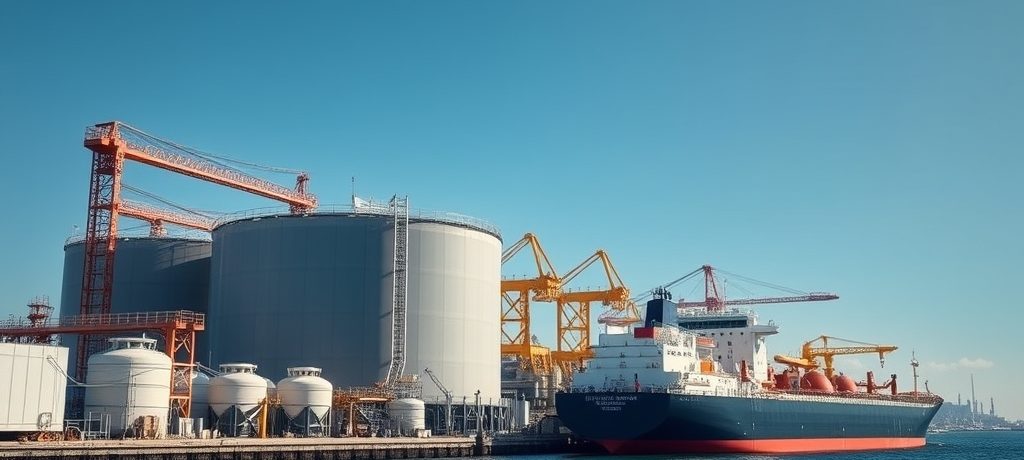
Canada has finalized a significant deal to export liquefied natural gas (LNG) to Germany, a move signaling Prime Minister Mark Carney’s strategic push to diversify Canada’s energy trade beyond its traditional reliance on the United States. The agreement, confirmed by an official familiar with the matter on Tuesday, will see up to 1 million metric tons (1.1 million US tons) of LNG annually shipped from a planned Pacific Coast terminal to Germany’s SEFE group.
The official, who spoke on condition of anonymity ahead of Wednesday’s announcement, confirmed that Canada will formalize the agreement with Germany’s Securing Energy for Europe (SEFE) group. The exports are slated to originate from the proposed KSI Lisims export facility located on the coast of British Columbia.
This deal aligns directly with Prime Minister Carney’s stated objective to double Canada’s non-U.S. trade within a decade. Currently, oil and gas-rich Canada exports nearly all of its energy resources to the United States, making this diversification a strategic imperative for the nation’s economic future.
British Columbia Premier David Eby highlighted the critical nature of this agreement for the Ksi Lisims project. Earlier on Tuesday, Eby stated that a deal to supply Canadian LNG to Germany would be a pivotal step for the partners behind the Ksi Lisims project to proceed with their $10-billion Canadian (US$7.2 billion) plant and export terminal. The Ksi Lisims facility, situated on Pearse Island near the Alaskan border, already possesses the necessary permits, but the consortium awaits a final investment decision (FID) to commence construction. Premier Eby emphasized that securing offtake agreements with international buyers like SEFE is essential for reaching this crucial milestone.
The Ksi Lisims partnership has already established supply agreements with a unit of London-based Shell and France-based TotalEnergies, further solidifying its market position ahead of the FID. The addition of Germany’s SEFE group underscores the project’s growing international appeal and the global demand for diversified energy sources.
For Germany, the agreement with Canada represents a significant move to bolster its energy security amidst ongoing geopolitical challenges. SEFE, a leading German energy utility, was the former German subsidiary of Gazprom before being nationalized by Germany in 2022. This nationalization occurred as Europe grappled with an acute energy crisis, exacerbated by the war in Ukraine and recent developments in the Mideast. Russia’s decision to drastically cut natural gas supplies to Europe in response to support for Ukraine led to soaring energy prices, fueling inflation and forcing some industrial operations to halt. Germany, historically a major importer of Russian gas, has been actively seeking alternative, reliable energy suppliers.
The Canadian-German LNG deal thus serves as a mutual strategic benefit, providing Canada with a key avenue for trade diversification and offering Germany a crucial new source of energy to stabilize its supply and mitigate future vulnerabilities in the European energy market.