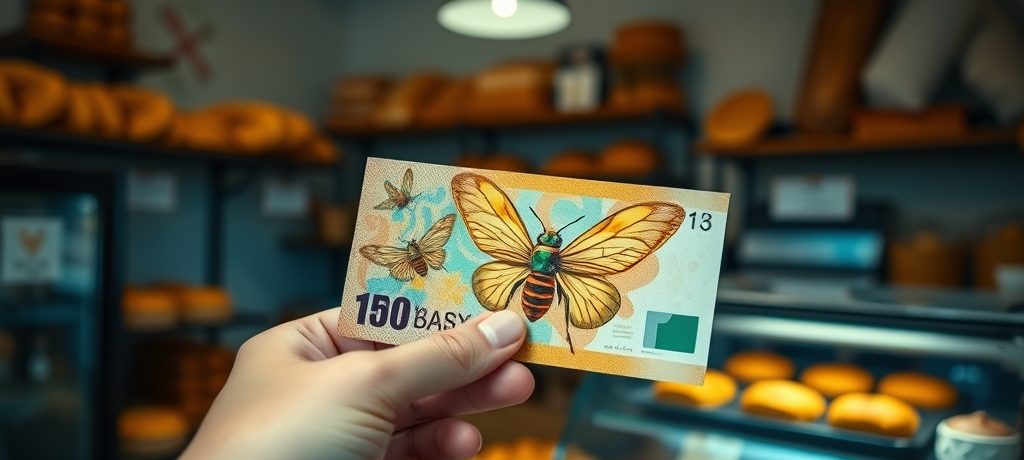
In the picturesque Chiemgau region of Bavaria, a unique form of currency is circulating, looking remarkably like play money. Colorful banknotes adorned with insects like grasshoppers and ladybugs are being used by customers in local bakeries and bookshops. This is the “Chiemgauer,” a self-invented currency that, over two decades, has evolved from a local business support initiative into a tool for cutting carbon emissions.
From Classroom Project to Regional Currency
The Chiemgauer’s origins trace back to 2003, when economics teacher Christian Gelleri and his students at a local high school sought a solution to support regional businesses struggling against larger shopping malls and chains. Their innovative idea was to create a currency designed to keep money circulating within the Chiemgau area. What began as a classroom experiment has since blossomed into a functioning micro financial system, with an estimated 10 to 15% of customers in participating businesses now using the Chiemgauer. Annually, approximately five million Chiemgauers are spent, according to Gelleri, who still heads the managing association, Chiemgauer e.V.
Currently, one Chiemgauer is pegged at a value of €1. The association’s vault in Traunstein, a town nestled in the Alpine foothills, holds over 200,000 Chiemgauers, equivalent to €200,000. These banknotes are now professionally printed with security features like watermarks to prevent counterfeiting. While German law generally prohibits the creation and use of currencies other than the euro, the Chiemgauer operates within legal boundaries due to its regional confinement and limited participation of around 4,200 individuals and 300 businesses. The Deutsche Bundesbank, Germany’s central bank, tolerates its existence under these conditions. Participants must join the Chiemgauer association to use the currency.
Incentivizing Local Circulation and Sustainability
The system’s success hinges on keeping the Chiemgauer in constant circulation. A key mechanism is a semi-annual stamp purchase requirement to maintain a note’s validity. For instance, a stamp for a 10-Chiemgauer note costs approximately €0.30 ($0.35). After three years, Chiemgauer banknotes expire entirely. While private users cannot convert their Chiemgauers back into euros, businesses can, but they incur a 5% fee. This fee is crucial, as it funds the currency’s operational costs and supports local non-profit organizations.
The Chiemgauer’s most recent evolution involves a significant environmental dimension. Organizers have introduced a system where residents can earn bonus Chiemgauers for adopting climate-friendly behaviors. These rewards can range from one to 200 Chiemgauers, incentivizing actions such as repairing clothing instead of buying new, utilizing car-sharing services, or opting for natural materials in home insulation. Gelleri pointed to a set of balcony solar panels, noting their owner received 100 Chiemgauers, a move projected to save 11 tons of carbon dioxide over 20 years.
A Mini Emissions Trading System
This environmental initiative functions as a localized emissions trading system. Local residents and businesses contribute to a shared pool to offset their emissions. For every ton of carbon offset through this fund, an additional nine tons are saved through the incentivized climate-friendly behaviors. This model has proven successful, with similar climate bonus schemes now active in four other German regions. Over the past four years, these initiatives have collectively saved 12,800 tons of CO2, a figure equivalent to the annual emissions of approximately 2,000 German cars, according to independent auditors TÜV Nord.
Global Context and Future Outlook
The Chiemgauer is part of a broader global trend of “complementary currencies,” with an estimated 300 such systems operating worldwide, predominantly in Europe and Brazil. These currencies primarily aim to bolster local economies and community welfare, with reduced transport emissions emerging as a significant side effect. Ester Barinaga, a researcher at the University of Lund, notes that these currencies encourage local purchasing, thereby shortening supply chains. Freight transportation accounts for 8% of global greenhouse gas emissions, according to data from MIT and the International Energy Agency.
Other complementary currencies are explicitly designed for environmental promotion, such as the “Vilawatt” in Viladecans, Spain, which rewards energy savings, or “Plastic Bank” tokens in Southeast Asia, given for collecting plastic bottles for recycling.
Despite its successes, the Chiemgauer faces limitations. The region still relies on imported manufactured goods, and participation remains relatively low, with fewer than 1% of locals involved. Furthermore, significant growth could trigger regulatory intervention from Germany’s central bank. Nevertheless, as Barinaga suggests, these currencies offer a vital lesson: “Money can be designed.” By intentionally creating monetary systems that reward pro-environmental actions, societies can foster more sustainable behaviors, however small the initial impact.