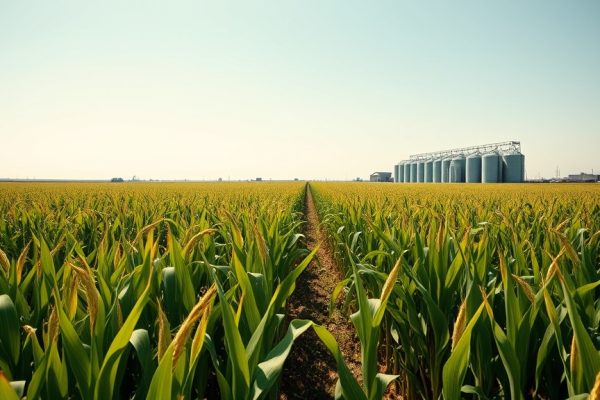
Corn futures continued their downward trajectory on Tuesday, with contracts closing notably weaker across the board, primarily driven by declines in new crop months. The session’s performance reflects persistent bearish sentiment, exacerbated by a critical initial crop condition report that fell below both analyst expectations and recent historical averages, signaling potential challenges for the upcoming harvest.
Futures and Cash Market Overview
The weakness was palpable across the futures market, with contracts shedding 2 ½ to 6 cents by the close of trading. The new crop months experienced the most significant pressure, indicating market participants are factoring in future supply dynamics. Specifically, July 2026 corn futures settled at $4.40 1/2, down 3 1/2 cents. September 2026 contracts saw a more substantial drop, closing at $4.48, a decline of 4 3/4 cents, while December 2026 corn futures led the losses, falling 6 cents to finish at $4.66 1/2.
This downward trend was mirrored in the cash market. The CmdtyView national average Cash Corn price registered a decline of 3 ¼ cents, settling at $4.04 ½. Nearby cash prices aligned with this trend, also closing at $4.04 1/2, down 3 1/4 cents. New crop cash prices were not immune, dropping 5 cents to $4.19 3/4, further underscoring the broad-based weakness impacting both immediate and forward pricing.
Initial Crop Condition Report Fuels Bearish Sentiment
A significant contributor to Tuesday’s market slide was the release of the NASS Crop Progress data, which provided the initial corn crop rating as of May 31. The report indicated that 67% of the U.S. corn crop was rated in good or excellent condition. This figure came in below the 70% estimate anticipated by a Reuters survey of analysts, and also represented a 2% decrease compared to the previous year’s initial rating.
Further emphasizing the concerning outlook, the initial rating translated to a 371 on the Brugler500 index, a proprietary scale ranging from 100 to 500 points based on the five USDA categories. This 371 rating marks a three-year low for initial crop conditions and stands as the third lowest initial rating recorded in the last 13 years. Such a historical context suggests a potentially challenging growing season ahead, with implications for overall yield and supply. Regional variations were also evident within the report, with Ohio registering a lower-end rating of 340, while Iowa, a key corn-producing state, reported a rating of 399. These disparities highlight localized conditions that could influence regional harvests.
Progress in Planting and Emergence
Despite the concerning initial crop condition, the NASS data did offer some positive notes regarding planting and emergence progress. As of May 31, 93% of the U.S. corn crop had been planted, placing it 1 percentage point ahead of the normal pace for this time of year. Emergence rates also showed efficiency, with 76% of the expected area having emerged, which is 2% faster than the normal rate. While these figures indicate that farmers are largely on schedule with their fieldwork, the quality of the emerged crop, as reflected in the good/excellent rating, remains a point of concern for market participants.
Weather Outlook and International Demand
Looking ahead, the 7-day forecast from the National Oceanic and Atmospheric Administration (NOAA) indicates varying rainfall patterns across the Corn Belt. Much of the Western Corn Belt, situated west of the Mississippi River, is expected to receive approximately ½ inch of rainfall. East of this line, rainfall is generally projected to be less than an inch, with northern Illinois and Wisconsin being notable exceptions that may see higher accumulations. The adequacy of this rainfall, particularly in areas with lower initial crop ratings, will be closely monitored as the growing season progresses.
On the international demand front, there was a notable, albeit insufficient to stem the tide of weakness, development overnight. A couple of South Korean importers reportedly purchased an estimated 120,000 to 136,000 metric tons (MT) of corn in tenders. While this represents a solid volume of export demand, it was not enough to counteract the bearish pressure exerted by the domestic crop condition report and the broader market sentiment.
Tuesday’s pronounced weakness in corn markets was primarily a reaction to the initial NASS crop condition report, which presented a less-than-optimistic outlook for the U.S. corn crop. The 67% good/excellent rating, a three-year low, combined with futures and cash price declines, underscores market anxieties regarding potential yield reductions. While planting and emergence are ahead of schedule and some international demand persists, the focus will now shift intently to subsequent crop progress reports and evolving weather patterns, which will be crucial in determining the trajectory of corn prices in the weeks and months ahead.