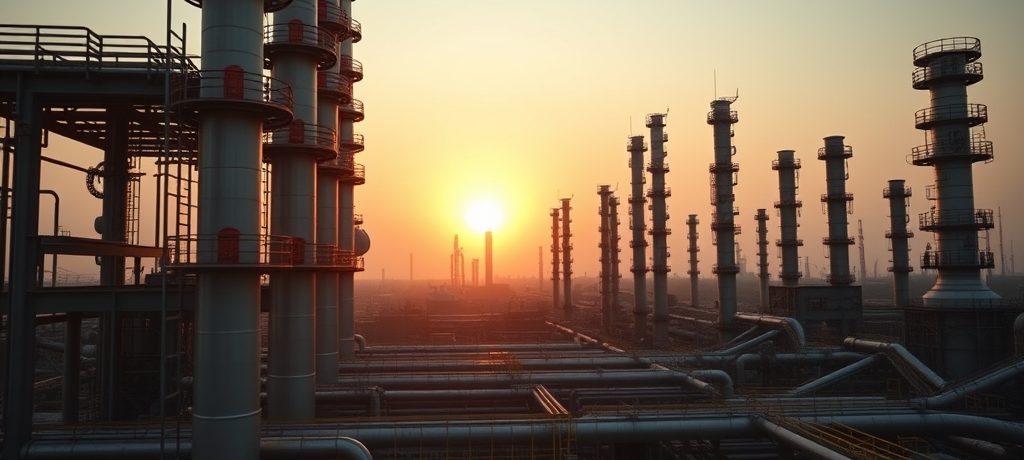
Crude oil prices experienced a significant slump on Friday, continuing the downward trend from the previous session. This decline is largely attributed to persistent optimism surrounding the potential reopening of the Strait of Hormuz in the coming days. The renewed confidence stems from announcements of an Israel-Lebanon ceasefire and reported progress in U.S.-Iran diplomatic discussions.
WTI Crude Oil Sees Sharp Decline
West Texas Intermediate (WTI) Crude Oil for July delivery was last observed trading down by $2.97, representing a 2.97% decrease, to settle at $90.07 per barrel. This marks a notable retreat in oil prices as market participants digest the latest geopolitical developments.
Ceasefire and Diplomatic Progress Fuel Optimism
The ongoing conflict, now in its 98th day, has seen expectations of an easing of tensions in the Middle East grow since Thursday. Investors have reacted positively to the news of an Israel-Lebanon ceasefire and the advancement of U.S.-Iran talks. In a joint statement released on Wednesday, the United States, Israel, and Lebanon confirmed an agreement to halt mutual strikes and reinstate a previous ceasefire that had been violated in April.
Under the terms of the proposed agreement, both nations are expected to finalize a comprehensive deal to end their long-standing hostilities within a month. However, the ceasefire is conditional upon a complete cessation of hostilities by the Iran-backed Hezbollah militant group, including the evacuation of all Hezbollah operatives from the South Litani Sector. Furthermore, Lebanon is required to establish secure zones where Hezbollah would be prohibited from operating.
Despite initial reports of Hezbollah rejecting the ceasefire, market sentiment has leaned towards a positive interpretation of these developments.
U.S.-Iran Talks Show Promising Signs
Adding to the market’s optimism, U.S. President Donald Trump indicated on Thursday that ongoing talks with Iran were progressing favorably. President Trump forecasted the potential signing of a Memorandum of Understanding (MOU) over the weekend, which could lead to the swift reopening of the Strait of Hormuz. He downplayed recent skirmishes in the Gulf region between the U.S. and Iran as inconsequential.
Confirming the diplomatic channels remain open, Iran’s Foreign Minister Abbas Araghchi stated that talks with the U.S. are ongoing. However, Mohsen Rezaei, an advisor to Iran’s Supreme Leader, noted that the negotiated MOU contains “ambiguities” requiring clarification. Meanwhile, the Islamic Revolutionary Guards Corps (IRGC) reported that the Iranian Navy had fired warning shots using missiles and drones towards U.S. destroyers operating in the Sea of Oman, asserting the operation aimed to prevent interference by U.S. naval assets. The U.S. Central Command, however, denied that its ships were attacked or fired upon.
Lebanon Criticizes Iranian Interference
In a separate development, the President of Lebanon, Joseph Aoun, criticized Iran’s involvement in Lebanese affairs during an interview with CNN. He deemed Iran’s use of Lebanon as a bargaining chip in U.S.-Iran negotiations unacceptable and urged Hezbollah to adopt a pragmatic approach and pursue diplomatic solutions.
China’s Reduced Oil Imports Impact Prices
The confidence among market participants regarding a swifter resolution to supply disruption concerns, particularly those linked to the Strait of Hormuz, has exerted downward pressure on oil prices. Further contributing to this trend, China, the world’s largest crude oil importer, has significantly reduced its oil purchases, according to industry estimates. Data from various energy research firms suggests that China is currently drawing down on stockpiles accumulated during periods of lower prices, leading to a decrease in oil shipments. Imports have fallen to approximately 7.5 million barrels per day from around 13 million barrels per day a year prior. The nation has also curtailed its exports of refined products, such as diesel and jet fuel.