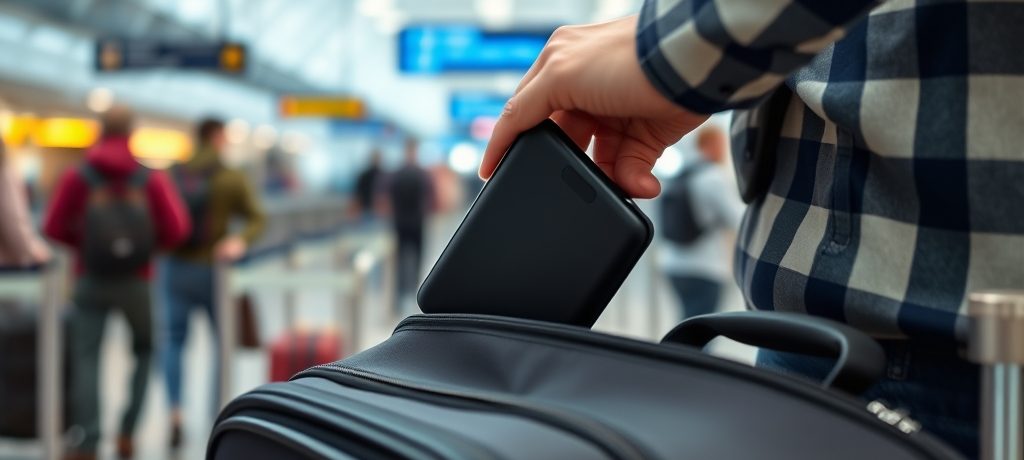
As summer travel plans take flight, passengers are reminded of critical updates to regulations governing lithium-ion portable battery chargers, commonly known as power banks. Following a series of smoke and fire incidents, U.S. and international aviation authorities, alongside airlines, have significantly tightened rules for carrying these popular devices, making adherence to new guidelines essential for a smooth journey.
The most crucial directive for travelers is that power banks are strictly prohibited from checked luggage. Instead, these rechargeable lithium-ion devices, which come in various protective enclosures and are a ‘handy and popular way for getting more juice when you’re on the move,’ must be transported in carry-on bags. This measure is a direct response to the inherent risks associated with these powerful energy sources.
Understanding Capacity Limits and Calculations
For most travelers, the updated rules allow for considerable flexibility. Passengers can generally bring two lithium-ion power banks with a capacity of up to 100 watt-hours (Wh) without requiring prior airline approval. This capacity is typically ‘more than enough to charge a cellphone several times over.’ For non-rechargeable lithium metal batteries, the limit is set at two grams of lithium per battery, with common AA and AAA batteries usually containing less than a gram. The Federal Aviation Authority (FAA) confirms that these limits encompass ‘nearly all types of lithium batteries in an average person’s electronic devices.’
Determining a power bank’s capacity is straightforward if the watt-hour rating is clearly labeled, as is common with newer lithium-ion batteries, according to the FAA. However, if the energy capacity is listed in milliampere hours (mAH), a simple calculation is necessary. To convert mAH to Wh, travelers should divide the mAH number by 1,000 to obtain ampere hours, and then multiply this figure by the device’s typical voltage, which is usually 3.7 volts. For instance, a battery rated at 10,000 mAH translates to 10 ampere hours, which, when multiplied by 3.7 volts, equals 37 watt-hours. The FAA also provides an online calculator for convenience. Larger lithium-ion batteries, ranging from 100 to 160 watt-hours—often found in professional video gear or medical equipment—require specific airline approval before travel.
The Peril of Lithium Batteries in Aviation
Airlines and aviation authorities are taking the risk of lithium battery fires with utmost seriousness, driven by a ‘rash of incidents.’ One notable event occurred in January 2025, when a fire erupted on an Air Busan plane in South Korea while awaiting takeoff, necessitating the evacuation of all 176 individuals onboard. The FAA has documented ‘nine lithium battery air incidents so far this year,’ with ‘six that involved power banks.’
Concerns are so acute that even the potential for a problem can disrupt flights. Last month, an Easyjet flight from Egypt to Britain made a precautionary diversion to Rome after a passenger informed the crew of a power bank charging a device in their checked luggage. The International Air Transport Association (IATA) highlights the critical danger posed by lithium batteries in a jet’s cargo hold: if smoke or fire occurs, the crew cannot take immediate action to identify and extinguish it. Conversely, keeping these devices in the passenger cabin enables the crew to swiftly address a potential blaze using specialized ‘fire-resistant bags and insulated gloves to contain an overheating device.’
Paul Christensen, a professor of pure and applied electrochemistry at the University of Newcastle in the United Kingdom, describes the risk of a lithium-ion battery short-circuiting and causing a fire as ‘very low,’ but warns that if it does, the resulting hazard is ‘very horrible.’ He explains that lithium batteries can store ‘a huge amount of energy in a very small space.’ The primary risks arise from crushing, overcharging, or overheating, which can trigger ‘thermal runaway’—a chemical reaction generating intense heat and toxic gases.
Pre-Flight Checks and Onboard Protocols
To mitigate risks, Professor Christensen advises travelers to inspect their power banks for any signs of damage, such as bulging or excessive heat during charging, as these could indicate an underlying problem. He also cautions against purchasing ‘cheap power banks from unknown manufacturers,’ which may lack adequate quality controls, potentially leading to defects or contamination that ‘produce thermal runaway a long time after they’ve been purchased.’
Once onboard, airlines enforce stringent rules for handling power banks within the passenger cabin. These devices must not be stored in the overhead bin. Instead, they should be kept in an easily accessible location, such as a seatback pocket or under the seat in front of you. Passengers are explicitly prohibited from using power banks to charge other devices during the flight and from recharging the power bank itself using the aircraft’s onboard power sockets.
A specific safety protocol addresses instances where a battery or battery-powered device slips down the side of a seat. IATA advises against attempting to retrieve it by moving the seat, as ‘Seats can crush or damage the battery, which could cause it to overheat or catch fire.’ In such situations, passengers must immediately alert a cabin crew member, who are specifically trained to retrieve devices safely.
Airline-Specific Regulations and Final Advice
It is crucial for travelers to remember that individual airlines and international regulations may impose more restrictive rules than standard U.S. guidelines. Therefore, ‘if in doubt, it’s best to check with your airline’ directly. For example, Southwest Airlines announced in April that it would limit passengers to carrying only one charger each. Many carriers provide detailed lists of rules for various battery types, including lithium-powered devices like laptops, tablets, and e-cigarettes, underscoring the importance of pre-flight verification to ensure compliance and safety for all.