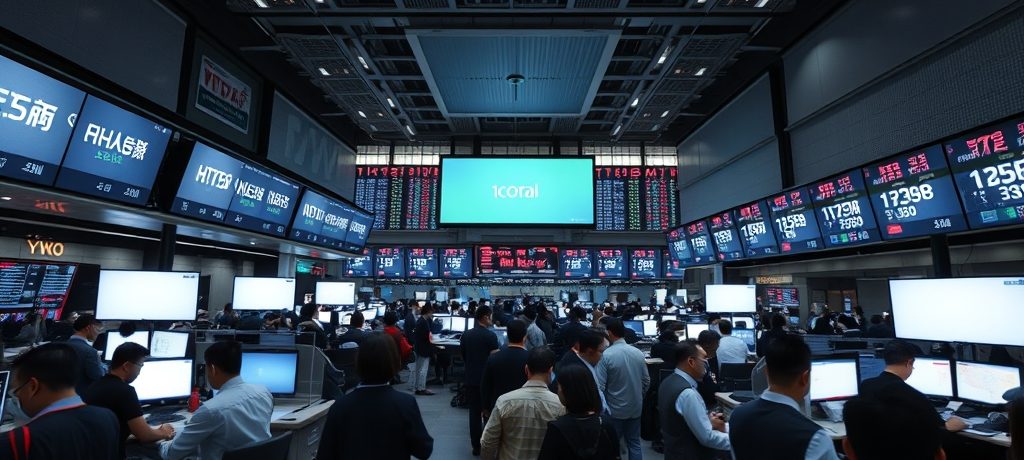
The investor enthusiasm for artificial intelligence, which has propelled South Korea’s stock market to the forefront of global rankings, is simultaneously exerting significant pressure on a different segment of its financial landscape: government bonds. This year, the nation’s government bonds have recorded a substantial loss of 7.5% in local-currency terms, marking the worst performance among 44 markets meticulously tracked by Bloomberg. The benchmark three-year yield, a critical indicator of borrowing costs, surged to approximately 3.9% on Friday, reaching its highest level since 2023. This stark divergence highlights a complex economic reality where technological success in one sector creates significant headwinds in another.
Economic Boom Fuels Bond Rout
At the core of this bond market downturn lies an economic growth narrative that is proving too robust for fixed-income assets. A powerful surge in AI-related investments and an escalating global demand for semiconductors have reignited Korea’s economy, driving up prices across various sectors and fueling market expectations that the Bank of Korea (BOK) will be compelled to raise interest rates to temper this accelerating momentum. This dynamic creates a challenging environment for bonds, which typically perform poorly in periods of rising rates as their fixed payments become less attractive compared to new, higher-yielding alternatives, and inflation erodes the real value of future returns. The robust economic activity, while positive for equity markets, directly translates into inflationary pressures that central banks aim to counteract through tighter monetary policy.
Local Pressures Intensify Global Trends
While South Korea is not isolated in experiencing bond market pressures – strong government spending and elevated energy costs, partly exacerbated by the Iran war, are heightening inflationary concerns globally – the squeeze is particularly acute in Asia’s semiconductor hub. Here, industry giants like Samsung Electronics Co. and SK Hynix Inc. have become magnets for investor capital, drawing funds towards equities and contributing to greater market volatility. Domestically, inflation had already been stoked by persistently high apartment prices, a long-standing concern for policymakers. Furthermore, the Korean won’s recent tumble intensifies fears of rising import costs, creating a feedback loop that further bolsters the case for potential Bank of Korea rate hikes. Cho Yong-gu, a fixed-income strategist at Shinyoung Securities, succinctly described the prevailing bond market conditions as ‘a vicious cycle feeding on itself,’ adding, ‘There doesn’t seem to be any clear way out at the moment,’ underscoring the deep-seated nature of the current challenges.
Aggressive Rate Hike Expectations
Market participants are now bracing for an anticipated aggressive tightening cycle from the Bank of Korea. The swaps market is currently pricing in expectations for at least three rate hikes this year, which would elevate the policy rate from its current 2.5% to 3.25%. This aggressive outlook reflects the market’s conviction that the BOK will act decisively to curb inflation and manage economic momentum. Cho Yong-gu projects that the nation’s three-year and 10-year yields could climb further, potentially reaching up to 4% and 4.4% respectively, within the year, signaling a significant increase in government borrowing costs. This hawkish sentiment is further supported by the chip sector’s boom, which has seen the Kospi index jump roughly 80%, prompting the BOK to revise its growth forecast for this year upwards to 2.6% from an earlier 2%.
Hawkish Tilt and Inflation Concerns
Inflationary pressures are also adding significant weight to the argument for rate increases. The core inflation reading in May stood at 2.5%, indicating that price pressures are spreading beyond just volatile energy costs into the broader economy. This data aligns with the distinctly hawkish tilt observed under the new BOK Governor, Shin Hyun Song, who appears committed to prioritizing price stability. Following the latest policy meeting, which conveyed a notably firm stance on monetary policy, Cho Yong-gu remarked, ‘one can’t help but wonder whether the bond market has simply been abandoned,’ highlighting the market’s perception of the central bank’s unwavering focus on inflation control, even at the expense of bond market stability.
Supply Risks Loom Large
Adding to the bond market’s anxieties are significant supply risks. Fiscal spending and the potential for additional bond issuance to fund it are under close scrutiny, particularly as tax coffers swell from robust chip sales under the current left-leaning government. Despite officials insisting in March that there would be no extra issuance to finance a supplementary budget, persistent discussions about yet another extra budget have left traders on edge, fearing an increase in bond supply that could further depress prices and push yields higher. The government, through officials from the finance ministry and the BOK, last week acknowledged the growing concerns by pledging to monitor the bond market and respond promptly to excessive volatility, signaling their awareness of the precarious situation.
The confluence of a booming AI-driven economy, persistent inflationary pressures, and the prospect of aggressive monetary tightening is creating an unprecedented challenge for South Korea’s government bond market. While the nation celebrates its technological prowess and economic resurgence, the repercussions are clearly manifesting in higher borrowing costs and diminished bond valuations, leaving investors to navigate a complex and volatile financial landscape where success in one area creates significant headwinds in another, demanding careful policy calibration to avoid further market dislocation.