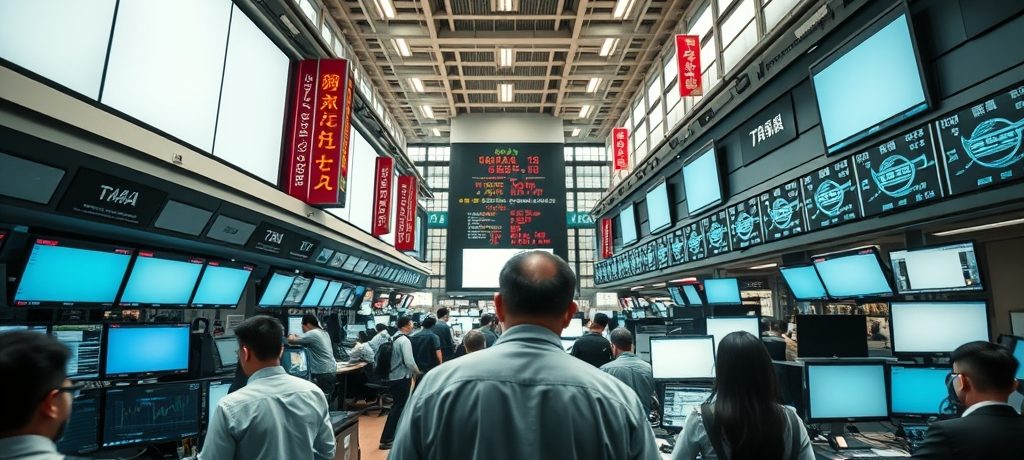
Tokyo’s equity market closed significantly lower on Monday, with the benchmark Nikkei 225 Index extending sharp losses from the previous session. The downturn was largely influenced by broadly negative cues from Wall Street on Friday, compounded by escalating concerns over the economic impact of the Omicron variant of the coronavirus, which has led to fresh lockdowns in Europe and renewed restrictions in other countries.
The Nikkei 225 Index concluded the trading day down 261.38 points, or 0.92 percent, settling at 28,284.30. Earlier in the session, the index touched an intraday low of 28,252.20, firmly placing it below the 28,300 level. This marked a continuation of the downward trend observed on Friday, when Japanese shares also ended sharply lower, reflecting a pervasive weakness across most sectors.
Global Market Contagion and Omicron’s Grip
The negative sentiment permeating the Japanese market was not isolated, echoing a broader global downturn. Wall Street experienced a volatile trading day on Friday, ultimately maintaining a negative bias. The Dow Jones Industrial Average tumbled 532.20 points, or 1.5 percent, to close at 35,365.44, while the S&P 500 slumped 48.03 points, or 1 percent, to 4,620.64. The tech-heavy Nasdaq Composite, despite seeing particular volatility, posted a more modest loss, edging down 10.75 points, or 0.1 percent, to 15,169.68.
European markets also largely moved lower. The UK’s FTSE 100 Index fell by 0.4 percent, the French CAC 40 Index edged down by 0.2 percent, and the German DAX Index saw a marginal decline of 0.1 percent. This synchronized global market reaction underscores the widespread apprehension among investors regarding the economic fallout from the rapidly spreading Omicron variant. The re-imposition of restrictions and potential for new lockdowns are fueling fears of a slowdown in economic activity and demand.
Sectoral Weakness and Corporate Performance
The broad-based decline in Tokyo saw significant pressure on several key sectors. Among market heavyweights, SoftBank Group edged down 0.3 percent, while Uniqlo operator Fast Retailing saw a 0.5 percent decline. The automotive sector was particularly hit, with Honda losing more than 2 percent and Toyota edging down 0.5 percent. Mazda Motor recorded a more substantial decline of more than 3 percent.
In the banking sector, major players experienced notable losses:
- Sumitomo Mitsui Financial: losing almost 2 percent
- Mitsubishi UFJ Financial: losing almost 2 percent
- Mizuho Financial: declining more than 1 percent
The technology space presented a mixed picture. While Advantest managed to gain more than 1 percent, Tokyo Electron and Screen Holdings both lost more than 1 percent each. Exporters also showed varied performance:
- Panasonic: edging up 0.4 percent
- Sony: slipping almost 1 percent
- Mitsubishi Electric: losing more than 1 percent
- Canon: declining almost 2 percent
Several other major companies faced significant downward pressure. Shinsei Bank was among the steepest losers, shedding almost 6 percent, followed by Bridgestone, which was down almost 4 percent. JTEKT, Mazda Motor, and Seiko Epson each declined more than 3 percent. Additionally, NTN, Tokyo Electric Power, Aeon, Taiheiyo Cement, Yokohama Rubber, NSK, Dowa Holdings, Sumitomo Mitsui Trust Holdings, and Nomura Holdings all slipped almost 3 percent each. Conversely, a few companies managed to buck the trend, with NEC and Trend Micro both gaining more than 2 percent.
Commodity Markets and Currency Dynamics
The concerns over the Omicron variant’s impact on global demand also reverberated through commodity markets. Crude oil prices tumbled on Friday, with West Texas Intermediate Crude oil futures for January delivery sinking $1.52, or 2.1 percent, to settle at $70.86 a barrel. WTI crude futures ended the week shedding 1.1 percent, reflecting anxieties about potential reductions in energy consumption due to renewed restrictions and economic slowdowns.
In the currency market, the U.S. dollar was trading in the mid-113 yen-range on Monday, indicating stability in the exchange rate despite the broader market volatility.
The pronounced decline in the Japanese market, mirroring a global trend, underscores the immediate economic anxieties triggered by the Omicron variant. The widespread weakness across sectors, from finance to manufacturing, suggests that investors are bracing for a period of uncertainty as governments grapple with containing the new strain and its potential implications for global trade and consumer activity.