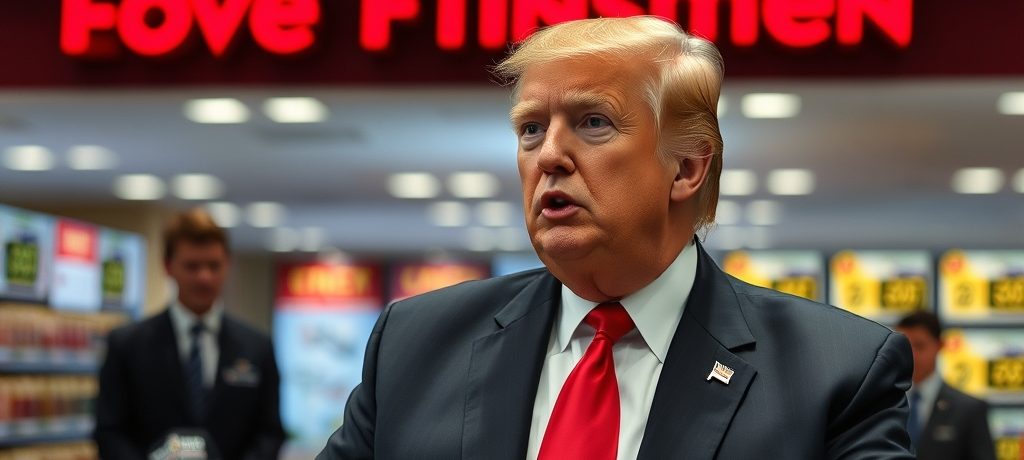
WASHINGTON – President Donald Trump on Wednesday offered an unexpected perspective on the nation’s economic challenges, declaring, “I love the inflation,” just hours after a new report revealed the consumer price index had spiked to its highest level in three years.
The May report indicated that the CPI had jumped 4.2% over the last year, marking the highest inflation rate since April 2023. This development comes as voters consistently rank the economy as a top concern ahead of the November midterm elections, an issue on which President Trump has received low marks.
Trump’s statement represents a significant departure from his previous rhetoric, where he has often dismissed affordability issues as a “hoax” or claimed to be actively reducing the cost of living. Instead, he adopted an optimistic stance on the challenging news, embracing the very numbers that typically signal economic strain for households.
Political Fallout and Democratic Reactions
The president’s on-camera comment quickly ignited a firestorm among Democratic leaders, who wasted no time in leveraging the quote on social media. Senate Democratic Leader Chuck Schumer posted on X, “Trump really said, ‘I love the inflation.’ On camera. For all of America to hear. His contempt for you knows no bounds.”
House Democratic Leader Hakeem Jeffries echoed this sentiment, stating on X, “We finally found something that Donald Trump loves as much as he loves himself.” The comment even made its way into a congressional hearing, where Rep. Emilia Sykes, D-Ohio, directly questioned Energy Secretary Chris Wright, asking, “Do you love inflation?” Wright initially responded, “I love ending Iran’s ability to have a nuclear weapon,” but conceded after further pressing, “No, I would prefer lower inflation.”
Trump’s Explanation: The Iran War and Secret Oil Operations
In his 2024 campaign, President Trump had pledged to swiftly vanquish inflation. However, his current argument attributes higher prices solely to the Iran war, which he claims has driven up energy costs. On Wednesday, he asserted that relief was already underway due to a secretive military operation.
Trump claimed this operation had ferried what he described as 100 million barrels of oil through the Strait of Hormuz, the primary shipping channel for 20% of the world’s global oil supply, which has been effectively closed by the war since late February. “I’m just announcing today for the first time, but we’ve been taking out millions of barrels of oil, millions of barrels every night,” Trump stated.
He further elaborated on social media that the mission began last month and “resulted in more than 100 MILLION Barrels of Oil making its way through the Strait, and into the Open Market. More than 200 Commercial Ships have safely traveled through the Strait.” To put this figure into context, a daily average of 20 million barrels of oil had gone through the strait before the war, meaning Trump’s claimed mission would represent the equivalent of five days’ worth of normal oil shipments.
Skepticism and Market Realities
Despite President Trump’s claims that these secretive shipments were responsible for oil prices falling below $90 a barrel from over $110 at the start of April, there was no immediate data available to corroborate the total volume or the specific role of the U.S. military in such an operation. When asked about Trump’s specific comments, Energy Secretary Chris Wright offered a more tempered assessment, describing the president as “an entertaining, hyperbolic guy who’s done tremendous leadership.”
Financial markets, meanwhile, reacted cautiously to Trump’s assertions. U.S. crude oil futures climbed roughly 4% on Wednesday, closing at nearly $92 a barrel, indicating a market sentiment that did not immediately align with the president’s claims of falling prices due to increased supply through the Strait of Hormuz. This market movement occurred concurrently with reports of the United States launching airstrikes against Iran, and Tehran responding with its own actions in the region.
White House Perspective and Broader Economic Picture
While President Trump focused on energy costs, the White House pointed to other economic indicators. White House spokesman Kush Desai stated via email, “President Trump has consistently maintained that oil and gas prices — and thus overall inflation — will plummet once the Iran situation is resolved, and the administration will continue pushing our affordability agenda to enable Americans to keep more of their hard-earned money.”
The administration also highlighted some expenses that had dropped in May relative to the previous month, including the price of new vehicles, prescription drugs, and auto insurance. However, when the overall inflation number is considered alongside the change in hourly wages, the data presents a bleaker picture, suggesting a decline in people’s spending power relative to their earnings.
President Trump’s declaration of love for inflation, set against a backdrop of rising consumer costs and a contentious geopolitical energy landscape, marks a surprising turn in the ongoing economic debate, likely to fuel further discussion as the midterm elections draw nearer.