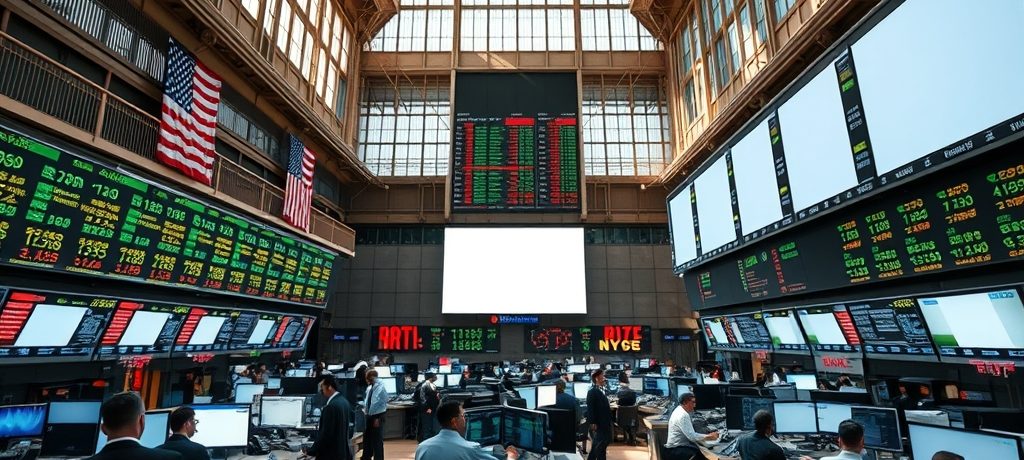
Asian stocks experienced a cooling of their recent rally on Tuesday as investors adopted a cautious stance, assessing the sustainability of gains driven by a US-Iran deal aimed at reopening the Strait of Hormuz. The pause in market momentum comes ahead of significant interest rate decisions from the Reserve Bank of Australia (RBA) and the Bank of Japan (BOJ), with the U.S. Federal Reserve also on the central bank calendar this week.
Regional Equities Face Headwinds
MSCI Inc.’s gauge of regional shares dipped as much as 0.3% in early trading before paring back its decline. This hesitation followed a strong performance on Monday, where U.S. equity futures showed a softening after the S&P 500 added 1.7% and the tech-heavy Nasdaq 100 rallied 3.1%. Brent crude oil edged higher, trading around $83.40 a barrel, after experiencing its largest drop in over two weeks following the news of the deal.
Central Bank Watch
The RBA is widely expected to maintain its key interest rate unchanged for the first time this year, a move anticipated amidst emerging signs of an economic slowdown in Australia. In contrast, the Bank of Japan is largely seen as preparing to raise its benchmark rate to its highest level since 1995. These decisions mark the beginning of a busy week for global central banks, with the Federal Reserve scheduled to announce its own policy decision on Wednesday.
Economists anticipate the Federal Reserve will hold its benchmark rate steady within a range of 3.5% to 3.75% during its upcoming meeting, which will be the first under new Chairman Kevin Warsh. Swaps traders are pricing in less than an 80% probability of a quarter-point Fed hike by December. Meanwhile, the Bank of England and the Swiss National Bank are also widely anticipated to keep their rates unchanged. Last week, the European Central Bank raised rates for the first time in nearly three years, with President Christine Lagarde noting that inflation, exacerbated by the conflict in Iran, was extending beyond energy prices.
Assessing the Iran Deal’s Impact
The US-Iran deal, which reportedly involves the reopening of the Strait of Hormuz, has injected a degree of relief into global markets. U.S. President Donald Trump and Vice President JD Vance signed an electronic memorandum of understanding with Iran, according to a senior U.S. official. Trump stated that Hormuz is “already partially opened” and “it’ll be completely opened” by Friday. This development spurred a climb in global stocks and bonds on Monday, driven by the decline in oil prices and renewed hopes for an end to the conflict that has disrupted markets since late February.
However, analysts caution against immediate assumptions about the deal’s long-term implications for monetary policy. ANZ Bank economists, including Matthew Galt, wrote in a note, “Markets will take time to settle, Hormuz flows will take time to normalize, and inventories will need to be replenished. We therefore see few immediate implications for central banks’ reaction functions. At the margin, a deal, if successful, may reduce pressure to tighten policy, but developments over the coming months will be closely monitored.”
Investor Caution Prevails
Investors remain vigilant, closely monitoring developments in the Middle East for confirmation of normalized shipping traffic through the Strait of Hormuz and assessing the durability of the peace accord. A gauge of global equities was down 0.1% on Tuesday, breaking a three-day rally. The U.S. dollar and 10-year Treasuries remained steady.
Strategists at BlackRock Investment Institute, including Jean Boivin and Wei Li, highlighted the importance of the Federal Reserve’s communication under its new leadership. They stated, “We’re closely watching how Warsh frames the balance between growth and inflation and any changes Warsh signals on Fed communication, such as reducing reliance on forward guidance to signal how it might act on policy rates next. That potentially makes the Fed’s policy changes a source of volatility as investors try to infer future moves from fewer clues.” This sentiment underscores the cautious approach adopted by markets as they digest geopolitical developments and await crucial monetary policy signals.