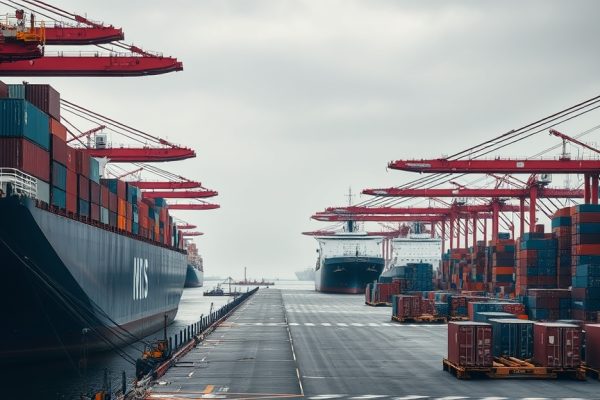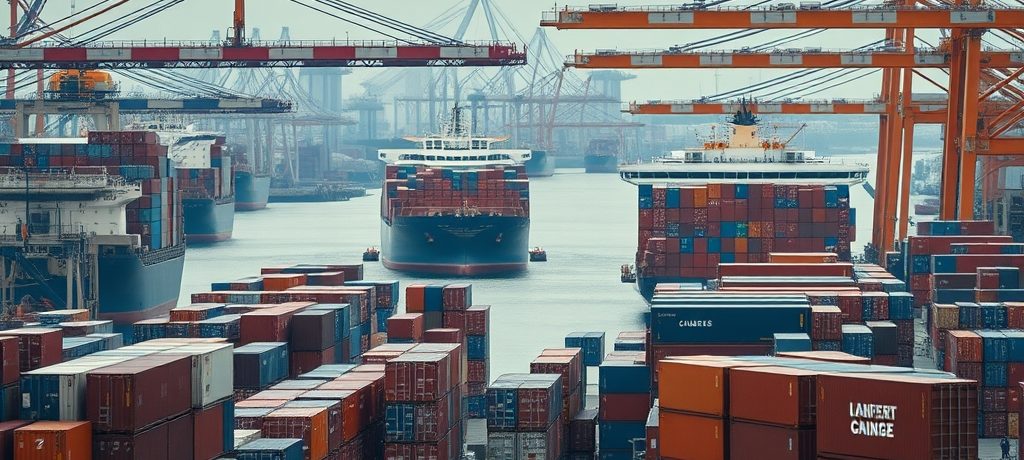
Europe’s economy faces an escalating threat from a surge in Chinese exports, prompting urgent concern among leaders and economists alike. For eight years, the United States has imposed significant tariffs on Chinese goods, but this economic pressure has not diminished China’s industrial output. Instead, the world’s second-biggest economy is redirecting its vast export volumes away from the U.S. tariff wall and towards more open markets, particularly in Europe and Asia. This shift risks creating a ‘China Shock 2.0’ for Europe, mirroring the original shock that devastated American manufacturing in the 2000s and contributed to considerable political upheaval.
The Redirection and its Stakes
Despite U.S. sanctions, China achieved a record global trade surplus of an astonishing $1.2 trillion last year. French President Emmanuel Macron has explicitly warned that Chinese exports are “literally killing a large part of the European industry,’’ admitting that Europe was “slow to see that.’’ This stark reality has now placed China’s trade practices at the forefront of the agenda for G7 rich democracies gathering this week in Évian-les-Bains, France. French officials have indicated hopes for a concrete plan to address the Chinese threat emerging from the summit.
One potential response under consideration is for the European Union and other nations to erect their own higher tariff barriers against Chinese imports. Currently, the EU applies relatively low tariffs on China under World Trade Organization rules, though it does impose higher duties on specific Chinese products, such as up to 35% on electric vehicles. Maurice Obstfeld, a senior fellow at the Peterson Institute for International Economics and former chief economist at the International Monetary Fund, cautioned that “China’s export surge, unless its leaders rein it in, will provoke a protectionist wave against Chinese imports worldwide.’’ He added that this would be “all the more so if the current disruptions around the Iran war persist and cause a sharper global slowdown.’’
China Shock 2.0: A Different Beast
The current situation, dubbed China Shock 2.0, differs significantly from its predecessor. The first China Shock, which began around 2001 with China’s entry into the World Trade Organization, saw low-cost Chinese textiles, furniture, and electronics flood Western markets. Economists David Autor of the Massachusetts Institute of Technology, David Dorn of the University of Zurich, and Gordon Hanson, now at Harvard, found that competition from China led to the loss of 2.4 million American jobs.
Today, China is not merely an emerging player but dominates global trade and manufacturing. Its share of global goods exports has soared from just 4% in 2000 to 16% currently, making Beijing’s trade policies far more consequential. Moreover, China has advanced its industrial capabilities, exporting sophisticated products such as electric vehicles (EVs), batteries, advanced machinery, software, and scientific instruments. This places it in direct competition with the richest countries. Researchers at the Federal Reserve and the Federal Reserve Bank of St. Louis reported last month that Chinese exports now compete with nearly 58% of the exports from the 21 European countries sharing the euro currency, a substantial increase from 46% in 2000.
Economist Eswar Prasad of Cornell University noted that “The second China shock is characterized by its companies running the board on manufacturing exports — from low-tech, low-wage to high-tech high value-added industries,” emphasizing that “This is directly hitting advanced economies where it now hurts the most″—specifically in high-tech sectors like EVs and high-end robotics, which many nations had been banking on for a manufacturing revival.
Germany’s Plight and Broader Impact
Germany, traditionally an export powerhouse, has been particularly hard hit. The dynamic has reversed; China now sells more goods to Germany than it purchases. German companies are struggling to compete with Chinese rivals across core sectors such as industrial machinery, construction equipment, cars, and chemicals—all mainstays of Germany’s export-oriented economy. Partly due to this intensified competition, Germany’s economy has stagnated, shrinking in both 2023 and 2024, and growing by a mere 0.2% last year.
The United States, by contrast, appears less vulnerable than it was in the 2000s. Trump’s tariffs have effectively curtailed many Chinese products, with exports of Chinese goods to the United States dropping 37% from January through April this year compared to the same period in 2025, according to the U.S. Commerce Department. The U.S. also benefits from a stronger economic position, producing its own energy—unlike the EU and Japan—and experiencing a boom in productivity and investment in artificial intelligence.
Despite diminished sales to the U.S., China benefits from soaring demand for its low-cost EVs and from AI investment, which drives sales of Chinese electrical components and machinery for data centers. Exports from China to the 27-nation EU climbed 16.4% from January to May compared to a year earlier. For France, Beijing’s customs statistics show its trade deficit with China rose to $5.3 billion from $3.3 billion a year earlier.
The Economic Drivers Behind China’s Export Surge
Economists attribute China’s export surge to domestic policies that encourage factories to overproduce while simultaneously pressuring consumers to underspend. For instance, state-run Chinese banks offer low interest rates to savers but provide cheap loans to government-owned manufacturers. A fragile social safety net compels Chinese families to save rather than spend, building financial buffers against old age and medical expenses. Obstfeld explained that these policies are partly designed to maintain factory activity and employment, resulting in “an excess domestic supply of manufactured products, which must be exported abroad.’’ This influx of low-priced Chinese products into global markets threatens to put European and other factories out of business.
Beijing has also fostered intense domestic competition among companies, leading to what Autor and Hanson described in a New York Times column last year as “apex predators” with whom “The rest of the world is ill prepared to compete.” China has long pledged to curb overproduction and stimulate consumer spending, a goal that would rebalance its economy away from exports and offer expanding markets for U.S. and European goods. However, Obstfeld observed, “The leadership has long said this is a goal… but they have been slow to act as if they mean it.’’
Former U.S. trade negotiator Wendy Cutler, now senior vice president at the Asia Society Policy Institute, warned that “Beijing has been relying on the rest of the world to address its overcapacity problem.” She concluded that “this unsustainable situation may soon change if the EU and others take steps to halt Chinese imports, following the U.S. lead.’’ The unfolding G7 discussions will be critical in determining whether Europe can forge a unified and effective strategy to counter this intensifying economic challenge.