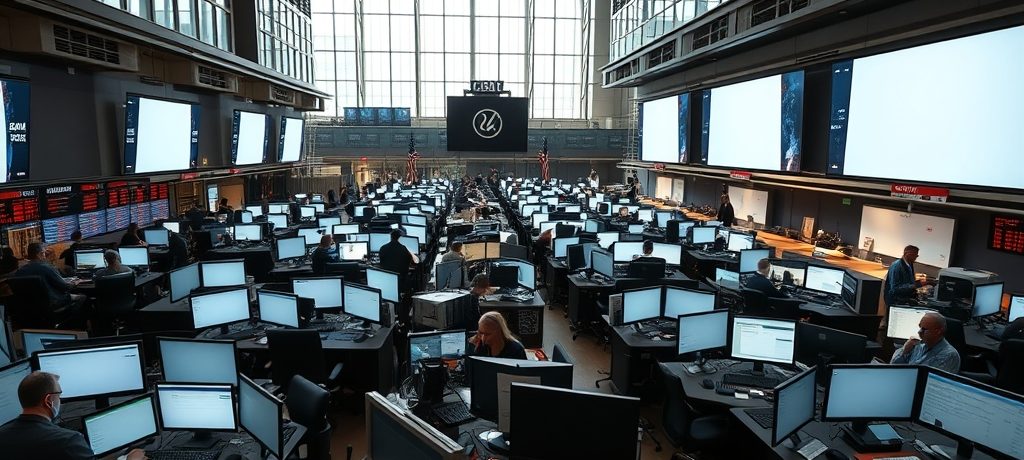
A widespread sell-off in major technology companies, originating in Asia, reverberated across U.S. markets early Tuesday, sending the technology-heavy Nasdaq composite tumbling 2.2%. The downturn reflects escalating investor anxiety over the increasing likelihood of interest rate hikes later this year, a prospect that has begun to deflate the massive run-up in AI-related stocks.
nn
The broader S&P 500 index also felt the pressure, falling 1.5% in early trading. This decline follows an impressive streak for the index, which had recorded 11 weekly gains out of the last 12, largely propelled by the robust performance of tech stocks. In contrast, the Dow Jones Industrial Average, with its comparatively lower weighting in technology, demonstrated greater resilience, registering a more modest decline of 0.6%.
nn
Tech Giants Face Significant Losses
n
The technology sector bore the brunt of the market’s apprehension, with several prominent companies experiencing substantial drops. Micron Technology, a key player in the semiconductor industry, slumped a notable 12%. Other chip manufacturers were also among the biggest losers in overnight trading, with Intel down more than 7% and Qualcomm falling 6.3%.
n
Companies specializing in memory and data storage also took a beating. Sandisk saw its shares fall nearly 9%, while Seagate was down 7.2% early Tuesday. Even Elon Musk’s SpaceX, which owns xAI, continued its slide, slipping another 1% before the opening bell after a significant 16.4% tumble to start the week. SpaceX, which trades on the Nasdaq, was trading just above $156 per share, a notable decrease from its highs of more than $200 last week, though still above its market debut price.
nn
Rate Hike Speculation and Inflation Concerns Drive Sell-Off
n
The primary catalyst for the widespread selling appears to be the growing expectation of interest rate hikes by the Federal Reserve. Traders are now betting on a nearly 90% chance that the Fed will raise its federal funds rate at least once by the end of the year, a sharp increase from the 57% chance seen just a week ago, according to data from CME Group. Higher interest rates are anticipated to make it more expensive for companies to fund growth through borrowing, particularly impacting high-growth technology firms that rely on future earnings potential.
n
This concern is compounded by persistent inflation worries. Economists are forecasting that a key measure of inflation for U.S. consumers, due out Thursday from the government, sped up to 4.1% in May from 3.8% in April. This acceleration in inflation, partly attributed to months of rising oil prices caused by the Iran war, strengthens the argument for the Federal Reserve to tighten monetary policy.
nn
Bond Market Reflects Rising Anxiety
n
The bond market has already begun to price in these expectations. Bond yields stabilized overnight after climbing for the past week on speculation of Fed action. The yield on the 10-year Treasury settled around 4.49% early Tuesday, up from 4.43% a week ago and 3.97% before the war. High yields in bond markets worldwide, driven by inflation concerns, threaten to slow economies and have already led to higher rates for mortgages and other types of loans. Moreover, high yields typically hurt prices for investments, especially those perceived as expensive, adding pressure on technology stocks whose valuations have soared amid the artificial-intelligence technology mania.
nn
Global Markets Feel the Impact
n
The tech-led sell-off was not confined to U.S. shores, with Asian and European markets also registering significant declines. In Asia, Japan’s benchmark Nikkei 225 lost 3.6% to finish at 69,788.38. South Korea’s Kospi experienced a substantial 10.0% decline to 8,203.84, dropping from previous record highs due to a major sell-off in technology issues, exacerbated by signs of greater regulatory scrutiny in the country’s semiconductor sector. Hong Kong’s Hang Seng slipped 1.8% to 23,336.28, while the Shanghai Composite shed 1.4% to 4,106.25.
n
European markets also traded lower at midday. France’s CAC 40 dipped 0.6%, the German DAX fell 1%, and Britain’s FTSE 100 declined 0.5%.
nn
As investors grapple with the twin specters of rising interest rates and persistent inflation, the market’s focus remains squarely on the Federal Reserve’s next moves and upcoming economic data, particularly the inflation report due later this week. The recent sell-off underscores a shift in sentiment, moving away from the unbridled enthusiasm for AI-driven growth towards a more cautious stance in an environment of tightening monetary policy.