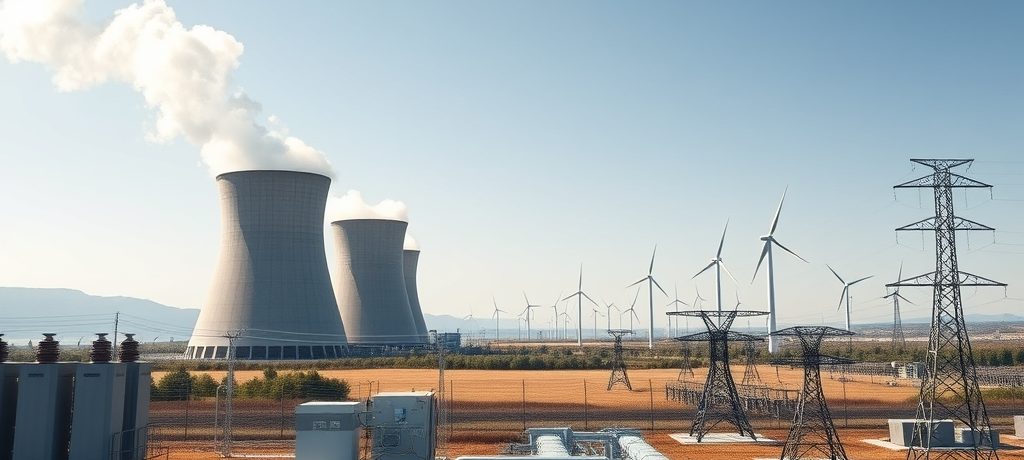
The escalating power demands from artificial intelligence and burgeoning data centers have sharply focused investor attention on the energy sector. In this dynamic environment, two prominent players, Constellation Energy (NASDAQ:CEG) and GE Vernova (NYSE:GEV), are emerging as key considerations for portfolios in 2026, each offering distinct exposure to the evolving energy landscape.
Constellation Energy, a leader in clean power generation, primarily leverages its extensive nuclear fleet, while GE Vernova provides the critical turbines and grid technology necessary for global power distribution. Both companies are integral to modernizing energy infrastructure, making them attractive to investors keen on electric utility stocks and advancements in carbon-free generation.
The Case for Constellation Energy
Constellation Energy stands as the largest producer of carbon-free energy in the United States, predominantly through its massive nuclear fleet. The company serves approximately 2.5 million customer accounts, including a significant 75% of Fortune 100 companies. Its strategic importance is underscored by major agreements, such as a 20-year power purchase agreement with Microsoft (NASDAQ:MSFT) for the restart of the Crane Clean Energy Center, and a deal with Meta Platforms (NASDAQ:META) concerning the Clinton plant.
Financially, Constellation Energy reported robust performance for fiscal year 2025, with revenue reaching nearly $25.5 billion, marking an 8.3% increase over the previous year. The company’s net income for the period was approximately $2.3 billion. However, the net margin, which indicates profit per dollar of sales, saw a decline to nearly 9.1% from roughly 15.9% in FY 2024.
As of its December 2025 balance sheet, Constellation Energy maintained a debt-to-equity ratio of roughly 0.6x, comparing total debt to shareholder equity. Its current ratio, a measure of ability to cover short-term debts with current assets, stood at approximately 1.5x. Free cash flow for the year, calculated as operating cash flow minus capital expenditures, was nearly $1.3 billion.
The Case for GE Vernova
GE Vernova plays a pivotal role in the global power grid by supplying essential hardware and software. Its extensive installed base includes over 7,000 gas turbines and 59,000 wind turbines. The company’s clientele spans global utilities, governments, and large industrial users, such as Amazon (NASDAQ:AMZN). Recent strategic maneuvers highlight its commitment to growth, including acquiring the remaining 50% stake in Prolec GE and purchasing Robotech Automation to enhance its grid automation capabilities.
For fiscal year 2025, GE Vernova generated close to $38.1 billion in revenue, reflecting growth of approximately 8.9%. The company’s net income for the year was approximately $4.9 billion, representing a substantial improvement compared to previous periods. The net margin concluded at nearly 12.8%, a notable recovery from a net loss just two years prior.
On its December 2025 balance sheet, GE Vernova reported a debt-to-equity ratio of 0.0x, indicating no total debt relative to its shareholder equity. The current ratio, measuring the ability to cover short-term liabilities with current assets, was approximately 1.0x. The company’s free cash flow for the year was strong at nearly $3.7 billion, providing ample capital for further expansion initiatives.
Risk Profile Comparison
Both companies navigate distinct risk landscapes. Constellation Energy faces significant integration risks following its acquisition of Calpine, which added 23 gigawatts of capacity to its fleet. The company must also contend with volatile wholesale market prices that can cause earnings to fluctuate. Furthermore, its nuclear operations necessitate ongoing license extensions from the Nuclear Regulatory Commission and continued federal support to maintain financial viability.
GE Vernova, conversely, deals with the complexities of long-cycle fixed-price contracts, where inflationary pressures can lead to cost overruns and diminished profitability. The business is also exposed to supply chain disruptions for critical materials, often exacerbated by geopolitical tensions. Additionally, GE Vernova faces intense competition from global giants such as Siemens Energy and Mitsubishi Heavy Industries, while also navigating intricate international trade regulations.
Valuation Comparison
According to recent data, Constellation Energy appears more attractively valued based on key metrics. Its Forward P/E ratio stands at 23.4x, compared to GE Vernova’s 38.1x, with the sector benchmark (SPDR XLU sector ETF) at 20.6x. Similarly, Constellation Energy’s P/S ratio is 3.9x, significantly lower than GE Vernova’s 7.8x.
- Metric: Constellation Energy | GE Vernova | Sector Benchmark
- Forward P/E: 23.4x | 38.1x | 20.6x
- P/S ratio: 3.9x | 7.8x | N/A
Valuation metrics were sourced from Financial Modeling Prep (FMP) and may vary from other data providers.
While both Constellation Energy and GE Vernova are poised to benefit from the massive electricity demands driven by AI and data centers, their differing business models offer exposure to distinct segments of the energy industry. Constellation Energy, as the largest producer of carbon-free nuclear energy in the U.S., boasts long-term agreements with major tech companies and provides strong cash flow and a regular dividend, appealing to investors seeking a more defensive approach. GE Vernova, on the other hand, is strategically positioned to capitalize on growing energy demand by manufacturing essential equipment like gas and wind turbines and upgrading global grid infrastructure. However, its stock currently carries a high valuation that already reflects much of this optimism. Ultimately, neither company represents a poor investment, as both are expected to thrive from increasing electricity demand. The choice for investors in 2026 hinges on whether they prefer the conservative, steady cash flow and dividends offered by Constellation Energy or are willing to accept the risk of a richer valuation in exchange for GE Vernova’s long-term growth potential in energy infrastructure.