Cattle markets experienced a notable downturn on Friday, June 26, 2026, with live and feeder cattle futures registering significant declines at midday. Weakness permeated cash trade and auction results, signaling a challenging close to the trading week for the livestock sector, according to data compiled by Barchart.
Live Cattle Futures Face Downward Pressure
Live cattle futures were firmly in the red, with contracts showing losses ranging from 35 cents to $1.20 by midday. The June 26 Live Cattle contract settled at $257.050, down $0.350, while the August 26 contract saw a more pronounced decline of $1.200, closing at $246.025. The October 26 Live Cattle futures contract also reflected this bearish sentiment, dropping $1.375 to $239.250.
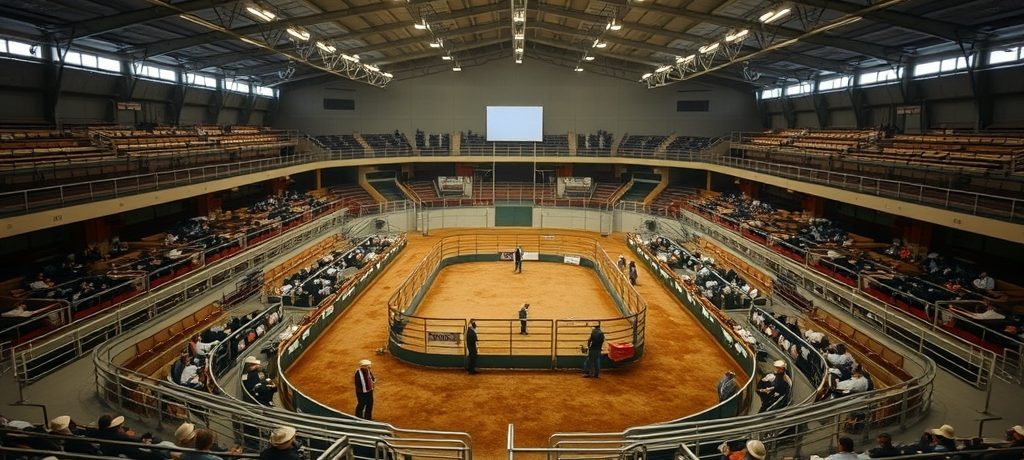
This downward pressure in futures was mirrored by subdued activity in the cash market. Cash trade volume was described as ‘very light’ in the northern regions, with live cattle trading at $260 and dressed at $408 on Wednesday. Bids were observed at $255, indicating buyer caution. Further underscoring the market’s hesitancy, the Friday morning Fed Cattle Exchange online auction reported no sales on the 1,636 head offered, despite bids also being placed at $255.
Feeder Cattle Futures Decline Despite Index Strength
The feeder cattle segment also faced considerable headwinds, with futures contracts experiencing drops between $3.47 and $3.70. The August 26 Feeder Cattle contract closed at $369.825, down $3.475. Similarly, the September 26 contract fell $3.675 to $367.700, and the October 26 contract decreased by $3.525 to $364.825.
This broad-based decline in feeder cattle futures occurred despite a recent positive movement in the CME Feeder Cattle Index, which had risen $6.03 on June 24 to reach $381.86. The divergence between the index’s prior strength and Friday’s futures performance highlights the immediate selling pressure impacting the market.
Wholesale Beef Prices and Cold Storage Data
Adding to the market’s concerns, wholesale boxed beef prices saw declines in the Friday morning report. Choice boxes were down $4.22, settling at $392.10, while Select boxes decreased by $2.33 to $372.41. The Choice/Select spread stood at $19.69.
Concurrently, Cold Storage data released on Thursday afternoon provided a mixed picture regarding beef stocks. At the end of May, beef stocks were reported at 403.474 million lbs. This figure represented a 1.06% drop from the previous year and a 0.49% decrease from the end of April, suggesting a slight reduction in overall supply compared to prior periods.
USDA Slaughter Figures Show Mixed Trends
In terms of processing activity, the USDA’s federally inspected cattle slaughter for Thursday was estimated at 109,000 head. This contributed to a weekly total of 433,000 head. While this weekly total marked an increase of 7,000 head from the previous week’s slaughter, it remained significantly lower than the same week last year, falling short by 18,966 head. The reduced year-over-year slaughter figures could imply tighter cattle availability in the broader market, yet this factor did not appear to offset the immediate bearish sentiment observed in futures and cash markets on Friday.
The collective data from futures, cash trade, auction results, wholesale prices, and slaughter figures paints a clear picture of Friday weakness across the cattle complex. From the immediate declines in live and feeder cattle contracts to the subdued activity in physical trade and lower wholesale beef values, the market demonstrated a distinct lack of buying conviction. As the trading week concluded, the livestock sector faced persistent downward pressure, signaling a need for close monitoring in the sessions ahead.