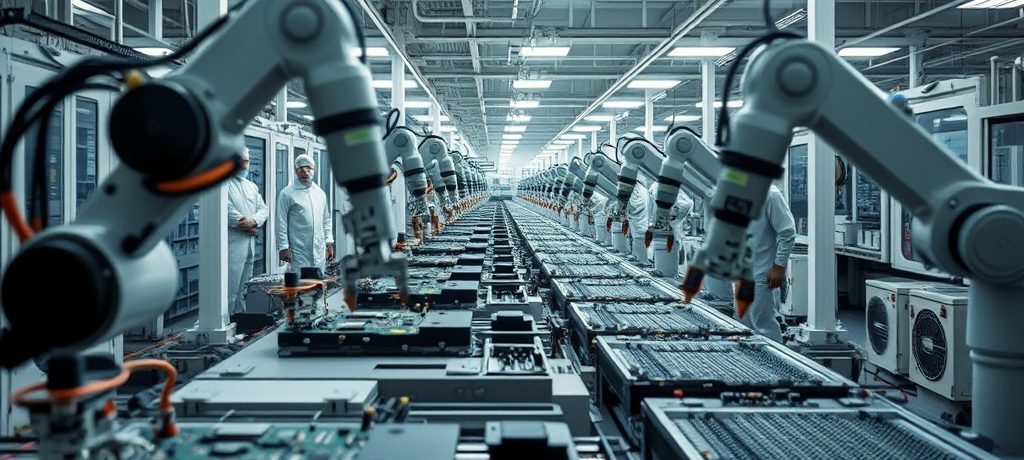
China’s factory activity picked up pace in June, with the official manufacturing purchasing managers index (PMI) expanding to 50.3, up from 50 in May. This growth, which surpassed economists’ expectations, was primarily propelled by strong demand for artificial intelligence (AI) hardware exports, according to an official survey released by the National Bureau of Statistics.
Key Indicators Point to Expansion
A PMI reading above 50 signifies expansion, while a figure below 50 indicates contraction. The June data reflects a notable improvement in the manufacturing sector. The sub-index for new orders climbed to 51.2 in June, an increase from 49.9 in May, signaling growing demand. Concurrently, the sub-index for production also expanded, reaching 51.4 from 51.2 in the previous month.
Huo Lihui, a chief statistician at the National Bureau of Statistics, stated that the June data reflected a warming economic climate in China.
Export-Driven Momentum
The resurgence in factory activity appears heavily reliant on external demand, particularly from the booming AI sector. Julian Evans-Pritchard, head of China economics at Capital Economics, noted that China’s economy has regained some momentum, but this remains "heavily dependent on exports and AI-related tech." He further emphasized that "External demand remains the main engine of growth for China’s manufacturing sector."
Domestic Demand Remains Cautious
Despite the positive export performance, some economists caution that domestic demand remains sluggish. Chinese consumers have maintained a cautious approach following a years-long downturn in the property sector. Lynn Song, chief economist for Greater China at ING Bank, suggested that further policy support from the Chinese government this year to boost domestic consumption and investment would be beneficial. Such measures, he argued, could help avoid an increasingly unbalanced growth pattern.
Chinese leaders have set an economic growth target of 4.5% to 5% for the entire year. Economists anticipate that the country is likely to meet this goal, largely aided by the surging exports of AI-related products.