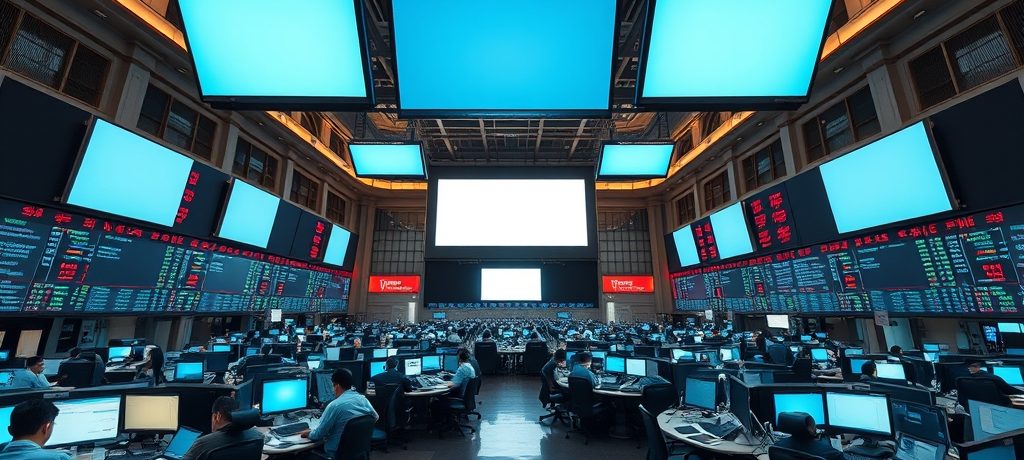
The Jakarta Composite Index (JCI) concluded Thursday’s trading session with a notable rally, successfully ending a three-day losing streak that had seen the index stumble by more than 100 points, or 1.4 percent. The benchmark index advanced 96.85 points, or 1.34 percent, to settle at 7,321.07, after trading within an intraday range of 7,220.10 and 7,330.81. Despite this positive close, market participants and analysts are bracing for renewed selling pressure on Indonesian shares come Friday, a sentiment largely influenced by a weak global market outlook, particularly across Asian equities.
Thursday’s upward movement in the JCI was primarily fueled by robust performances in key domestic sectors, notably food, finance, and automobiles. The financial sector showcased significant strength, with Bank Central Asia accelerating 3.06 percent, Bank Rakyat Indonesia soaring 2.73 percent, Bank Mandiri strengthening 1.55 percent, Bank Negara Indonesia rallying 1.50 percent, and Bank CIMB Niaga collecting 0.84 percent. The automotive industry also saw gains, with Astra International jumping 1.79 percent and United Tractors improving 2.31 percent. Consumer-oriented stocks like Indofood Sukses Makmur added 0.41 percent, and Astra Agro Lestari advanced 0.87 percent. Telecommunications provider Indosat Ooredoo Hutchison spiked 1.94 percent, while Semen Indonesia rose 0.25 percent, and Bumi Resources climbed 1.27 percent, reflecting broad-based buying interest.
Resource Sector Underperforms Amid Broader Concerns
In contrast to the broader market’s gains, the resource sector faced headwinds on Thursday, with several companies recording declines that partially offset the overall positive momentum. Mining and infrastructure-related stocks were particularly affected. Timah experienced one of the day’s sharpest drops, plunging 3.72 percent. Toll road operator Jasa Marga slumped 1.44 percent, while Vale Indonesia dropped 0.78 percent, and Aneka Tambang shed 0.36 percent. In the banking sector, Bank Danamon Indonesia also saw a downturn, sinking 0.76 percent. Meanwhile, Indocement and Energi Mega Persada closed the session unchanged, indicating a mixed and cautious sentiment across different market segments.
Looking ahead to Friday, the prevailing sentiment suggests a challenging trading day for the JCI, with expectations for the index to head south once more. This outlook is largely predicated on a confluence of factors, including a poor lead from major global markets and a generally weak forecast for Asian equities. Analysts specifically anticipate continued selling pressure among technology and semiconductor stocks, a trend observed globally and expected to reverberate across regional markets. The predominantly negative performance of European and U.S. markets on Thursday sets a precedent that Asian bourses, including Indonesia’s, are widely expected to follow.
Wall Street’s Negative Influence and Geopolitical Tensions
Wall Street’s performance on Thursday provided a clear indication of the headwinds currently impacting global equity markets. After opening marginally higher, major U.S. averages quickly reversed course, spending the remainder of the trading session deep in negative territory. The Dow Jones Industrial Average registered a significant plunge of 533.06 points, or 1.29 percent, closing at 40,665.02. Similarly, the NASDAQ Composite, heavily weighted towards technology stocks, lost 125.70 points, or 0.70 percent, ending the day at 17,871.22. The broader S&P 500 also sank, shedding 43.68 points, or 0.78 percent, to close at 5,544.59.
This widespread weakness on Wall Street was partly attributed to growing concerns about the near-term market outlook, exacerbated by a notable tech sell-off that occurred on Wednesday. Further contributing to investor apprehension were reports indicating that the Biden administration is actively considering the implementation of tougher trade rules against companies involved in its ongoing chip crackdown on China. Such geopolitical tensions and potential policy shifts carry significant implications for global supply chains and the profitability of multinational corporations, particularly those in the technology and semiconductor sectors.
U.S. Economic Indicators and Commodity Market Dynamics
The cautious market environment was further shaped by a series of U.S. economic reports released on Thursday. The Labor Department’s data revealed that first-time claims for U.S. unemployment benefits climbed more than expected last week, suggesting a potential cooling in the robust U.S. labor market. Conversely, the Federal Reserve Bank of Philadelphia provided a more optimistic assessment, reporting that growth in regional manufacturing was more widespread in July, indicating some resilience in industrial activity. However, the Conference Board’s reading on leading U.S. economic indicators for June showed a modest decrease, collectively painting a mixed picture of the nation’s economic health and contributing to investor uncertainty.
In the commodity markets, oil futures experienced a slight easing on Thursday. This modest decline was primarily driven by concerns surrounding the future outlook for oil demand from China, a major global consumer. Additionally, the recovery of the U.S. dollar exerted downward pressure on commodity prices, as a stronger dollar makes dollar-denominated goods more expensive for international buyers. West Texas Intermediate (WTI) Crude oil futures for August delivery ended the session down $0.03, settling at $82.82 a barrel, reflecting the broader cautious sentiment pervading global financial markets.
Considering the confluence of a weak global market outlook, the negative lead from Wall Street, and specific concerns surrounding technology trade policies and economic indicators, the Jakarta Composite Index appears poised to face renewed selling pressure. While Thursday offered a temporary reprieve for Indonesian shares, the underlying macroeconomic and geopolitical factors suggest a challenging and potentially volatile trading environment for the immediate term, with investors likely to remain on edge.