BERLIN – The SuperReturn private equity summit in Berlin, gathering investors representing over $50 trillion (€43 trillion) in assets under management, has become the focal point of intense protests by activists accusing the industry of exacerbating inequality, driving job cuts, and inflating costs. The ‘NoSuperReturn’ group initiated a week of demonstrations, directly challenging the high-stakes financial practices discussed within the conference halls.
Activists Demand Economic Rebalance
The protests kicked off outside the Wittenbergplatz subway station, where activist Hedda highlighted that the majority of Germany’s super-rich inherited their wealth, citing an analysis showing only one in four billionaires is self-made. ‘Which tax can the government use to fairly redistribute this excessive wealth generated by genetic lottery?’ Hedda questioned, with a crowd member responding, ‘Inheritance tax!’ The activists, accompanied by a polar bear in a pink cape, cheered, distributing golden chocolate coins.
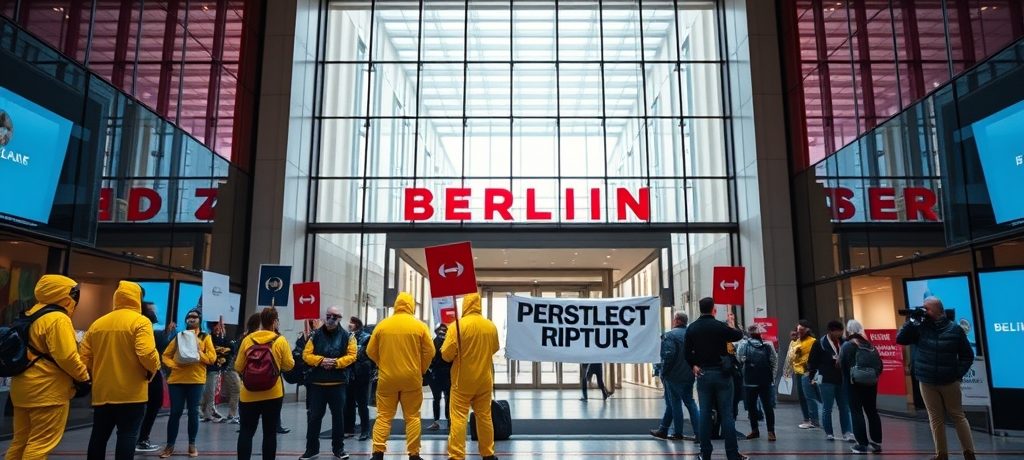
As the week progressed, the demonstrations escalated. On the third day, activists declared the area in front of the conference hotel a ‘toxic area,’ with some wearing yellow protective suits and gas masks, while others lay on the road in business suits, symbolizing ‘victims of an economic system that prioritizes profit over life.’ Police swiftly intervened to clear the area. Dominik Lange, a spokesperson for NoSuperReturn, articulated the group’s broader objective: ‘We want a shift in mindset… For an economy that ensures a good life for everyone.’ The final protest saw approximately 200 people making noise through the streets, featuring a dragon puppet, the pink-caped polar bear, and three puffy elephants carrying a banner that read: ‘The elephant in the room: Tax The Rich.’
The Mechanics of Private Equity and Its Critics
At its core, private equity involves firms collecting capital from pension funds, insurance companies, banks, and wealthy individuals. This capital is then used to acquire companies with the explicit goal of reselling them within three to five years for a significant return, often exceeding typical stock market gains. A key method employed is the leveraged buyout, where acquisitions are typically financed with 30% to 40% equity and a substantial 60% to 70% debt. This means the private equity firm itself contributes only a small share, playing largely with ‘other people’s money,’ as noted by Rosemary Batt, a professor emeritus of human resource studies at Cornell University.
To maximize returns, the acquired companies frequently undergo restructuring, which can involve staff reductions, asset sales, and the assumption of large amounts of debt. Batt, who has studied private equity operations for over 15 years, emphasized the inherent risk dynamic: ‘They’re taking risks with other people’s money. They win on the upside… They do not lose on the downside.’ She further highlighted a frequent concern at the SuperReturn conference itself: the ‘exit backlog,’ or the challenge of selling acquired companies for the highest price.
Economic Impact and Sectoral Concerns
Batt contends that the wealth extraction methods employed by private equity can have detrimental effects across companies, workers, clients, and the broader economy. ‘The profits from companies, from productive enterprises, are going into the pockets of financial actors, not being put back into companies to help them grow and be innovative and compete well in the economy,’ she told DW. While private equity is pervasive, its practices in the health and elderly care sector are particularly troubling, according to Batt, as firms often extract more value than they invest.
A notable example cited is Alloheim, Germany’s largest privately owned nursing home chain. Alloheim was passed between private equity firms twice—first from Star Capital Partners to Carlyle Group, and then to Nordic Capital in 2017. Nordic Capital later initiated a sale to an investment bank, which was halted in 2024 due to challenging market conditions, illustrating the ‘exit backlog’ concern.
Volatility as Opportunity: The Industry’s Perspective
Despite external criticisms and market challenges, a different sentiment prevailed within the SuperReturn conference. Panelists frequently viewed market volatility as an opportunity. ‘Volatility is our friend,’ remarked one participant, pointing to various new avenues for investment. Another panelist likened recent years to the ‘Hunger Games,’ referencing the COVID-19 pandemic, Russia’s invasion of Ukraine, Middle East tensions, and concerns over the Strait of Hormuz.
A ‘bright spot’ identified by a manager of a German private equity fund was the German defense industry, which he described as a ‘boon for investors’ due to significant government funding expected to continue for the next 10 to 20 years. An American firm, with decades of involvement in defense contracts, reported tripling its invested money in this sector, underscoring the potential for high returns in specific, government-backed areas.
Performance Under Scrutiny
However, Batt’s research challenges the narrative of consistently exorbitant returns. She states that ‘The median fund has not beaten the stock market since the vintage year 2006.’ Furthermore, her findings indicate that companies subjected to private equity buyouts face approximately 20% higher bankruptcy rates compared to average publicly traded companies. This data suggests a more nuanced picture of private equity’s financial performance and its impact on corporate stability.
The Berlin summit thus highlighted a stark contrast between the private equity industry’s pursuit of high-yield investments, often leveraging significant debt and restructuring, and the growing public and academic scrutiny over its societal and economic consequences, particularly concerning wealth distribution, job security, and the long-term health of acquired enterprises.