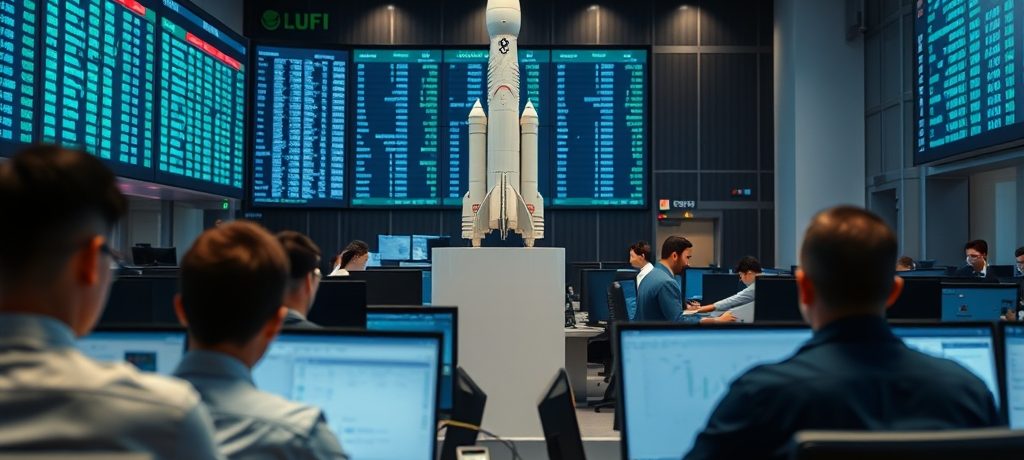
Despite Wall Street’s fervent endorsement, shares of Elon Musk’s SpaceX have remained largely earthbound since their initial public offering in June, trading around $152 per share after an initial surge past $200. Investment firms that underwrote the IPO have issued overwhelmingly bullish research notes, forecasting the stock to climb well above $200 within 12 to 18 months, with some even predicting an eventual ascent to $800. Yet, the market’s current valuation reflects a more cautious stance, suggesting investors are weighing the company’s monumental ambitions against significant technological and operational hurdles.
Wall Street’s Bullish Outlook on Space Dominance
Many of the investment firms that facilitated SpaceX’s IPO on June 12 issued their inaugural research notes this week, with nearly all recommending a ‘buy’ rating for the stock. Analysts are particularly focused on SpaceX’s potential to lead the market for space transportation and infrastructure, driven by its reusable rocket technology that enables the transport of people and cargo into Earth’s orbit and aims for deeper solar system exploration.
J.P. Morgan, for instance, projects SpaceX’s stock price to reach $225 by the end of 2027. The bank highlighted the company’s substantial competitive advantage in space transportation, citing approximately 670 orbital launches and a nearly 99% success rate with its Falcon rockets. According to J.P. Morgan, most payloads launched into orbit since 2023 have been through SpaceX. An analyst from J.P. Morgan stated in a research report, “SpaceX’s ambitions, and potential impact on humanity, are bigger than any company’s we’ve ever seen.”
The optimism extends further with investment bank Raymond James, which stands as the most bullish, forecasting the stock to eventually reach $800 per share. Raymond James analysts consider SpaceX a pivotal industrial company for the 21st century, asserting that the company is building foundational infrastructure. “Just as railroads, electric grids, and the Internet reshaped prior economic eras, we believe SpaceX is building the foundational platform for the next generation of industrial capacity,” their research report noted. Currently, most of SpaceX’s revenue is derived from its Starlink satellites, with AI innovations anticipated to further advance this technology.
Investor Caution Amidst Earthbound Shares
Despite the strong ‘buy’ recommendations and ambitious price targets, SpaceX’s stock has struggled to maintain its initial momentum. After topping $200 in its first week of trading, the shares are now hovering around $152, barely above their opening price on IPO day. This cautious investor sentiment appears to stem from the very factors that fuel Wall Street’s enthusiasm, but viewed through a lens of execution risk and technological uncertainty.
A key element of SpaceX’s future growth, the gigantic Starship rocket, remains in its test phase. While Starship is crucial for launching larger pieces of cargo, including future data centers in space, the technology for such ambitious endeavors, or for sending people to Mars, does not yet fully exist. Wall Street analysts themselves acknowledge that any delay or failure to establish a steady schedule of launches for Starship poses a significant risk that could undermine their optimistic forecasts.
Ambition, Valuation, and Underlying Risks
Elon Musk’s decision to take SpaceX public was driven by the substantial capital required to fund its expansive ambitions, which include deploying more satellites, establishing data centers in space, and ultimately, a colony on Mars. SpaceX concluded its first day on Wall Street in June with a market value exceeding $2 trillion, a level it largely maintains. This initial valuation briefly propelled Musk to become the world’s first trillionaire, though his net worth has since receded below that mark, according to Forbes.
However, not all financial institutions share the same level of bullishness. Equity research firm MoffettNathanson, while acknowledging the company’s potential, has issued a more ‘neutral’ rating, projecting the stock to eventually settle around $131 per share. Their concerns revolve around numerous unknowns, including potential regulatory issues, unproven technologies, and uncertainties regarding future demand. MoffettNathanson articulated their cautious stance in a report, stating, “It is, in short, a bet on any and all things made possible by a virtual lock on rocket manufacturing and launch.” These concerns underscore the speculative nature of investing in a company whose most transformative projects are still in nascent stages.
The dichotomy between Wall Street’s high-flying forecasts and the market’s more grounded valuation highlights the inherent complexities and risks associated with investing in a company like SpaceX. While its vision for space transportation and infrastructure is undeniably transformative, the path to realizing these ambitions is fraught with technological challenges, regulatory hurdles, and the immense capital requirements that necessitate continued investor confidence. The coming years will be critical in determining whether SpaceX can bridge the gap between its colossal potential and the practical realities of its operational execution, ultimately validating or challenging the divergent views currently held by analysts and investors.