The Stock Exchange of Thailand (SET) finds itself at a precarious juncture, sitting just above the critical 1,600-point plateau following a modest decline on Tuesday that brought an end to a three-day winning streak. The Thai bourse, which had advanced by almost 30 points or 2 percent over its recent rally, is now bracing for another soft start on Wednesday, influenced by a weak global forecast for Asian markets.
Tuesday’s trading saw the SET index fall by 12.75 points, or 0.79 percent, to close at 1,604.13. This dip occurred after the index traded within a range of 1,594.69 and 1,613.12 points throughout the day. Market activity reflected this cautious sentiment, with a volume of 11.170 billion shares changing hands, valued at 81.814 billion baht. The session was characterized by a broader negative trend, as 274 stocks declined against 180 gainers, with 206 stocks finishing unchanged.
Sectoral Weakness and Global Headwinds
The downturn on the SET was broadly distributed across several key sectors, with food, property, resource, service, and technology segments all registering losses. This localized weakness coincided with a broader global sentiment that points to a soft outlook for Asian markets. The primary drivers behind this cautious global forecast are renewed hostilities in the Middle East and the subsequent surge in crude oil prices.
International markets on Tuesday presented a mixed picture, with European bourses showing varied results while U.S. markets closed lower. This divergence suggests that Asian markets are likely to experience a split performance, leaning towards a softer opening as global concerns weigh heavily on investor confidence. The interconnectedness of global financial markets means that geopolitical developments, particularly those impacting crucial commodities like oil, quickly ripple across continents, affecting regional bourses like the SET.
Wall Street’s Retreat and Sectoral Shifts
The lead from Wall Street was notably weak, setting a somber tone for global trading. Major U.S. averages, after opening mixed, quickly turned lower and remained underwater for the remainder of the session, ultimately finishing off session lows. The Dow Jones Industrial Average sank by 130.76 points, or 0.25 percent, closing at 52,925.15. The NASDAQ Composite experienced a more significant slump, falling 302.47 points, or 1.16 percent, to end at 25,818.69. Similarly, the S&P 500 lost 33.58 points, or 0.45 percent, to close at 7,503.85.
The NASDAQ’s substantial decline was primarily attributed to a sharp pullback in semiconductor stocks, with the Philadelphia Semiconductor Index plummeting by 4.7 percent. Beyond semiconductors, other sectors such as gold, airline, and computer hardware stocks also exhibited considerable weakness. Conversely, some sectors managed to defy the broader downtrend, with energy, pharmaceutical, and healthcare stocks turning in strong performances, indicating a flight to defensive plays and beneficiaries of specific market conditions.
Oil Prices Spike Amid Middle East Tensions
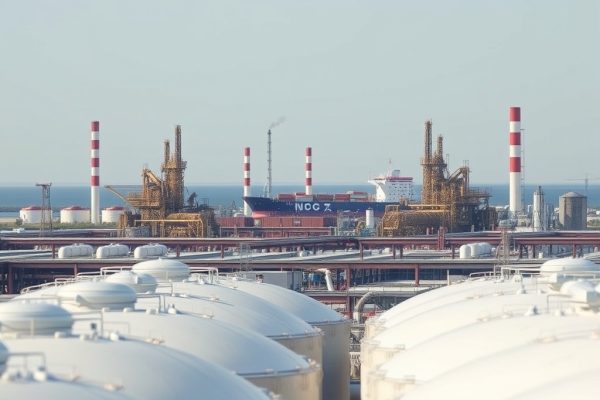
A significant factor contributing to the global market unease was the sharp spike in crude oil prices on Tuesday. This surge was triggered by mounting concerns over fresh U.S.-Iran conflicts, following reports of attacks on at least three tankers in the strategically vital Strait of Hormuz. The geopolitical tensions in the Middle East, a critical region for global oil supply, immediately translated into higher energy costs.
West Texas Intermediate (WTI) crude for August delivery saw a notable increase, rising by $2.01, or 2.93 percent, to settle at $70.56 per barrel. While this sharp increase in crude oil prices provided a significant boost to energy stocks globally, it simultaneously exerted downward pressure on other sectors, as higher energy costs tend to weigh on corporate margins and consumer spending. The dual impact highlights the complex interplay between commodity markets and broader economic performance.
As the Thai bourse approaches Wednesday’s trading session, the confluence of its recent retreat, the immediate proximity to the 1,600-point support level, and the prevailing global headwinds—particularly renewed Middle East hostilities and elevated oil prices—suggests a challenging period ahead. The market’s ability to hold this psychological and technical support will be closely watched by investors, as it navigates a landscape shaped by both domestic sector performance and international geopolitical developments.