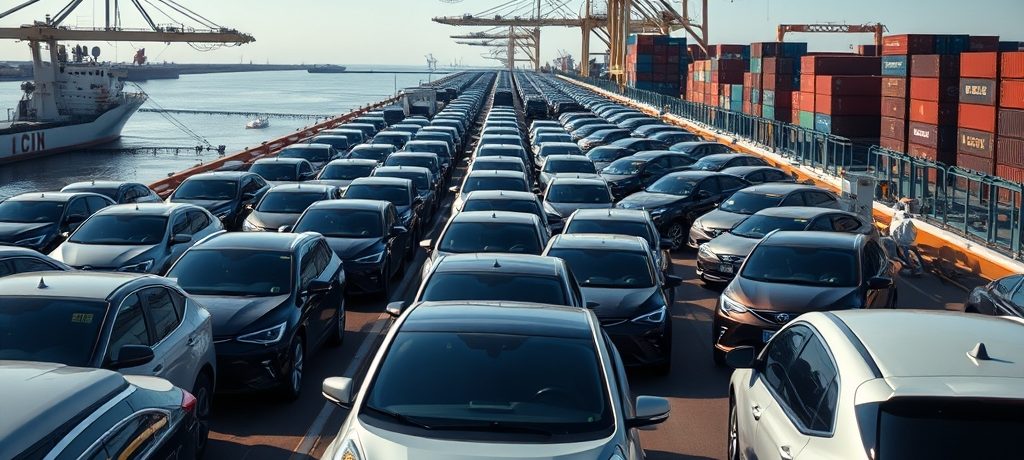
HONG KONG — China’s passenger car exports experienced a significant surge of 80% in June compared to the previous year, primarily fueled by robust international demand for electric vehicles. This export boom unfolded even as the domestic market saw a considerable downturn, with sales sinking 26% over the same period, according to an industry group.
Export Momentum Driven by EV Demand
The first half of the year underscored this outward shift, with Chinese passenger vehicle exports jumping 72% to exceed 4.4 million units, as reported by the China Association of Automobile Manufacturers. In June alone, China exported approximately 905,000 passenger cars, an increase from 809,000 units in May, highlighting a consistent upward trajectory in global shipments.
Analysts anticipate this growth trend to continue. Stephen Chan, an analyst at S&P Global Ratings, projected that China’s passenger car exports could grow by 30% to 50% for the entirety of 2026 compared to the prior year. Similarly, consultancy AlixPartners recently forecast that Chinese exports for 2026 could reach about 10 million vehicles, a substantial rise from approximately 7 million in 2025.
Domestic Market Under Pressure
Despite the export success, China’s domestic car market faces considerable headwinds. Sales inside China, while still larger at nearly 8.3 million for January-June and around 1.5 million passenger cars in June, are under severe pressure. The market is described as overcrowded and plagued by fierce price wars, which have intensified competition among automakers. Furthermore, a prolonged slump in the property market has adversely affected household budgets, directly impacting consumer demand for new vehicles. Cutbacks in government support for purchases of electric vehicles have also contributed to the domestic slowdown.
Consultancy AlixPartners forecasts that sales of light vehicles, including passenger cars, in China will likely fall by 10%. This decline is partly attributed to potential buyers deferring purchases, anticipating further price reductions in a highly competitive environment.
Strategic Shift Towards Global Expansion
In response to the challenging domestic landscape, Chinese automakers are increasingly prioritizing overseas markets. Companies like BYD have been actively expanding their international footprint, including setting up factories in key markets globally. This strategic pivot is seen as crucial for improving their profitability and ensuring long-term viability.
Wei Haigang, president of automaker GAC International, articulated this necessity at an autos expo in Hong Kong in June, stating that going global has “become a necessity” for automakers in China. He emphasized, “In China’s highly competitive environment, companies that don’t venture overseas will face immense difficulties in surviving.”
Navigating International Trade Dynamics
However, this aggressive global expansion has not been without its challenges, adding to friction with trading partners. While Chinese car brands are making inroads in certain regions, such as Canada, which approved an annual import quota of 49,000 EVs from China at a low tax rate, other markets remain more restrictive. Auto analysts are closely monitoring whether the Canadian agreement might pave the way for exports to the U.S. market, where hefty tariffs have historically blocked Chinese EV exports.
The complexities of international trade were further highlighted last month when Sweden-headquartered EV maker Polestar, controlled by Chinese auto group Geely, announced that the U.S. Commerce Department had banned it from selling vehicles in the U.S. from the 2027 model year. This incident underscores the intricate regulatory and geopolitical landscape Chinese automakers must navigate as they pursue global market share.
The dual trends of surging exports and contracting domestic sales paint a clear picture of the evolving strategy for China’s automotive industry. With domestic pressures mounting, the imperative to expand globally has become a defining characteristic, albeit one fraught with both significant opportunities and considerable international trade complexities.