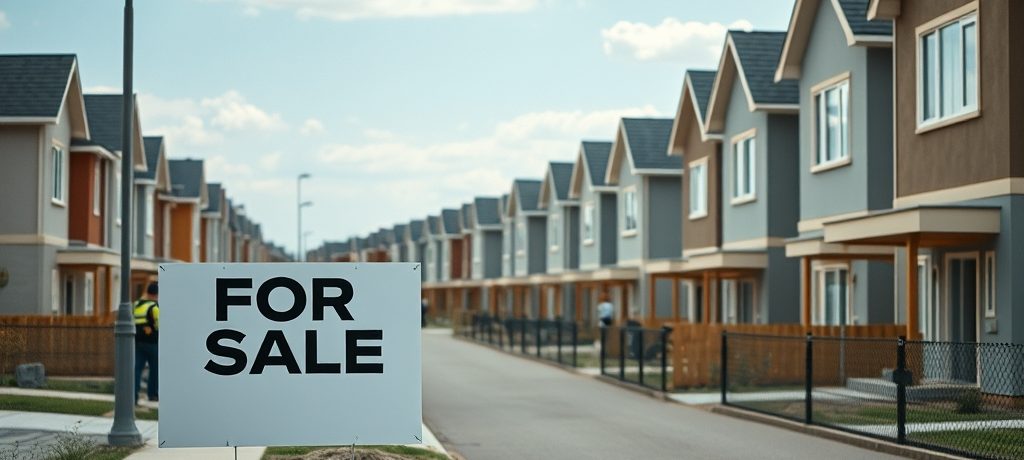
The average 30-year fixed U.S. mortgage rate has climbed to 6.49% this week, drawing closer to the critical 6.5% threshold and directly increasing borrowing costs for prospective homebuyers. This latest uptick, reported by mortgage buyer Freddie Mac, marks a rise from 6.43% just last week, adding tangible financial pressure to an already cautious and constrained housing market.
Mortgage Rates Ascend, Directly Impacting Homebuyer Affordability
The benchmark 30-year fixed rate mortgage rate increased to 6.49% from 6.43% last week, according to data released by Freddie Mac on Thursday. This recent movement signifies a notable shift, particularly when contrasted with the rate observed one year ago, which stood at 6.72%. For individuals seeking to purchase a home, such incremental rate increases translate directly into higher monthly expenses. Freddie Mac highlighted that rising mortgage rates ‘can add hundreds of dollars a month in costs for borrowers,’ a significant burden that inherently ‘reduc[es] their purchasing power’ in a competitive market.
The upward trend was not exclusive to long-term loans. Borrowing costs on 15-year fixed-rate mortgages, a product often sought by individuals refinancing existing home loans, also experienced an increase this week. The average rate for a 15-year loan rose to 5.82% from 5.79% last week. Comparatively, a year ago, the average 15-year rate was slightly higher at 5.86%, as further detailed by Freddie Mac.
Persistent Volatility and a Protracted Housing Slump
Mortgage rates have demonstrated considerable volatility throughout the current year, contributing to market uncertainty. The average rate on a 30-year loan briefly dipped below 6% in February, a significant event as it marked the first time it had done so since late 2022. However, this period of lower rates proved temporary, as rates subsequently ‘climbed in May to its highest level in nine months.’ This persistent elevation and fluctuation in mortgage rates have demonstrably ‘weighed on home sales this year,’ exacerbating a broader slowdown in the housing sector.
The nationwide housing slump is not a recent phenomenon but rather a protracted challenge that dates back to 2022. This was the year when mortgage rates began their steady ascent from the historically low levels observed during the pandemic era. Despite the current average long-term mortgage rates remaining ‘lower than they were at this time last year,’ the prevailing ‘uncertainty about their trajectory amid the war with Iran’ continues to keep ‘many would-be homebuyers on the sideline,’ hesitant to commit to major investments.
Economic and Geopolitical Undercurrents Driving Rate Movements
The dynamics of mortgage rates are influenced by a complex interplay of macroeconomic factors, extending from the Federal Reserve’s interest rate policy decisions to the broader expectations of bond market investors concerning the future trajectory of the economy and inflation. These rates generally mirror the trajectory of the 10-year Treasury yield, which serves as a primary benchmark that lenders utilize as a guide for pricing home loans.
Recent movements in the bond market underscore these influences. The 10-year Treasury yield was recorded at 4.55% at midday Thursday on the bond market, an increase from 4.49% a week prior. This yield stood notably lower at just 3.97% in late February, specifically before the onset of the ‘war with Iran.’ The current upward trend in long-term bond yields, and consequently mortgage rates, is directly attributed to ‘expectations of hotter inflation amid higher crude oil prices’ — a direct consequence linked to the geopolitical conflict that began in late February.
It is worth noting that the average rate on a 30-year mortgage has now returned to the level observed ‘two weeks ago,’ highlighting the rapid and sensitive fluctuations within the market in response to evolving economic indicators and geopolitical developments.
Stagnant Home Sales Reflect Market Hesitation
The combination of elevated and volatile mortgage rates, coupled with the overarching ‘uncertainty about their trajectory amid the war with Iran,’ has had a palpable effect on buyer behavior, effectively keeping ‘many would-be homebuyers on the sideline.’ This widespread hesitation is clearly reflected in recent sales data for the U.S. housing market.
Sales of previously occupied U.S. homes experienced a decline in the first three months of the year when compared to the same period a year earlier, extending the nationwide housing slump. Furthermore, through the first half of this year, seasonally adjusted sales of existing U.S. homes have shown only a modest increase of 0.7% compared to the same period in 2025, according to data provided by the National Association of Realtors. This figure underscores the persistent sluggishness and lack of robust recovery in the market.
Currently, sales of existing U.S. homes continue to hover ‘close to a 4-million annual pace.’ This rate falls significantly short of the historic norm for the U.S. housing market, which is typically ‘closer to 5.2-million’ annually. This sustained underperformance relative to historical averages indicates a market grappling with significant headwinds.
The latest rise in average long-term mortgage rates underscores the ongoing financial challenges facing prospective homebuyers and the broader U.S. housing market. Influenced by both domestic monetary policy decisions and international geopolitical events, the trajectory of borrowing costs remains a critical factor shaping affordability and overall market activity. As economic and geopolitical uncertainties persist, the housing sector is likely to continue navigating a period of constrained demand and cautious investment, with potential buyers remaining sensitive to further rate fluctuations.