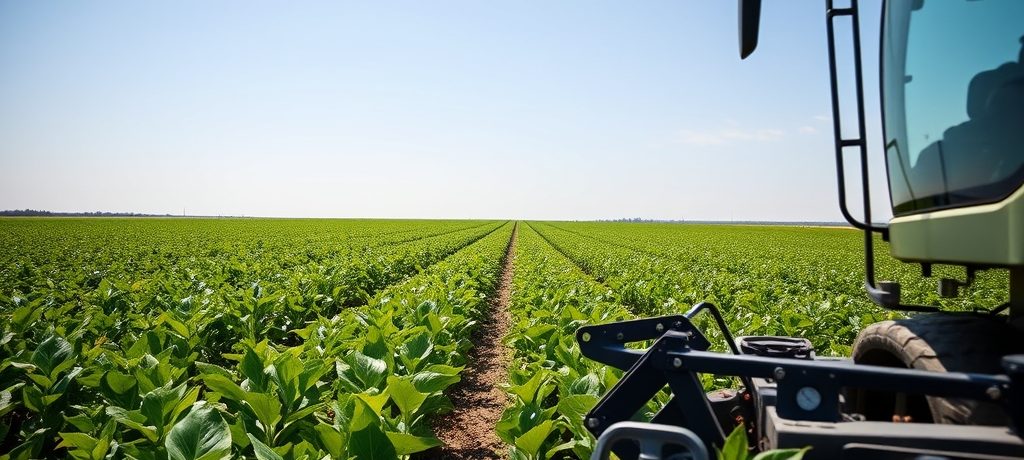
Soybeans concluded Monday’s trading session firmly in positive territory, extending gains across key futures contracts and cash markets. The commodity saw increases ranging from 4 to 5 ½ cents, underpinned by robust export demand and favorable domestic crop development data, even as some segments of the complex experienced downward pressure.
Market Performance Reflects Upward Momentum
The commodity’s performance was notable across various contracts. July 2026 soybean futures closed at $12.02, marking a 5 ½ cent increase, while August 2026 contracts advanced 5 cents to settle at $11.96 ¾. New crop November 2026 soybeans also saw gains, rising 4 cents to $11.94 ¾. This upward trend was not limited to futures; the broader cash market reflected similar strength. The cmdtyView national average Cash Bean price climbed a nickel, reaching $11.50 ¾. Specifically, Nearby Cash prices matched this increase, moving up 5 cents to $11.50 ¾, and New Crop Cash prices followed suit with a 4-cent rise to $11.29 ¾.
This positive momentum in soybeans contrasted with mixed performance in related products within the oilseed complex. Soymeal futures experienced a decline, trading down between $3.20 and $6.30. In contrast, soy oil futures posted significant gains, rising between 148 and 236 points, indicating a shift in demand or supply dynamics within the processed soybean market.
Export Demand Bolsters Sentiment with China Sale
A key driver for Monday’s soybean rally was a fresh report from the USDA, detailing a private export sale of 136,000 metric tons (MT) of soybeans to China. This significant transaction, designated for the 2026/27 marketing year, underscores persistent international demand for U.S. agricultural commodities and provided a tangible boost to market sentiment. Such export activity is often closely watched by traders as an indicator of global consumption patterns and potential future price support, particularly from a major importer like China.
Domestic Crop Progress Outpaces Norms
Domestically, the U.S. soybean crop is progressing ahead of schedule, according to the latest Crop Progress data from the National Agricultural Statistics Service (NASS). As of July 12, 50% of the U.S. soybean crop was reported blooming, a notable 6 percentage points above the normal pace for this time of year. Furthermore, 19% of the crop was already setting pods, outpacing the normal rate by 6 percentage points. These accelerated development stages suggest a healthy and potentially robust harvest.
The condition ratings for the crop also showed improvement, with 65% rated good to excellent, an increase of 1 percentage point from previous assessments. The Brugler500 index, a widely referenced measure of crop health, also improved by 2 points, reaching 367, further reinforcing the optimistic outlook for the current growing season. These strong domestic fundamentals contribute significantly to market confidence, offsetting potential concerns.
Weather Outlook Presents Mixed Signals for Key Regions
Despite the strong crop progress, updated forecasts from the NOAA 7-day Quantitative Precipitation Forecast (QPF) present a mixed picture for key growing regions. The forecast indicates little to no precipitation for a broad area stretching from the Dakotas south through Kansas, as well as parts of Minnesota, Iowa, Illinois, and Missouri. Trace totals are also expected in Ohio and Indiana. While dry conditions can be beneficial for early harvest activities, prolonged lack of moisture in critical development stages could introduce concerns for future yields, particularly if temperatures remain elevated. Market participants will closely monitor these weather patterns for any potential impact on the developing crop.
Broader Commodity Context: Corn Shipments Show Mixed Trends
In related agricultural markets, the latest Export Inspections report, covering the week of July 9, provided insights into corn shipments. A total of 418,592 MT (15.38 million bushels) of corn were shipped, representing a 22.8% decrease from the previous week. However, this volume was more than double the shipments recorded during the same week last year, indicating a year-over-year improvement in export pace. Major destinations included Egypt, receiving 108,548 MT; Mexico, with 88,239 MT; and China, which imported 65,869 MT. Despite the weekly dip, the marketing year total for corn shipments now stands at 38.29 MMT (1.407 billion bushels), though this remains 17.6% below the volume shipped during the same period last year, highlighting ongoing challenges in overall corn export volumes.
The soybean market’s ability to sustain its Monday gains reflects a complex interplay of strong export demand and favorable domestic crop development, providing a bullish undertone despite some regional weather concerns. While the mixed performance in related soy products highlights the nuanced dynamics within the broader oilseed complex, the fundamental support from international sales and an advanced crop cycle suggests continued attention will be paid to these factors in the coming weeks as the market navigates seasonal trends and evolving global demand.