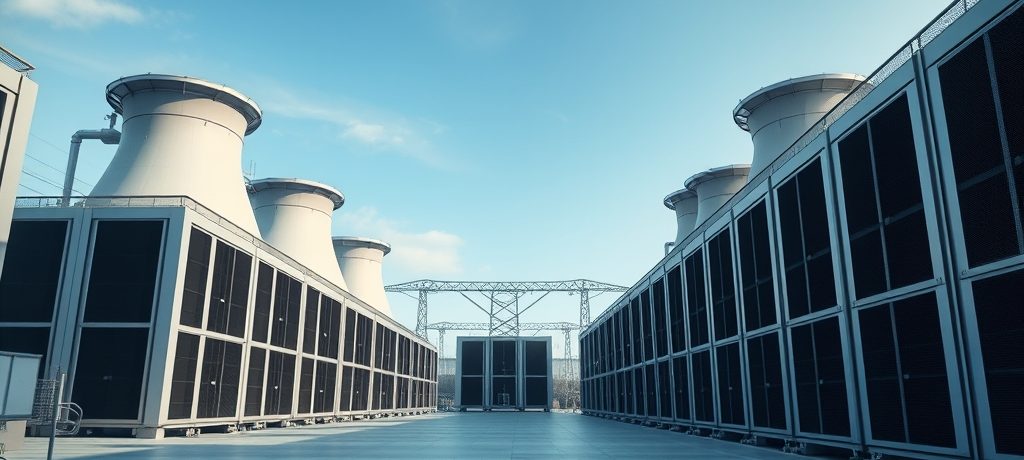
CoreWeave, a key player in the burgeoning artificial intelligence (AI) infrastructure market, is positioning itself for an ambitious target: a $1 trillion valuation by 2030. At the heart of this aspiration is the company’s aggressive expansion in AI data center capacity, particularly its focus on gigawatts of power, a critical bottleneck in the current AI build-out. While the demand for such infrastructure is described as insatiable, the path to this valuation is fraught with financial complexities and strategic decisions, according to recent analysis.
The Gigawatt Gold Rush and CoreWeave’s Strategic Position
The scarcity of power is a defining characteristic of the AI infrastructure boom, making companies like CoreWeave central to the industry’s expansion. The company currently boasts more than 1 gigawatt of active power and has set an ambitious target to exceed 8 gigawatts by 2030. This capacity has proven highly lucrative, enabling CoreWeave to secure long-term, substantial deals with major tech firms, known as hyperscalers.
A notable example of this success is CoreWeave’s expanded AI infrastructure agreement with Meta Platforms, valued at $21 billion and extending through December 2032. While the specific megawatt allocation for this deal was not disclosed, it underscores the significant demand for CoreWeave’s offerings. Analysts suggest that just as AI chips and memory chips have rapidly created trillion-dollar valuations, power constraints could similarly elevate companies well-positioned in this niche.
Dissecting the Path to a Trillion-Dollar Valuation
Achieving a $1 trillion valuation would necessitate CoreWeave’s market capitalization to grow more than 20-fold from its current levels. The company’s 8-gigawatt target by 2030 is considered a pivotal factor in reaching this milestone. The underlying mathematics suggest that if CoreWeave successfully builds out 8 gigawatts of data center capacity, it could represent approximately $480 billion in value, based on an estimated cost of $60 billion to construct a 1-gigawatt AI data center. This calculation does not even account for potential property appreciation or the value of long-term hyperscaler deals.
CoreWeave’s existing pipeline of 3.5 gigawatts indicates that expanding to 8 gigawatts by 2030 is feasible from a demand perspective, given its proven ability to secure new deals with hyperscalers. However, this projection hinges on a critical assumption: CoreWeave must increasingly shift from renting data center space to owning a higher percentage of its gigawatts.
Financial Headwinds and the Ownership Dilemma
Despite the robust demand, CoreWeave faces significant financial challenges on its journey to the 8-gigawatt target. The substantial capital expenditure required—$60 billion per 1-gigawatt data center—raises questions about how the company will finance the remaining 4.5-gigawatt gap. Potential avenues include debt financing, tax incentives, and strategic energy deals. Furthermore, CoreWeave needs to fully power its remaining pipeline and finalize deals with hyperscalers for this capacity.
A core issue highlighted by analysts is CoreWeave’s business model, which heavily relies on renting AI data center capacity. This approach subjects the company to higher costs from landlords, potentially eroding its profit margins. In Q1 2026, CoreWeave more than doubled its revenue year over year, but its net losses also more than doubled during the same period. This trend of escalating losses alongside revenue growth is deemed unsustainable, particularly as costs are expected to increase significantly.
The WeWork Analogy and Margin Pressures
The company’s operational model draws parallels to WeWork, which, despite reaching a $47 billion valuation, eventually filed for bankruptcy. WeWork’s strategy involved securing long-term leases for office space and then subleasing it, aiming for an arbitrage profit. CoreWeave employs a similar model, but for AI data center capacity rather than office space.
While a complete collapse akin to WeWork is unlikely for CoreWeave, given the ‘insatiable demand’ for AI infrastructure compared to the pandemic-hit commercial office space market, the risk of margin pressure remains high. Landlords are expected to raise prices, especially as CoreWeave locks in lucrative, long-term contracts with tech giants. Although CoreWeave owns its AI chips, which offers some mitigation, a heavy reliance on rented capacity is ‘guaranteed to face margin pressure.’
Strategic Pivot and Competitive Landscape
For CoreWeave to truly realize its $1 trillion potential, a strategic pivot towards owning its AI data centers is crucial. Investors are advised to monitor any developments indicating such a shift. If the company can secure favorable debt financing terms and continue to forge strong deals, the path to a $1 trillion valuation becomes more viable. However, competitors like Nebius and Iren, which already own their land, power, and data centers, are seen by some analysts as having a stronger foundation for future profitability and potentially better chances of reaching high valuations due to their superior margin flexibility.
The current market sentiment, as reflected by The Motley Fool Stock Advisor analyst team, suggests caution. CoreWeave was not included in their recent list of the 10 best stocks for investors to buy, indicating that while the company operates in a high-growth sector, its specific business model presents unique challenges that warrant careful consideration from investors seeking to multiply their money.