Cotton futures demonstrated robust performance on Monday, extending gains across most contracts, buoyed by a confluence of positive agricultural progress reports and supportive movements in related commodity markets. The commodity saw an increase of 9 to 37 points, signaling sustained investor confidence as key crop development metrics surpassed historical averages.
Futures Market Shows Broad Upward Momentum
Specifically, the October 2026 cotton contract closed at 77.37 cents per pound, marking an increase of 30 points. The December 2026 contract followed suit, rising by 29 points to settle at 78.92 cents per pound. The furthest-dated March 2027 contract also registered an upward trend, closing at 80.29 cents per pound after gaining 28 points. This broad-based upward trajectory across the futures curve indicates a prevailing bullish sentiment among traders, reflecting expectations of continued demand or tightening supply dynamics, as reported by Austin Schroeder for Barchart.
Crude Oil and US Dollar Bolster Market Environment
The positive momentum in cotton futures was mirrored by gains in other significant commodity markets. Crude oil prices advanced by another 65 cents per barrel, a movement that often correlates with broader economic activity and demand for raw materials, including those used in textile production. Concurrently, the US dollar index saw an uptick of 0.209. This factor can influence the competitiveness of US cotton exports in international markets, though its immediate impact on Monday’s gains requires further analysis.
Crop Progress Report Signals Favorable Development
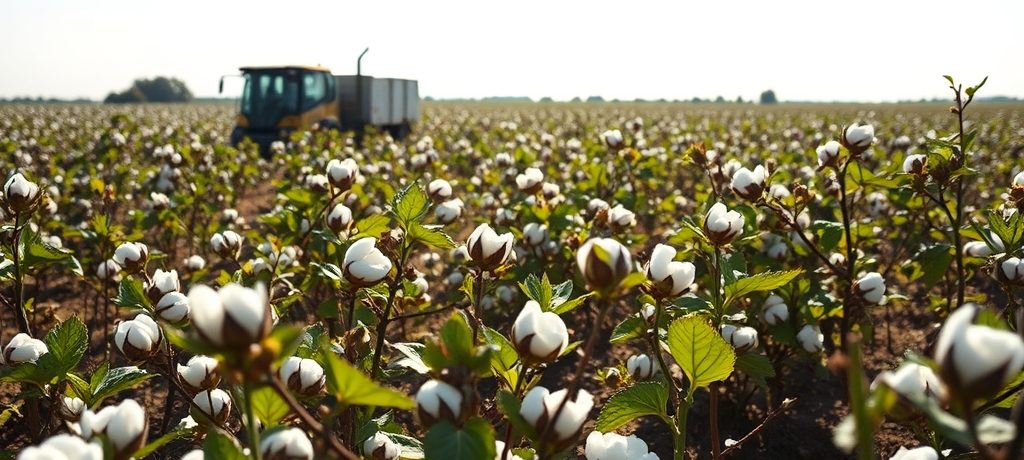
Crucially, the latest Crop Progress report, released Monday afternoon and reflecting conditions as of Sunday, provided a favorable outlook for the US cotton crop, contributing significantly to the day’s positive market sentiment. The report indicated that 73% of the crop had reached the squaring stage, a critical developmental milestone where flower buds begin to form, positioning it 1% ahead of the normal pace for this time of year. This early advancement in squaring suggests a healthy start to the growing season, potentially mitigating concerns about future supply.
Furthermore, 32% of the crop was reported to be setting bolls, the stage where cotton fibers begin to develop within the boll, aligning precisely with the five-year average pace. This metric suggests a healthy and on-schedule progression towards harvest, reinforcing expectations for a stable yield. Crop condition ratings also showed a modest but significant improvement, with 45% of the US cotton crop assessed as good or excellent, a 1 percentage point increase from the previous week. This upward revision in quality ratings further bolsters the positive agricultural narrative. The Brugler500 index, a recognized measure of crop quality and potential yield, also edged up by 1 point to 332, reinforcing the overall optimistic assessment of the domestic cotton supply.
Mixed Signals from Spot Markets and Global Indices
Beyond the futures market and domestic crop development, an examination of spot market activity and key global indices presented a nuanced, yet overall supportive, picture for cotton. The Seam, a prominent online cotton trading platform, reported the sale of 2,299 bales on Friday, transacting at an average price of 80.40 cents per pound. This active trading volume and specific price point offer a tangible indication of ongoing commercial demand for physical cotton, providing a real-time snapshot of market liquidity and pricing.
In contrast, the Cotlook A Index, a widely recognized benchmark for international cotton prices, registered a decline of 225 points on July 17, settling at 88.40 cents. This earlier dip in the international index suggests a potential divergence between global spot prices prior to Monday’s trading and the more recent bullish sentiment observed in the futures market. Such fluctuations are common and can reflect varying regional supply-demand dynamics or timing differences in data aggregation. Meanwhile, ICE certified cotton stocks remained unchanged on July 17, holding steady at 98,838 bales. The stability in certified inventory levels indicates no immediate pressure from excess supply in warehouses, providing a neutral but reassuring data point for market participants. Adding to the bullish undertone, the Adjusted World Price (AWP), a crucial reference price for US cotton producers that influences loan rates and marketing decisions, was notably raised by 3.52 cents on Thursday, reaching 65.37 cents per pound. This upward adjustment in the AWP reflects a stronger global pricing environment and provides a positive signal for producers regarding the value of their crop.
Monday’s trading session for cotton futures was characterized by solid gains, untermauert by encouraging domestic crop development and a generally supportive commodity landscape. While some international indices showed previous declines, the overall market sentiment, driven by robust futures performance and positive agricultural reports, points to a resilient cotton market navigating current supply and demand dynamics with a clear upward bias.