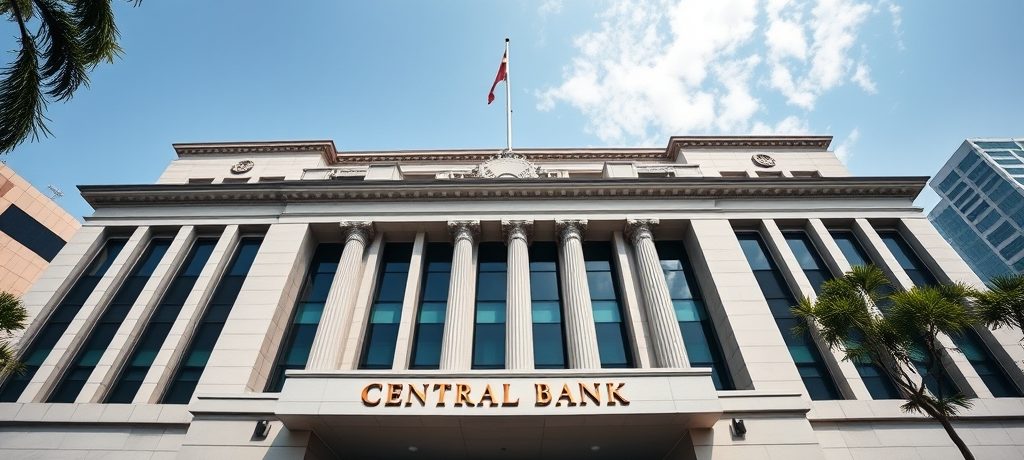
Singapore’s central bank, the Monetary Authority of Singapore (MAS), implemented a second consecutive policy tightening on Monday, signaling its proactive stance against anticipated inflationary pressures. The move comes as renewed geopolitical tensions in the Middle East threaten to sustain elevated energy prices, posing a significant risk to global economic stability.
Unlike most central banks that utilize interest rates, the MAS manages medium-term price stability by adjusting the appreciation rate of its currency against a trade-weighted basket, known as the S$NEER. In its latest decision, the authority opted to raise the rate of appreciation of its policy band “very slightly,” while maintaining the width and center of the band unchanged. This action surprised the majority of analysts, with a Bloomberg survey indicating that 13 out of 18 analysts had anticipated no change, while only four expected a steepening of the band and one predicted a re-centering.
The MAS articulated its rationale, stating, “External price pressures are expected to persist and pass through more broadly to domestic consumer prices in the period ahead.” Policymakers are navigating a complex global landscape, weighing the potential impact of the US-Iran conflict, which could fuel higher oil prices and contribute to a global economic slowdown. Concurrently, they are also factoring in the boost from the artificial intelligence boom, which has notably powered Singapore’s exports higher.
Despite these external headwinds, Singapore’s economy demonstrated robust performance, expanding by 5.7% last quarter. This puts the city-state on track to surpass the government’s latest full-year projection of 2%-4%. However, this economic strength is tempered by rising global trade uncertainty, particularly as President Donald Trump reportedly rebuilds his tariff wall. Singapore itself was recently hit with a 12.5% duty on Friday, although key electronic and pharmaceutical shipments to the US are currently exempted.
Domestically, Singapore’s inflation has quickened but remains relatively contained this year, registering 1.6% last month. This figure sits below the MAS’s medium-term target of approximately 2%. Nevertheless, the central bank anticipates future challenges, noting, “Singapore’s imported costs are likely to rise in the quarters ahead.”
The MAS’s decisive action contrasts with the more cautious approach adopted by other major Southeast Asian central banks. Both Indonesia and Malaysia, for instance, chose to leave their rates unchanged this month, despite their policymakers expressing alarm regarding renewed Middle East tensions, the possibility of accelerating global inflation, and the prospect of the US Federal Reserve hiking its key rate sooner. This latest tightening marks the MAS’s second response to the oil shock triggered by the Iran conflict, having previously adjusted policy in April, making it the first central bank in Asia to do so.
The back-to-back tightening underscores the MAS’s commitment to maintaining price stability amidst a volatile global economic environment, positioning Singapore to mitigate imported inflationary pressures even as its economy shows resilience.