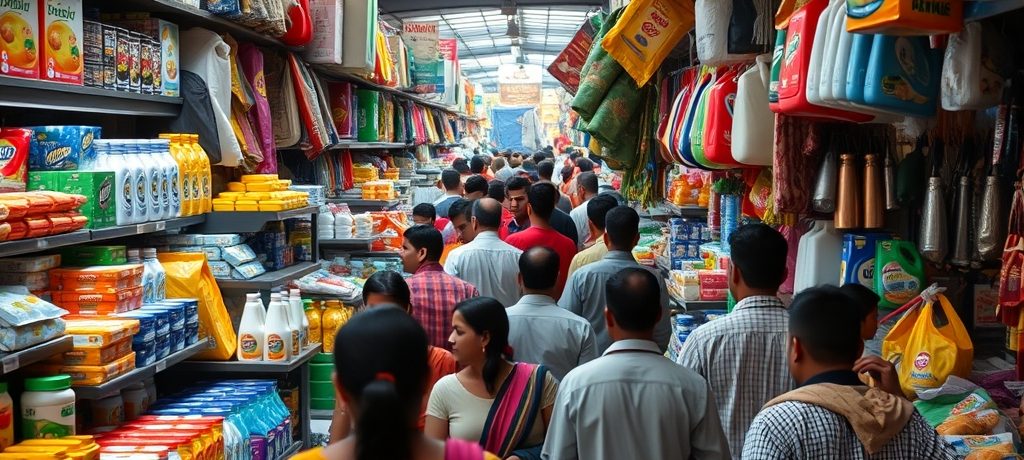
India’s largest consumer goods companies are preparing to implement a second consecutive quarter of price hikes on a wide array of products, from everyday essentials like toothpaste and detergents to durable goods such as tires and paint. This move, timed ahead of the crucial festival season, signals a persistent inflationary pressure exacerbated by the ongoing Middle East conflict, which continues to drive up commodity costs and casts a shadow over the nation’s inflation outlook.
Broad-Based Price Adjustments Expected
Hindustan Unilever Ltd., the country’s largest consumer goods firm, has indicated that it will undertake “measured price increases” in the coming quarter across categories including detergents and dishwashing bars. This strategic adjustment is a direct response to escalating input costs.
Niranjan Gupta, Chief Financial Officer at Hindustan Unilever, elaborated on the company’s strategy during a recent analyst call. “Given the external volatility, we continue to see inflation in crude-linked derivatives and are taking calibrated price increases across the segment” for home care products, he stated. This highlights the direct impact of global energy prices on manufacturing costs for a significant portion of consumer goods.
Beyond Hindustan Unilever, at least seven other prominent companies have signaled their intentions to raise prices. These include entities such as Dodla Dairy Ltd. and Asian Paints Ltd., according to information shared during their post-earnings calls and subsequent media briefings. This suggests a widespread industry trend rather than isolated corporate decisions.
Inflationary Pressures Intensify
The planned price increases come at a time when consumer prices in India have already breached the Reserve Bank of India’s (RBI) target. In June, the consumer price index rose above the central bank’s 4% objective for the first time in approximately 18 months, primarily due to climbing food and fuel costs. While the inflation gauge remains within the RBI’s 2%-6% tolerance band, the current trajectory suggests a potential for further escalation.
Analysts and policymakers are particularly concerned about the confluence of factors that could intensify price pressures in the coming months. Companies are actively passing on higher costs, and a deficient monsoon season raises the specter of significantly higher food prices, a critical component of India’s inflation basket.
The Reserve Bank of India itself anticipates inflation to average 5.1% in the fiscal year ending March 2027, a projection that underscores the persistent nature of these price challenges. The prolonged conflict in the Middle East, and specifically renewed tensions involving Iran, means that relief from high energy costs is unlikely in the immediate future. This has prompted companies to prepare for a second wave of price adjustments across a broad spectrum of products, from home appliances to staple kitchen items.
Examples of recent price adjustments include Havells India Ltd., which has already increased prices by as much as 8%, and Tata Consumer Products Ltd., which has seen its salt products become approximately 7% more expensive.
Festival Season Dynamics
The timing of these price hikes is particularly noteworthy, coinciding with India’s major festival season, which typically spans from August to November. This period is characterized by a significant surge in consumer spending, culminating in festivals like Diwali, the Hindu festival of lights. For many companies, this season accounts for nearly a third of their annual sales, creating an environment where robust demand might cushion the impact of price increases for consumers.
However, the ability of consumers to absorb these higher costs will be a key determinant of the overall economic impact. The planned price increases will serve as a critical test of the resilience of India’s consumption demand and will be closely monitored by policymakers.
Policymakers Watch Closely
The Reserve Bank of India has maintained a cautious stance, indicating that it would only intervene if inflationary pressures become more broad-based and sustained. Recent warnings from India’s finance ministry suggest that this threshold may be approaching. The ministry highlighted on Wednesday that price pressures are indeed spreading beyond the food sector, with elevated global fuel costs and adverse weather patterns contributing to a wider range of consumer price increases.
The central bank has kept its benchmark interest rates unchanged throughout the current year and is widely expected to maintain this policy when its monetary policy committee convenes for its next meeting from August 3-5. The future trajectory of monetary policy will likely hinge on the persistent elevation of oil prices due to geopolitical tensions and the extent to which the monsoon season impacts the summer-sown crop harvest.
The interplay between corporate pricing strategies, consumer demand, and the broader inflation environment will be a defining narrative for the Indian economy in the coming months, with the festival season serving as a crucial barometer.