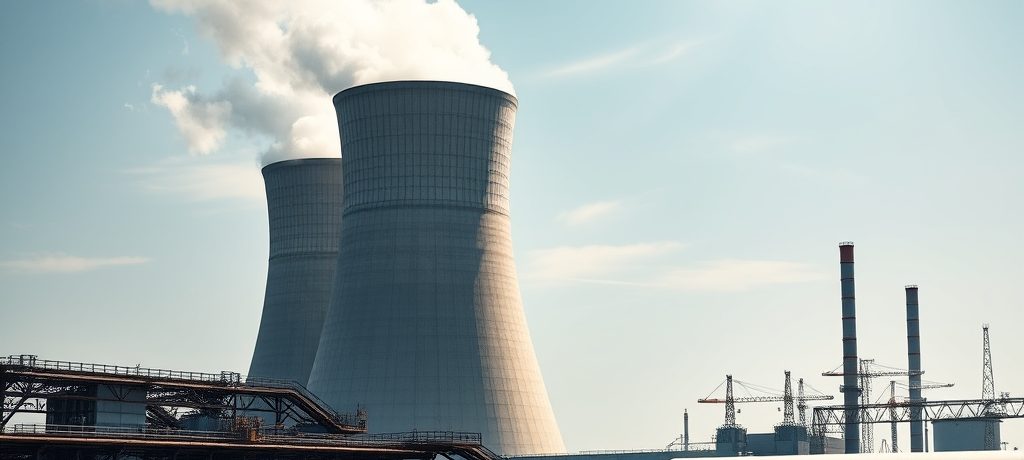
On July 22, President Donald Trump announced a significant agreement permitting Saudi Arabia to enrich uranium for civilian nuclear power plants. This development, while subject to congressional approval and geopolitical debate, has drawn considerable attention from investors, as it underscores a growing global appetite for nuclear energy, even among oil-rich nations. For market participants, this deal represents a bullish signal for uranium miners and nuclear energy exchange-traded funds (ETFs).
Geopolitical Implications and Investment Signals
The deal, announced by President Trump, allows Saudi Arabia to develop nuclear capabilities for peaceful purposes. Critics have raised concerns about potential military tensions and a nuclear arms race in the Middle East, given the rivalry between Saudi Arabia and Iran. However, from an investment perspective, the agreement highlights a broader trend: many countries are actively seeking to expand their nuclear energy production. This shift is expected to be favorable for companies involved in uranium mining and the manufacturing of nuclear reactors.
The pursuit of nuclear power by a nation as rich in oil as Saudi Arabia serves as a powerful indicator of nuclear energy’s increasing strategic importance. This demand is driven by the global need for reliable, low-carbon-emission power sources, particularly with rising energy demands from sectors like AI data centers.
Global X Uranium ETF (URA): A Deep Dive
The Global X Uranium ETF (NYSEMKT: URA) stands out as a prominent investment vehicle designed to capitalize on the uranium trade. This fund, established in November 2010, holds 53 stocks in companies with operations spanning uranium mining, refining, and nuclear power component manufacturing. As of the time of writing, URA’s top holdings include:
- Cameco: 23.5% of the fund
- NexGen Energy: 6.6%
- Sprott Physical Uranium Trust Fund: 5.6%
- Oklo: 5.5%
- Uranium Energy: 5.2%
While investing in the uranium industry carries inherent risks and volatility, URA has demonstrated strong recent performance. The fund has delivered average annual returns (by net asset value) of approximately 20.2% over the past five years, 31.9% over the past three years, and 17.6% over the past year. This recent surge contrasts with its long-term performance, which saw annualized returns of -2.51% since its inception. The fund charges an expense ratio of 0.69%, which is higher than many broad market index funds but reflects its specialized, concentrated focus on the uranium sector.
VanEck Uranium and Nuclear ETF (NLR): A Broader Approach
Another key player in the nuclear energy investment landscape is the VanEck Uranium and Nuclear ETF (NYSEMKT: NLR). Launched in August 2007, NLR offers a slightly different investment profile. While more concentrated with 28 stocks in its portfolio, it provides broader diversification by including stocks of nuclear power producers, such as utilities, and nuclear facility service providers, in addition to uranium miners. Its top holdings include:
- Constellation Energy: 9.15% of the fund
- Cameco: 7.8%
- Public Service Enterprise Group: 7.5%
- BWX Technologies: 6.4%
- Fortum Oyj: 5.99%
NLR has also experienced a period of robust growth in recent years, with average annual returns (by net asset value) of 19.99% for the past five years and 28.09% for the past three years. Its one-year return stands at 7.37%. Similar to URA, its long-term performance since inception has been more modest, delivering 3.16% annualized returns. The fund has faced challenges in the current year, with a year-to-date return of -6.27% by net asset value. NLR’s expense ratio is 0.52%, making it slightly less costly than URA.
The Global Nuclear Energy Outlook
The Trump administration’s deal with Saudi Arabia is but one component of a much larger global trend towards expanding nuclear energy capacity. According to the World Nuclear Association, there are currently 440 nuclear power plants operational worldwide. Furthermore, a substantial pipeline of new projects is underway, with 80 new nuclear reactors under construction, 119 planned, and an additional 327 proposed. Should these projects materialize, they would significantly boost the global nuclear reactor fleet, driving substantial demand for uranium and related services.
The world’s increasing energy requirements, coupled with a strong push for decarbonization, position nuclear energy as a critical solution. For long-term investors willing to accept the inherent risks and volatility associated with specialized sectors, both the VanEck Uranium and Nuclear ETF and the Global X Uranium ETF present opportunities to gain exposure to the future growth of uranium mining and nuclear power.