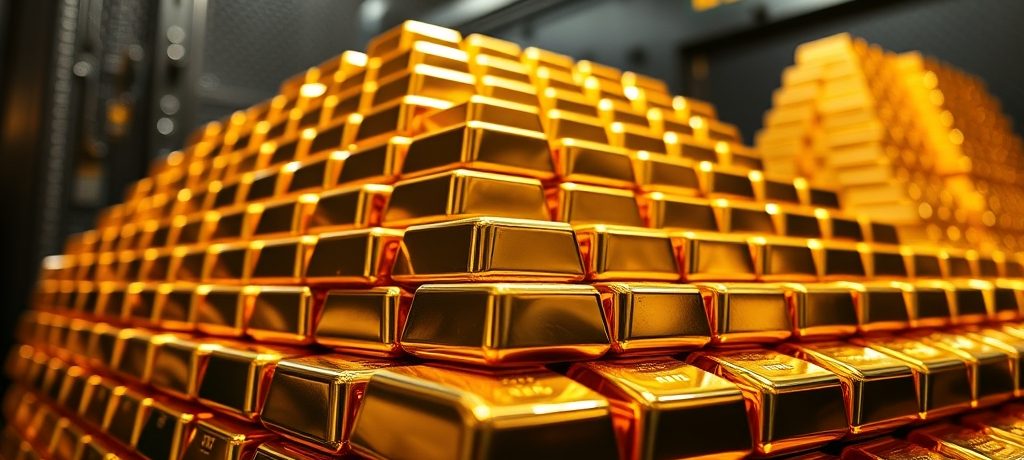
Gold prices are showing sustained strength, with some analysts forecasting a continuation of its record-breaking run and even a doubling of value within the next five years. This upward trajectory is largely attributed to investors seeking a secure haven for their wealth amidst global economic and geopolitical uncertainties.
Gold’s Ascent: A Multi-Year Trend
The precious metal has experienced a significant climb in recent years. Since 2020, the price of gold has surged from approximately $1,585 per ounce to over $4,500 per ounce. This performance stands in contrast to traditional interest-bearing investments, which are currently less attractive due to relatively low central bank interest rates. In this environment, investors are increasingly turning to precious metals as a means to preserve and grow their capital, a trend that naturally drives up prices.
Central Banks Bolster Gold Reserves
A key factor underpinning gold’s strength is the growing appetite for the metal among central banks worldwide. A study by Deutsche Bank, published on April 27, highlighted that central banks in countries such as China, Russia, India, and Turkey, along with those in emerging markets, are actively increasing their gold reserves. This strategic accumulation by official institutions is seen as a significant driver of demand.
Michael Hsueh, a precious metals analyst at Deutsche Bank Research and co-author of the study, distinguishes between ‘inelastic’ and ‘elastic’ buyers. He notes that stable, inelastic buyers like central banks have become more prominent, potentially displacing more price-sensitive ‘elastic’ customers, such as private buyers of jewelry. This consistent demand from central banks is identified as a crucial element supporting gold’s strength between 2021 and 2025.
Drivers of the Gold Rally
The current rally in gold prices is a confluence of several factors. Frank Schallenberger of Landesbank Baden-Württemberg (LBBW) points to expectations of interest rate cuts and a weaker U.S. dollar, coupled with robust central bank purchases and high demand for physical gold in the form of coins and bars. He also identifies cryptocurrencies as a relatively new, yet increasingly important, source of demand. As cryptocurrencies diversify their own assets, they are also turning to gold, which could provide further momentum to its price.
Geopolitical Uncertainty as a Primary Catalyst
Thomas Kulp, a research analyst at DZ BANK, identifies the accumulation of geopolitical uncertainty as the primary driver behind the gold price rally in recent years. Gold’s long-standing reputation as a ‘safe haven’ asset, offering a hedge against instability and a guarantee of independence, has amplified its appeal during times of heightened global tension.
The Enduring ‘Safe Haven’ Status
Gold has historically been regarded as a reliable store of value, offering a degree of safety that surpasses simply holding cash. While it does not generate returns on its own and is subject to speculative trading, its tangible nature provides a perceived security. However, Schallenberger cautions that the ‘safe haven’ reputation can sometimes be overstated, suggesting that holding excessive amounts of gold may not be advisable. He recommends a portfolio allocation of around five to 10% in gold as a means to reduce overall portfolio volatility.
Conversely, Michael Hsueh of Deutsche Bank Research holds a different perspective, believing that gold can be held on a large scale as a store of value. He reiterates that diversification, protection against geopolitical risks, and hedging against inflation are key reasons for reserve managers, including central banks, to increase their gold holdings.
DZ Bank analyst Thomas Kulp remains confident in gold’s role in stabilizing investments, stating, ‘Gold is and remains the ultimate safe haven. In uncertain periods or times of crisis, the precious metal is usually in demand.’ He does, however, remind investors that the price can experience ‘sometimes significant fluctuations,’ a factor that should be carefully considered.
Divergent Forecasts for Gold’s Future
While predictions about future economic developments are inherently uncertain, expert opinions on gold’s trajectory vary. Frank Schallenberger expresses skepticism about gold prices doubling in the next five years, citing a recent loss of momentum in gold ETF buying and central bank accumulation. He does not see sufficiently strong drivers at current price levels to support such a dramatic increase.
Michael Hsueh, however, stands by his forecast. His research on gold accumulation by emerging market central banks suggests a potential long-term driver. He anticipates that central banks will continue to rebuild their gold reserves, a trend he links to a ‘return of history’ characterized by rising geopolitical tensions reminiscent of the Cold War. Hsueh projects that if emerging market foreign exchange reserves decline and central banks increase their gold allocation to pre-1990 levels (around 40% of reserves), this could translate to a nominal gold price of $8,000 per ounce.
Thomas Kulp offers a more moderate outlook, expecting gold prices to return to the $5,000-per-ounce level within the next 12 months. He believes the fundamental drivers of demand remain intact, supporting a positive long-term view for gold prices.