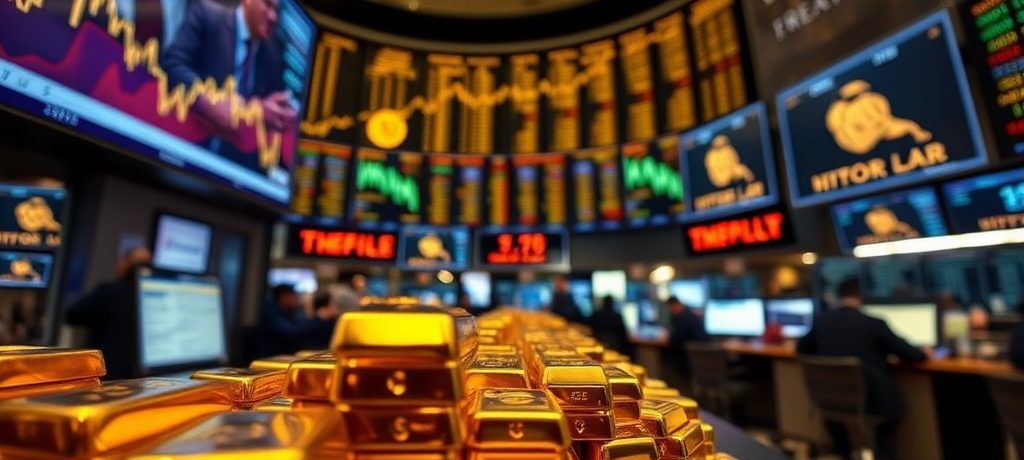
Gold prices experienced their most significant weekly advance since January, climbing above $4,300 an ounce on Friday. This robust performance, which saw spot gold jump 1.8 percent to $4,316.95 an ounce and U.S. gold futures rise 1.9 percent to $4,377.57 an ounce, reflects a confluence of factors including reduced expectations for a Federal Reserve rate hike in September, eased inflation concerns, and renewed hopes for stability in the Middle East.
nn
The precious metal recorded a weekly gain of more than 6 percent, reaching a seven-week high on Thursday, August 7, 2026. This upward trajectory underscores a shift in investor sentiment, as market participants recalibrate their outlook on monetary policy and geopolitical risks.
nn
Federal Reserve Outlook and Economic Indicators
n
A primary catalyst for gold’s ascent appears to be the diminished likelihood of an aggressive Federal Reserve rate hike in the near term. Despite several Fed officials signaling hawkish stances, the broader market has begun to price in a more tempered approach to monetary tightening. Investors are keenly awaiting the monthly U.S. jobs report, due later in the day, for additional insights into the economic and rate outlook.
nn
The Labor Department’s closely monitored report is anticipated to show that U.S. employment increased by 88,000 jobs in July, following a gain of 57,000 jobs in June. These figures will be crucial in shaping the Fed’s policy decisions. St. Louis Fed President Alberto Musalem, in prepared remarks at the Center for Public Policy Debate in Brazil on Thursday, emphasized the importance of maintaining price stability, stating that it would be a “mistake” for the Federal Reserve to tolerate elevated inflation in pursuit of higher productivity growth.
nn
Geopolitical Developments in the Middle East
n
Hopes for peace in the Middle East also contributed to gold’s strong performance, despite ongoing tensions. Reports indicated that Iran struck “hostile targets” in the Strait of Hormuz, and a deal with Oman to manage traffic through the vital global trade route would not fully reopen it. Furthermore, Iran declared its intention to bar U.S., Israeli, and other “hostile” vessels from transiting the Strait of Hormuz. A draft bill, which proposes fines of up to 20 percent of a ship’s cargo value for violations, is currently under expert review.
nn
Amid these developments, U.S. President Donald Trump stated in the Oval Office that the war with Iran would end “pretty soon,” offering a glimmer of optimism that may have influenced market sentiment towards a perceived de-escalation, traditionally a bullish factor for gold as a safe-haven asset.
nn
Broader Economic and Trade Landscape
n
The U.S. dollar, while little changed on Friday, was headed for a weekly gain against major peers, reflecting a resurgence in broader geopolitical and trade tensions. This dynamic suggests that while specific drivers boosted gold, the overall global economic environment remains complex.
nn
On the trade front, the Trump administration has reportedly paid back $100 billion in “Liberation Day” tariff refunds to businesses through customs officials, representing approximately 60 percent of all tariff revenue collected under the policy, according to a recent court filing from U.S. Customs and Border Protection. Concurrently, solar cells and modules shipped to the United States are set to face an additional 15 percent tariff from December 4, under a new trade measure signed by President Trump. These trade policies continue to shape the global economic landscape, adding layers of complexity for investors.
nn
Gold’s significant weekly gain underscores a market grappling with evolving monetary policy expectations, persistent geopolitical risks, and shifting trade dynamics. As investors digest upcoming economic data and monitor international relations, the precious metal’s role as both an inflation hedge and a safe haven remains central to portfolio strategies.