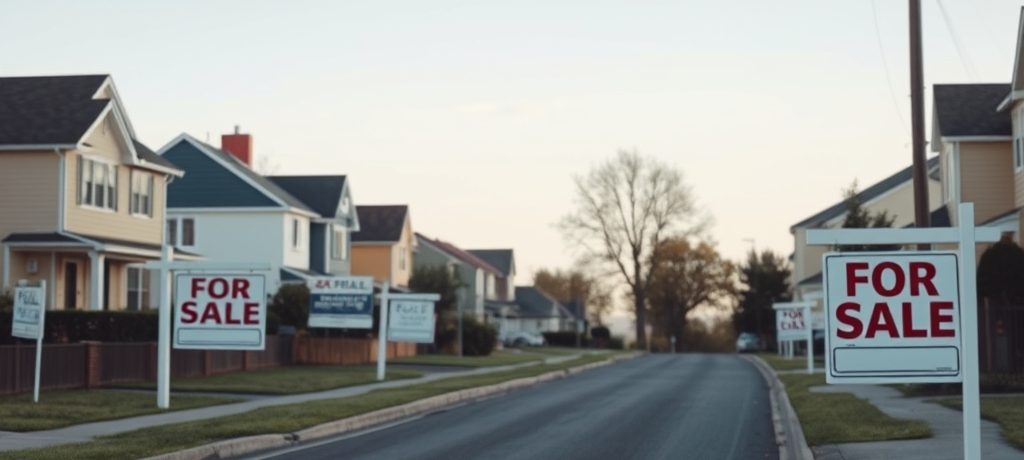
Sales of previously occupied U.S. homes experienced another slowdown in July, declining by 1.7% from June, as the dual pressures of record-high prices and the highest mortgage rates in a year continued to deter prospective buyers. The National Association of Realtors (NAR) reported Tuesday that existing home sales reached a seasonally adjusted annual rate of 4.06 million units last month, a figure that, while slightly exceeding economists’ expectation of a 4.05 million pace, underscores persistent challenges in the housing market.
Despite the monthly dip, July sales did show a modest increase of 0.7% compared with the same period last year, indicating a complex market dynamic where year-over-year comparisons offer a slightly different perspective than month-over-month trends. However, the overarching narrative remains one of constrained activity, largely attributed to affordability hurdles.
Record Prices and Soaring Mortgage Rates
The median sales price for U.S. homes continued its upward trajectory, hitting an unprecedented $434,100 in July. This represents a 2% increase from a year earlier, pushing homeownership further out of reach for many. Concurrently, borrowing costs have escalated significantly. Mortgage buyer Freddie Mac reported last week that the benchmark 30-year fixed rate mortgage climbed to 6.69%, marking its highest level in just over a year. This was the fifth consecutive week that the average rate rose, intensifying the financial strain on would-be homebuyers.
Lawrence Yun, NAR’s chief economist, acknowledged the market’s resilience despite these headwinds. “Home sales have been remarkably stable, even amid the rising mortgage rate environment of the past few months,” Yun stated. He further emphasized the profound impact of interest rates, noting, “There’s no doubt that the housing market would be thriving if average mortgage rates were to return near 6%.” This sentiment highlights a critical threshold for market vitality, suggesting that even a slight reduction in rates could unlock substantial buyer demand.
Persistent Slump and Historical Context
The U.S. housing market has been mired in a slump since 2022, when mortgage rates began their ascent from the historic lows observed during the pandemic era. For approximately three years, home sales have largely hovered around a 4-million annual pace, a stark contrast to the historical norm, which is closer to 5.2 million units. Last year, sales of previously occupied U.S. homes remained essentially flat, registering a 30-year low, underscoring the prolonged nature of the market’s contraction.
The current sluggishness in sales is further exacerbated by broader economic factors. Mortgage rates have predominantly trended higher in recent months, a trend linked to expectations of increased inflation. Surging oil prices, in particular, have pushed up the long-term bond yields that lenders utilize as a guide for pricing home loans, consequently driving mortgage rates upward and adding another layer of complexity for buyers.
Inventory Shortfalls and Market Imbalance
Compounding the challenges of high prices and elevated mortgage rates is a persistent shortage of available homes. At the end of July, there were 1.54 million unsold homes, a decrease of 1.9% from June and 0.6% less than July of last year, according to NAR. This figure remains significantly below historical norms; prior to the COVID-19 pandemic, a typical inventory level was closer to 2 million homes for sale.
The current inventory translates to a 4.6-month supply at the prevailing sales pace. This falls short of what is traditionally considered a balanced market, which typically ranges from a 5- to 6-month supply between buyers and sellers. The tight supply environment contributes to upward pressure on prices, even as demand is suppressed by affordability concerns.
Regional Disparities and First-Time Buyer Challenges
Regional data reveals varying market dynamics. The Northeast, for instance, continues to experience faster price appreciation than other parts of the country, with prices jumping 5.2% year-over-year. This accelerated growth is primarily driven by a pronounced shortage of inventory in the region, illustrating how localized supply constraints can amplify price increases.
First-time homebuyers, often the bedrock of a healthy housing market, continue to face significant hurdles. They accounted for 29% of sales in July, a decrease from 33% in June but a slight increase from 28% in July 2025. Historically, first-time buyers have represented closer to 40% of home sales, indicating that the current market conditions are disproportionately affecting this crucial segment of the buyer pool.
The latest sales figures paint a clear picture of a U.S. housing market grappling with a delicate equilibrium. While home sales have shown a degree of stability despite rising rates, the combination of record prices, elevated borrowing costs, and critically low inventory levels continues to create a formidable barrier for many prospective homeowners. The market’s trajectory remains heavily dependent on shifts in interest rates and an eventual increase in housing stock, factors that currently offer little immediate relief for would-be buyers.