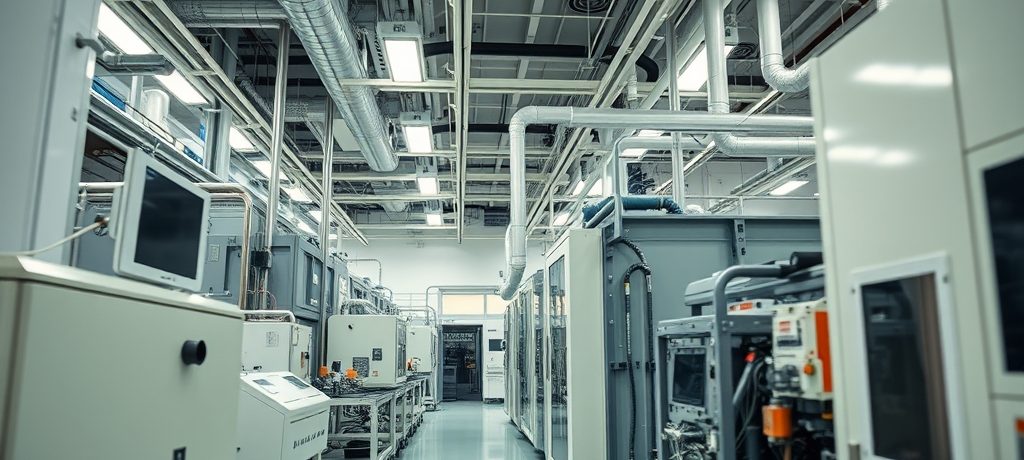
European industrial giants, traditionally known for heavy machinery and chemical production, are quietly emerging as pivotal beneficiaries of the artificial intelligence revolution. As investors seek robust opportunities beyond the high-profile chipmakers and software developers, a distinct group of companies specializing in vacuum pumps, heat exchangers, and specialty gases are cementing their position as the ‘next layer down’ of AI winners, offering compelling prospects for those wary of more established AI stocks.
Shifting Investment Landscape
Barclays analyst George Featherstone notes a clear investor trend: ‘Having had the pullback in AI stocks globally over the last couple of months, investors are wanting to get back in because they see the power of the underlying demand.’ However, their focus has shifted. Featherstone explains that while ‘easy pickings’ like chipmakers and electrical equipment manufacturers dominated early AI trades, the current hunt is for ‘where are the strongest pockets of growth in the next layer down?’ This search is directing capital towards firms whose foundational technologies are indispensable to AI’s physical infrastructure.
Underpinning Semiconductor Manufacturing
The intricate process of producing advanced semiconductors, the bedrock of AI, relies heavily on specialized industrial equipment and materials. Swedish industrial firm Atlas Copco AB’s vacuum technique segment, which provides essential pumps and exhaust management systems for chipmakers, exemplifies this trend. After a decline last year, the segment’s sales are projected to jump a significant 19% this year, outpacing all other divisions within the company. Similarly, Air Liquide SA’s electronics segment, a critical provider of industrial gases for semiconductor manufacturing, is anticipated to be its standout performer this year. Berenberg analyst Sebastian Bray highlights the depth of this exposure, estimating that approximately 40% of Air Liquide’s current backlog is concentrated within its AI-exposed electronics division. Further solidifying this foundational role, Wacker Chemie AG stands as the largest global producer of semiconductor-grade polysilicon, a fundamental material for chip fabrication.
Cooling and Powering the AI Engine
The escalating computational demands of AI necessitate advanced data center architectures, particularly in liquid cooling and power management. Alfa Laval AB, another Swedish industrial firm, is poised for substantial growth through its energy unit, which supplies liquid cooling systems and heat exchangers crucial for data centers. Goldman Sachs analyst Daniela Costa observes that investors are ‘getting more granular and looking specifically for liquid cooling exposure,’ positioning Alfa Laval for a significant boost. The criticality of such components is further underscored by Barclays’ Featherstone, who describes Belimo Holding AG’s liquid cooling valves as ‘so critical I can’t overstate it.’ Beyond cooling, the sheer power requirements of data centers are driving demand for specialized solutions. Johnson Matthey Plc, for instance, expanded its capabilities in May by acquiring Comertech Inc. to address the growing power-generation needs of US data centers. Even companies like paint maker Sherwin-Williams Co. are benefiting indirectly, providing fire-resistant coatings and resinous floorings essential for server farms.
Strategic Investments Amidst Market Shifts
The robust demand from the AI sector is proving to be a vital counterweight for these industrial and chemical companies, helping to offset weaker performance in other traditional end markets such as residential housing, carmaking, and broader industrial manufacturing. This strategic advantage is prompting significant investment. Air Liquide, for example, has committed more than $170 million to supply SK Hynix Inc.’s semiconductor facility in Indiana, demonstrating a clear focus on bolstering its AI-related capabilities. Berenberg’s Sebastian Bray aptly summarizes the varying impact: ‘For most companies, it’s a nice-to-have tailwind. For a few, it’s more significant.’ The targeted investments and accelerating growth in these AI-exposed segments indicate a strategic pivot, as these firms capitalize on the enduring demand for the foundational elements of artificial intelligence.
The AI boom’s expansive reach is clearly redefining value beyond the immediate technology frontrunners. For investors, the detailed analysis of industrial and chemical companies providing the essential, often unseen, infrastructure for AI offers a compelling avenue for diversified growth, highlighting the profound and pervasive economic impact of this transformative technology.