Italy’s unique ‘cheese bank,’ Credito Emiliano (Credem), a financial institution long celebrated for accepting wheels of Parmigiano-Reggiano as loan collateral, is now confronting a surprisingly modern challenge: climate change. What began as an eccentric regional financing model has evolved into a stark case study in how extreme weather translates directly into financial risk, impacting everything from energy consumption to agricultural output.
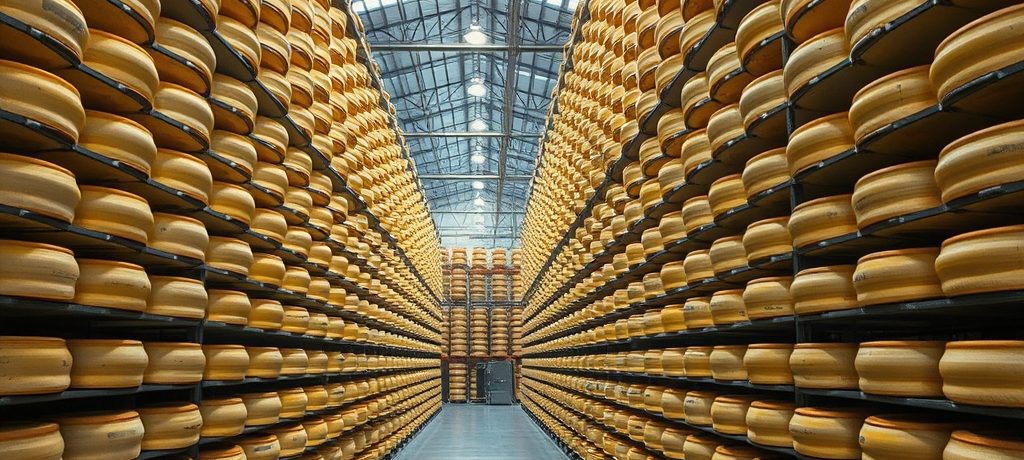
Since 1953, Credem has offered a specialized lending service that allows Parmigiano-Reggiano producers to secure working capital against their aging inventory. Deep within climate-controlled warehouses in Emilia-Romagna, hundreds of thousands of these iconic cheese wheels sit, not as decorative elements, but as productive assets securing substantial loans. According to a Fortune report, Credem’s subsidiary, Magazzini Generali delle Tagliate, operates facilities in Reggio Emilia and Modena, collectively holding over 500,000 wheels valued at more than 300 million euros (approximately $347 million).
This innovative model addresses a critical cash flow dilemma for producers. Parmigiano-Reggiano requires a minimum of 12 months to mature, with much of it aging for 24 to 36 months. During this extended period, producers incur significant costs for cows, feed, labor, and production, yet their finished product cannot be sold. Credem bridges this gap, typically allowing producers to borrow against 60% to 80% of a wheel’s expected mature value. The bank assumes responsibility for storing and aging the cheese, monitoring its quality, and retains the right to sell it in the event of a borrower default. A Harvard Business School case study highlighted this model as financing intrinsically built around the operational realities of a highly specialized industry, where collateral appreciates in value over time.
Digital Evolution: Blockchain Integration
In recent years, Credem has also embraced digital innovation, integrating a blockchain platform into its operations. This technology records pledged cheese wheels and enables real-time monitoring of their condition and location. Crucially, this digital advancement expands the pool of eligible collateral, as some cheese can now remain at producers’ facilities rather than requiring immediate transfer to a bank-owned warehouse, as detailed in the Fortune report. This application of blockchain serves a practical, unglamorous purpose: maintaining a secure, shared record of physical goods securing loans. Credem’s 2023 sustainability report indicated that over 291 million euros (about $336 million) in operational credit lines were tied to the cheese program, with more than 93 million euros (about $107 million) managed through its blockchain platform, supporting 137 businesses.
The Climate Challenge: Rising Costs and Reduced Output
However, this centuries-old product, now underpinned by cutting-edge technology, is increasingly ‘feeling the heat’ from climate change. While the cheese wheels are not literally melting into fondue, the economic framework supporting them is under pressure. Reuters reported on July 13 that during peak heat waves this past summer, daily energy consumption at Credem’s cheese warehouses surged by approximately 30% as cooling systems worked harder to maintain optimal aging conditions. The impact extends beyond the warehouses to the source of the product itself: nearby farms observed that cows ate less and produced as much as 10% less milk during periods of extreme heat.
In response, both producers and Credem are implementing mitigation strategies. Producers have invested in fans and water-misting equipment to alleviate heat stress on their herds, while Credem has upgraded its cooling systems, improved insulation in its warehouses, and increased its renewable-energy capacity. These measures, while necessary, represent additional costs that directly affect the economics of the cheese-backed loans.
Broader Implications of Climate Risk
The localized challenges faced by Credem align with broader climate trends. The European Union’s Copernicus Climate Change Service reported that western Europe experienced its hottest June on record in 2026, with average temperatures 3.06 degrees Celsius above the 1991-2020 norm. An analysis by the European Central Bank further elucidated how extreme weather events can disrupt economic activity by reducing labor supply, interrupting production, and imposing additional costs across various sectors. For Credem, this chain of impact is unusually transparent: heat affects cows, which affects milk production, which affects cheese quality and quantity, ultimately impacting the value and risk profile of the loans secured by that cheese. The weather, in essence, has become an unexpected, yet critical, factor in the bank’s credit department.
While this Italian model might seem unique, the underlying principle of commodity-backed finance is not without precedent. The U.S. government’s Commodity Credit Corporation, for instance, held nearly 486 million pounds of surplus cheese in 1981, according to a Government Accountability Office report. Italy, however, opted for a more market-oriented approach by lending against the cheese rather than purchasing surpluses. Credito Emiliano’s cheese vault remains a charming spectacle in the world of finance, but the lessons emerging from its encounter with climate change are profoundly serious. The integrity of good collateral, it demonstrates, relies on far more than just its market price; it is intricately linked to energy costs, logistical resilience, data integrity, and the fundamental physical conditions required for its preservation. The cheese may still stand alone on its shelves, but its risk profile is now inextricably linked to the warming planet.