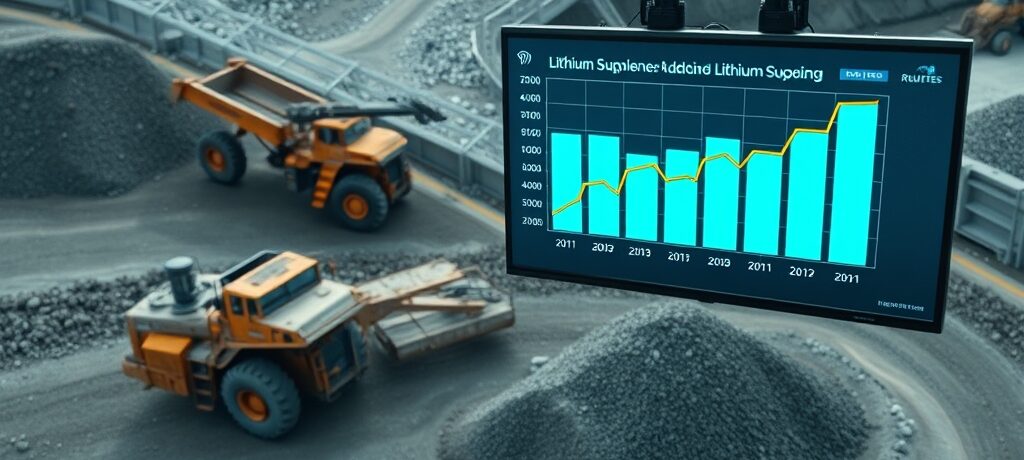
The global lithium market is experiencing a profound structural reversal, moving decisively from a multi-year period of severe oversupply to an aggressively tightening environment. Major financial institutions are now projecting a steep supply deficit for the critical battery metal by 2026, marking a significant pivot for a commodity central to the energy transition.
As noted by Mining Visuals in a recent report, ‘The question is no longer if the lithium market will face a supply shortage, but rather how aggressively the supply chain will struggle to meet compounding demand.’ This sentiment underscores a dramatic shift from the market conditions observed between 2022 and 2024, which were characterized by a massive wave of excess supply.
From Glut to Correction: The Price Plunge and Its Aftermath
The period of oversupply was largely fueled by a surge of new production, primarily from operations in Australia and China, which flooded the market just as short-term demand growth temporarily cooled. This imbalance led to a severe market surplus, peaking at approximately 175,000 tons of Lithium Carbonate Equivalent (LCE) in 2023, according to Fastmarkets.
The consequence of this excess inventory was a dramatic collapse in spot prices. Lithium prices plummeted by more than 80 percent from their late-2022 highs, bottoming out at just US$8,259 per ton in China by June 2025. This sharp decline, however, triggered a fierce market correction. As prices fell below the cost of production, major Chinese operations curtailed capacity, Australian spodumene miners halted output, and global exploration budgets were heavily slashed.
Consequently, the surplus is now shrinking rapidly. S&P Global Commodity Insights forecasts this surplus will narrow to 141,000 tons LCE in 2025, driven by a robust 13.5 percent year-over-year increase in consumption. The definitive pivot, according to consensus, is set to arrive in 2026, when the market is firmly expected to enter a structural deficit.
Accelerating Demand and Strategic Imperatives
While supply was aggressively reined in throughout 2025, the underlying demand drivers for lithium accelerated significantly. Global electric vehicle (EV) sales rose 22 percent in 2025, maintaining their position as the primary demand driver, consuming roughly 70 percent of total lithium output.
However, energy storage systems (ESS) are rapidly emerging as a critical swing factor, capable of tightening global balances independently. Battery energy storage demand grew an explosive 51 percent in 2025, elevating storage to about a fifth of total global battery demand. This growth is propelled by essential grid reliability upgrades and the massive power requirements of expanding AI infrastructure. In the US, the energy storage industry installed a record 57.6 GWh of new capacity in 2025, a figure four times greater than what the industry installed just three years prior. China dwarfed this, with 65 GWh of grid-scale battery energy storage entering operation in December 2025 alone.
On the policymaking front, governments have increasingly viewed critical minerals less as mere inputs and more as strategic assets. In the US, a Section 232 action focused on critical minerals concluded that reliance on imports poses a threat to national security, potentially opening the door to price floors, tariffs, and negotiated import frameworks. Furthermore, the US launched ‘Project Vault’ in February 2026, a US$12 billion public-private initiative designed to procure and store critical minerals, including a strategic lithium reserve.
Simultaneously, supply unreliability is injecting a heavy risk premium into the market. Zimbabwe, which accounts for approximately 10 percent of global mined lithium production, abruptly suspended exports of raw lithium earlier this year to force domestic processing. In China, regulatory issues have delayed the restart of CATL’s massive Jianxiawo lepidolite mine, removing a key source of supply from the market.
Pricing the Pivot: A Lagging Supply Response
Markets are forward-looking, and the anticipated shift from glut to deficit is already being aggressively priced in. Between early December 2025 and late January 2026, spot battery-grade lithium carbonate prices surged from approximately US$13,433 per metric ton to US$26,278, representing a 95 percent increase. Spodumene prices have followed suit, climbing above US$2,000 per metric ton for the first time since late 2023.
While this rebound in prices has improved project economics, a meaningful supply response is expected to lag significantly. During the prolonged market downturn, feasibility studies for new projects dropped from dozens annually to fewer than 10 in 2025. With demand compounding across multiple sectors and new supply constrained by lengthy development timelines and geopolitical maneuvering, the era of cheap, abundant lithium appears to be decisively over.