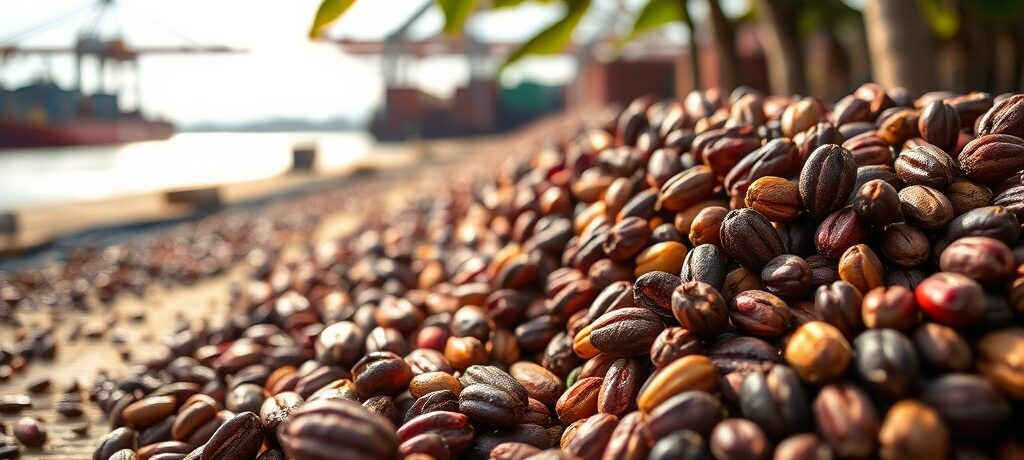
Global cocoa prices experienced a significant downturn on Friday, marking a second consecutive day of sharp declines, as mounting evidence of weak global demand weighed heavily on the market. May ICE NY cocoa (CCK26) futures closed down -181 points, a -5.38% drop, while May ICE London cocoa #7 (CAK26) futures fell -104 points, or -4.17%. This pronounced price pressure comes amidst a confluence of factors, primarily driven by disappointing consumption data from key regions and an easing of supply concerns.
Regional Demand Indicators Show Weakness
Recent data on cocoa grindings, a key indicator of demand from chocolate manufacturers, painted a mixed but predominantly bearish picture. The National Confectioners Association reported that North American Q1 cocoa grindings declined by -3.8% year-over-year to 106,087 metric tons (MT). Even more starkly, the European Cocoa Association announced a -7.8% year-over-year fall in Q1 European cocoa grindings, reaching 325,895 MT. This figure represented a larger decline than expectations of -6% year-over-year and marked the lowest Q1 grindings in 17 years for the region.
Conversely, the Cocoa Association of Asia provided an unexpected bright spot, reporting that Q1 Asian cocoa grindings rose +5.2% year-over-year to 223,503 MT. This performance was stronger than expectations of a -6.7% year-over-year decline, suggesting a regional divergence in demand trends.
Beyond industrial processing, consumer demand for chocolate products also showed signs of softening. Circana reported that chocolate candy sales in North America for the 13 weeks ending March 22 fell -1.3% from the same period a year ago. Further compounding this bearish sentiment, Bloomberg Intelligence noted that chocolate candy sales during the recent Easter holiday, a prime seasonal period for chocolate consumption, dropped approximately 5% from last year’s figures.
Evolving Supply Dynamics and Inventory Build-Up
The supply side of the equation also contributed to the downward pressure on prices. ICE cocoa inventories have seen a notable increase, rising to a 19.75-month high of 2,624,492 bags on Thursday. This build-up suggests that current supply is more than sufficient to meet the prevailing demand.
Furthermore, cumulative data from the Ivory Coast, the world’s largest cocoa producer, indicated larger supplies reaching ports. Farmers in the Ivory Coast shipped 1.46 MMT of cocoa to ports in the current marketing year (October 1, 2025, through April 12, 2026), representing a +0.7% increase from 1.45 MMT in the same period a year ago. The reopening of the Strait of Hormuz on Friday was also cited as a negative factor for cocoa prices, as a return to normal shipping flows is expected to ease global cocoa supply concerns, potentially reducing freight costs and transit times.
Farmer Incentives and Future Production Outlook
Recent policy decisions in major producing nations highlight the complex interplay between global prices and local farmer economics. Ghana, a significant cocoa producer, cut the official price it pays its cocoa farmers by nearly 30% for supplies for the 2025/26 growing season. Similarly, the Ivory Coast announced a substantial 57% cut in cocoa farmer pay, which commenced with the mid-crop harvest this month. These cuts, implemented by countries that collectively produce more than half of the world’s cocoa, could impact future planting decisions and supply.
Production forecasts present a mixed outlook. Nigeria, the world’s fifth-largest cocoa producer, saw its December cocoa exports rise +17% year-over-year to 54,799 MT, according to a Bloomberg report on February 17. However, Nigeria’s Cocoa Association projects that Nigerian cocoa production in 2025/26 will fall by -11% year-over-year to 305,000 MT, down from a projected 344,000 MT for the 2024/25 crop year. The Ivory Coast also anticipates a decline, projecting its cocoa production in 2025/26 to fall -10.8% year-over-year to 1.65 MMT from 1.85 MMT in 2024/25.
Shifting Global Surplus Projections
The market’s sentiment has been further influenced by revised global surplus estimates. The International Cocoa Organization (ICCO) on March 2 raised its global 2024/25 cocoa surplus estimate to 75,000 MT from 49,000 MT in November, marking the first surplus in four years. ICCO estimated that global cocoa production in 2024/25 climbed by +8.4% year-over-year to 4.7 MMT.
Looking further ahead, Rabobank cut its 2025/26 global cocoa surplus estimate to 250,000 MT from a November forecast of 328,000 MT. Meanwhile, StoneX, on January 29, forecasted a global cocoa surplus of 287,000 MT in the 2025/26 season and a 267,000 MT surplus for 2026/27. These projections, indicating a move towards a more balanced or even oversupplied market in the coming seasons, contribute to the current bearish outlook.
The cumulative effect of weak demand signals, rising inventories, and shifting surplus projections has created a challenging environment for cocoa prices. While an excessively short position by funds in New York cocoa, which stood at 16,368 net short positions in the week ended April 7 according to the weekly Commitment of Traders report—the most in over 3 years—could potentially fuel a short-covering rally, the immediate market sentiment remains firmly bearish, driven by the fundamental imbalance between supply and demand.