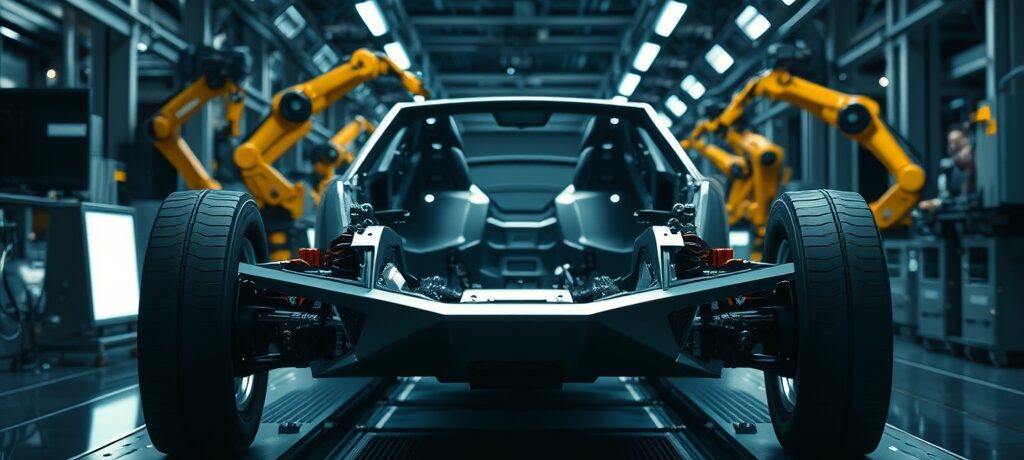
Tesla (NASDAQ: TSLA) has officially commenced pilot production of its Cybercab, a vehicle purpose-built for autonomy. This development, confirmed in the company’s first-quarter update, injects further realism into Tesla’s long-standing autonomy narrative and signals a serious commitment to a dedicated autonomous ride-sharing fleet.
Cybercab Enters Pilot Production Amidst Mixed Q1 Results
The start of Cybercab’s pilot production marks a significant milestone, with more substantial manufacturing anticipated later this year. This news arrives as Tesla navigates a transitional period for its core automotive business. While the company reported a solid 16% year-over-year revenue increase in the first quarter, driven by its automotive segment, sequential trends indicate some pressure. Total vehicle deliveries declined to 358,023 in Q1 from 418,227 in the preceding quarter, and global vehicle inventory days of supply rose to 27 from 15.
Despite these headwinds in legacy vehicle sales, the first quarter offered encouraging signals related to Tesla’s autonomy initiatives. The number of active Full Self-Driving (Supervised) subscriptions climbed to 1.28 million, up from 1.10 million in Q4. More notably, paid Robotaxi miles, a key metric for Tesla’s autonomous ride-sharing network, nearly doubled sequentially. The company also expanded its unsupervised Robotaxi operations beyond Austin, Texas, to Dallas and Houston in April, with preparations underway in Phoenix, Miami, Orlando, Tampa, and Las Vegas.
Why Cybercab Matters for Tesla’s Future
Tesla harbors ambitious expectations for the Cybercab. Once pilot production transitions to volume manufacturing, the company anticipates it will supersede the existing Model Y fleet in its Robotaxi service and eventually become the largest volume vehicle within that fleet. However, investors should temper expectations for an immediate sales surge.
During the first-quarter earnings call, Tesla CEO Elon Musk cautioned that new product ramps, especially with novel supply chains, typically follow a “stretched-out S curve.” He indicated that initial Cybercab production would be “very slow” before a later ramp-up. Furthermore, Musk projected that unsupervised FSD or Robotaxi revenue would likely “not be super material this year” but could become “material in a significant way next year.”
This measured outlook suggests that Cybercab’s financial impact will not be substantial in the short term. The production ramp-up is expected to be gradual. Moreover, demand for Cybercab is intrinsically linked to the expansion and proven economics of Tesla’s Robotaxi network. A primary selling point for Cybercab owners is the potential to deploy their vehicles into the network to generate income. However, the timeline for the Robotaxi service’s ramp-up remains uncertain, and this nascent business is heavily reliant on regulatory approvals.
Is Tesla Stock a Buy Ahead of Potential Sales Growth?
The question of whether Tesla’s stock is a buy hinges on more than just the Cybercab’s production status. A significant factor for investors to consider is the stock’s current valuation. With shares trading at a price-to-earnings ratio well exceeding 300, the market may have already priced in a successful Cybercab and Robotaxi rollout. This high valuation leaves little room for error or delays.
Adding to the valuation concerns, Tesla’s capital expenditures are projected to escalate significantly. The company now anticipates exceeding $25 billion in capital expenditures in 2026. “While this may seem a lot, and we will have the impact of negative free cash flow for the rest of the year, we believe this is the right strategy to position the company for the next era,” stated Tesla CFO Vaibhav Taneja during the earnings call.
While the long-term potential for a massive sales surge from Cybercab and Robotaxi services is considerable, it remains unclear if these ventures will be sufficient earnings growth drivers to justify the stock’s current valuation, especially given the anticipated surge in spending. The commencement of Cybercab pilot production is a positive indicator, but Tesla’s own commentary suggests a lengthy ramp-up period. Consequently, the current stock price appears to afford minimal buffer for delays or unmet expectations.
The path forward for Tesla involves balancing the execution of its ambitious autonomy plans with the financial realities of production ramps, regulatory hurdles, and substantial capital investment. Investors must weigh the long-term vision against the near-term financial implications and the stock’s demanding valuation.