Crude oil and gasoline prices posted gains on Friday, driven by escalating tensions in the Middle East, specifically renewed hostilities between the United States and Iran in the strategically vital Strait of Hormuz. June WTI crude oil (CLM26) closed up +0.61, marking a +0.64% increase, while June RBOB gasoline (RBM26) saw a more significant rise of +0.0707, or +2.05%. The market’s upward movement reflects profound concerns regarding the sustainability of the fragile ceasefire between the two nations, as fresh confrontations threaten global energy supplies.
Escalating Tensions in the Strait of Hormuz
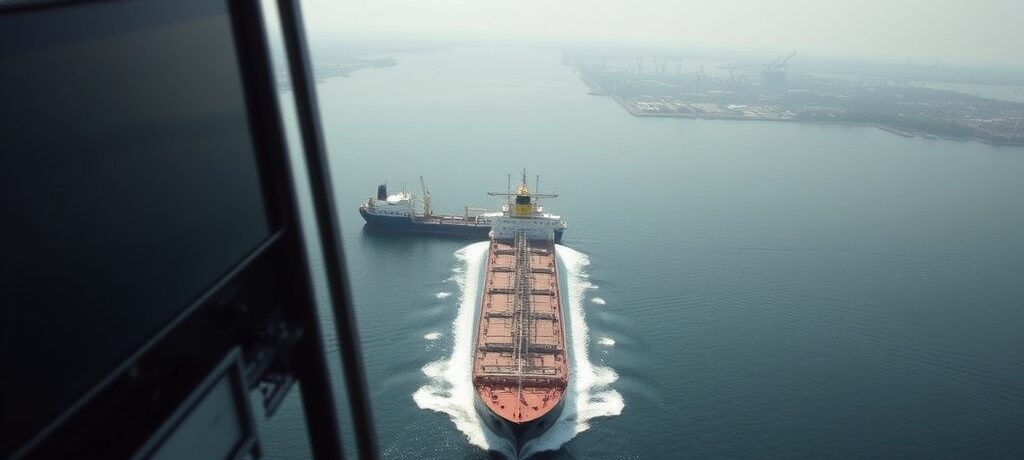
The Strait of Hormuz, a critical chokepoint through which approximately a fifth of the world’s oil and liquefied natural gas transits, has become the epicenter of recent escalations. On Friday, Iran’s semi-official Tasnim news agency reported that Iran seized an oil tanker in the strait, citing its attempt to ‘disrupt oil exports and the interests of the Iranian nation.’ In a retaliatory move, US forces targeted missile and drone launch sites and other military assets within Iran, which were deemed responsible for attacking three US Navy destroyers traversing the strait. Furthermore, the US confirmed it had ‘disabled’ two unladen, Iranian-flagged oil tankers attempting to navigate the waterway. These incidents unfold as the markets await Iran’s response, expected via Pakistan in the coming days, to a US proposal aimed at gradually reopening the Strait of Hormuz and lifting the US blockade on Iranian ports. The Wall Street Journal also reported that Saudi Arabia and Kuwait have lifted previous restrictions on the US military’s use of their bases and airspace, following an Iranian missile and drone attack on the UAE, which was a response to US efforts to open the strait.
Global Supply Disruptions and Market Impact
The ongoing US-Iran conflict and the resulting closure of the Strait of Hormuz continue to underpin energy prices by exacerbating global oil and fuel shortages. Goldman Sachs estimates indicate a significant curtailment of crude output in the Persian Gulf, by approximately 14.5 million barrels per day (bpd). This disruption has already drawn down nearly 500 million barrels from global crude stockpiles, with projections suggesting a potential depletion of one billion barrels by June. Persian Gulf oil producers have reportedly been forced to cut production by roughly 6% as local storage facilities reach capacity due to the strait’s closure. The International Energy Agency (IEA) further highlighted the severity of the situation, stating that about 14 million bpd of global oil supply has been shuttered by the Iran war and the closure of the Strait of Hormuz. The IEA also noted that more than 80 energy facilities have been damaged during the conflict, with a recovery period estimated to take as long as two years.
OPEC+ Dynamics and Broader Geopolitical Factors
Adding another layer of complexity to the global oil market, the United Arab Emirates (UAE), the third-largest producer in the OPEC cartel, announced its departure from the organization effective May 1. While this decision is generally considered bearish for crude prices, as it allows the UAE to boost production unconstrained by OPEC’s output quotas, its immediate impact is overshadowed by the broader regional conflict. OPEC+ had previously indicated plans to boost its crude output by 188,000 bpd in June, following a 206,000 bpd increase in May. However, these planned hikes now appear unlikely given that Middle East producers are already being forced to cut production due to the ongoing war. OPEC+ is still working to restore 827,000 bpd of the 2.2 million bpd production cut initiated in early 2024. Meanwhile, OPEC’s April crude production fell by -420,000 bpd, reaching a 35-year low of 20.55 million bpd. Beyond the Middle East, the protracted Russia-Ukraine war also contributes to bullish sentiment for oil prices. A recent US-brokered meeting in Geneva to end the conflict concluded early, with Ukrainian President Zelenskiy accusing Russia of prolonging the war. Russia’s insistence on an unresolved ‘territorial issue’ and its declaration of ‘no hope of achieving a long-term settlement’ without its territorial demands being met suggest continued restrictions on Russian crude exports. Ukrainian drone and missile attacks have targeted at least 30 Russian refineries over the past ten months, with 21 strikes in April alone, reducing Russia’s average refinery runs to a 16-year low of 4.69 million bpd, according to Bloomberg data. US and EU sanctions further curb Russian oil exports.
US Inventory and Production Landscape
Domestically, recent data from the US Energy Information Administration (EIA) for May 1 showed US crude oil inventories were +0.7% above the seasonal five-year average. In contrast, gasoline inventories were -3.1% below, and distillate inventories were -10.1% below their respective five-year seasonal averages. US crude oil production in the week ending May 1 experienced a slight decline of -0.1% week-over-week, settling at 13.573 million bpd, just below the record high of 13.862 million bpd posted in November. Concurrently, Baker Hughes reported on Friday that the number of active US oil rigs in the week ended May 8 rose by +2 to 410 rigs, moving slightly above the 4.25-year low of 406 rigs recorded in December. This figure, however, remains significantly lower than the 5.5-year high of 627 rigs reported in December 2022, indicating a broader trend of reduced drilling activity over the past two and a half years.
The confluence of heightened geopolitical tensions in the Middle East, significant disruptions to global supply chains, and the lingering effects of the Russia-Ukraine conflict continues to exert upward pressure on crude oil and gasoline prices. While domestic production and inventory levels offer some counterpoints, the immediate market reaction underscores the profound sensitivity of energy markets to regional instability, suggesting sustained volatility as diplomatic efforts and military actions unfold.