IFM Investors Pty has issued a stark warning, indicating it may abandon a proposed A$3 billion ($2.2 billion) investment to produce sustainable aviation fuel (SAF) in Australia. The global infrastructure manager asserts that the ambitious project hinges entirely on the Australian government mandating that airlines use the cleaner-burning product, with a policy framework needing finalization within the next six months.
Danny Elia, IFM’s global head of infrastructure asset management, emphasized the critical need for government intervention. “Within the next six or so months, we are really going to need to see some finality around the policy framework,” Elia stated in a recent interview. “We actually need a demand-side mandate.” He added that “You will not see a project of any significance get up at all without demand-side support,” underscoring the industry’s reliance on policy certainty to de-risk substantial capital outlays.
Decarbonization and Fuel Security at Stake
Sustainable aviation fuel is widely recognized by airlines as the most viable pathway to significantly reduce aircraft emissions, with the potential to cut them by as much as 80%. Despite this environmental imperative, global SAF output remains a mere trickle, accounting for less than 1% of total jet fuel consumption last year. This low production volume is primarily attributed to the absence of robust legislative frameworks designed to incentivize producers and guarantee demand.
IFM’s proposed investment, which the firm has been assessing for at least two years, aims to produce SAF from local agricultural feedstock. This initiative is not only aligned with global decarbonization goals but also addresses Australia’s precarious fuel security. The recent geopolitical tensions, particularly the Iran War, have highlighted Australia’s heavy reliance on imported fuel, a vulnerability that has already led Qantas Airways Ltd. and Virgin Australia Holdings Ltd. to cut services and raise fares due to soaring jet fuel prices. According to Elia, producing home-grown sustainable fuel would significantly bolster Australia’s fragile fuel security.
Strategic Investments and Industry Calls
The ultimatum from IFM, which manages A$266 billion of assets globally and is owned by major Australian pension funds and the UK fund Nest, also aligns with its own strategic investment portfolio. The firm holds significant stakes in key gateway airports, including Sydney, Melbourne, and Brisbane in Australia, as well as international hubs like London Stansted and Vienna Airport. A robust local SAF supply chain would directly support these aviation assets.
IFM’s call for government policy echoes similar demands from major players in the aviation sector. Plane manufacturer Airbus SE has also advocated for government policies to foster a sustainable fuel supply chain within Australia. However, the implementation of demand mandates is not without its critics. The International Air Transport Association (IATA) has voiced concerns that mandates, such as those seen in Europe, can inflate SAF prices, thereby discouraging voluntary demand and potentially reducing overall output. IATA noted in February that while cleaner fuel is typically more than double the price of conventional jet fuel, mandates can push its cost to four times higher.
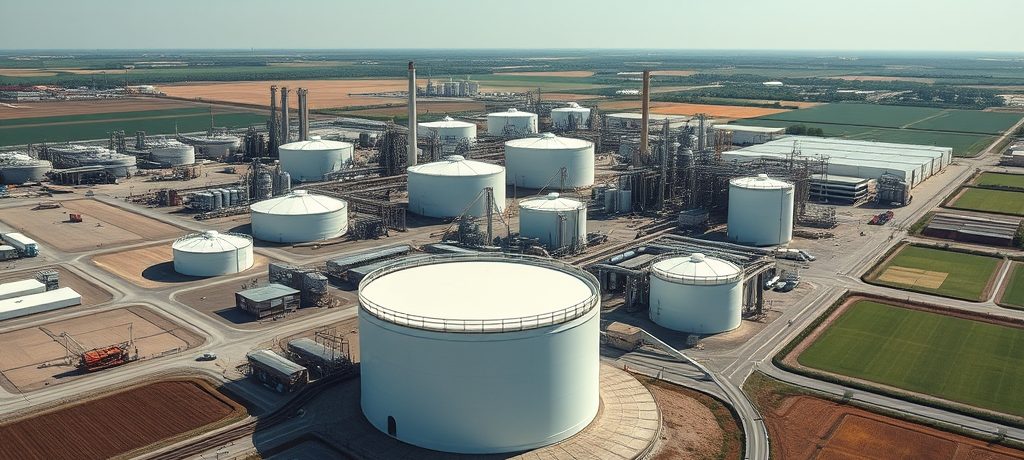
The proposed project involves collaboration with agribusiness GrainCorp Ltd. and fuel company Ampol. Plans include constructing a new feedstock crushing facility and a new fuel refinery in the Brisbane suburb of Lytton. A representative for GrainCorp declined to comment on IFM’s position, while an Ampol spokesman affirmed that a competitive lower-carbon, liquid-fuels manufacturing capability would only be viable with supportive demand and supply policies in place.
The clock is ticking for the Australian government to respond to IFM’s ultimatum. “We have stretched our timeline, but we just can’t stretch anymore,” Elia warned. “You can’t hold preferred sites where you want to build forever.” The decision facing Australian Minister for Climate Change and Energy Chris Bowen’s office, which had no immediate comment on the matter, will be pivotal for the future of large-scale sustainable aviation fuel production in the country and its broader implications for both environmental targets and national energy resilience.