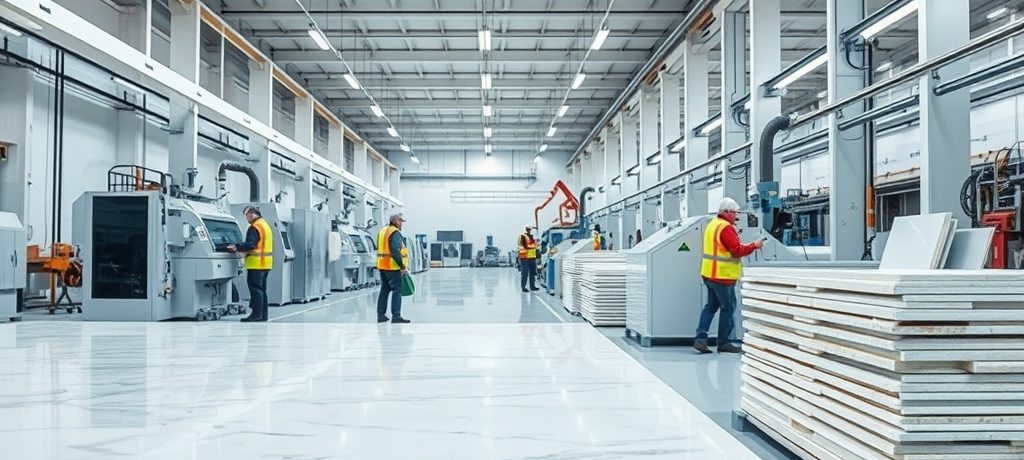
Cambria CEO Marty Davis, a prominent donor to President Trump, is facing accusations of leveraging his political connections to implement tariffs on imported quartz, a move his business rivals claim unfairly targets them and raises prices for consumers. The private Minnesota-based company, a significant manufacturer of quartz countertops, has repeatedly petitioned the U.S. government for increased tariffs, leading to a heated industry dispute.
Davis, who runs the $500 million Cambria company and is part of a billionaire family dynasty that once included Sun Country Airlines, publicly champions American manufacturing and ‘free and fair trade.’ He told NPR, ‘Free and fair trade has to prevail, or the American manufacturer will be gone, and these jobs will leave. And they are jobs that really promote a healthy middle class.’
However, Cambria’s competitors paint a starkly different picture. They allege that Davis, a wealthy CEO, is actively harming jobs, particularly within small businesses, and driving up costs for middle-class homeowners. These businesses rely heavily on imported quartz slabs, and the imposed tariffs directly increase their operational expenses, forcing them to pass these costs onto consumers.
Kyle Keck, general manager of Marble Uniques, an Indiana-based small business employing around 30 people, stated, ‘I don’t believe that our customers will absorb the full cost … so I could potentially see loss of jobs overall.’ His family-owned business is part of a broader industry coalition actively opposing Cambria’s latest tariff requests. This coalition includes large importers, small fabricators, and home builders who purchase quartz.
A War Over Jobs and Affordability
The conflict over quartz countertop costs has escalated into a public relations battle. Both Cambria and its opponents have engaged high-powered legal and communications firms to advocate their positions to the government and the public. Each side claims to be acting in the best interest of everyday Americans, rather than solely pursuing corporate profits.
Both factions are highlighting the potential impact on jobs and the affordability crisis facing U.S. home buyers, with each asserting they are protecting over 100,000 jobs across the quartz industry. Yet, Cambria’s rivals point to Davis’s close ties to President Trump as an unfair advantage. Davis has hosted significant fundraisers for the president, including a $100,000-per-person event in 2020. He also stated he is ‘invested in’ Trump Media and Technology Group.
The ultimate decision on further quartz tariffs rests with President Trump. This prospect has led Cambria’s competitors to accuse Davis of exploiting the president’s favored trade policy tool and using his political influence to create an uneven playing field.
‘Very few of us have the time or the resources to advocate on a political level,’ Keck commented. ‘It certainly feels like these larger corporations are kind of cornering that market.’
Cambria’s Role in Popularizing Quartz
Founded in 1999, the Davis family’s Cambria played a crucial role in establishing quartz as a dominant material in kitchen design. Quartz countertops, a manufactured alternative to granite and marble, are produced at Cambria’s Minnesota factory using raw quartz mined in Canada. The company emphasizes the customization, durability, and aesthetic appeal of its product, which is sold to both luxury markets and more budget-conscious consumers through retailers like Home Depot.
Davis argues that his importer rivals are driving down prices by benefiting from what he describes as unfair trade practices by foreign governments, particularly China, India, and Turkey. In their petitions, Cambria and other domestic manufacturers contend that these countries are violating U.S. trade laws by flooding the market with artificially cheap quartz, aiming to push domestic producers out of business.
Cambria specifically targets large distributors like MS International (MSI), a California-based company with approximately $2.5 billion in annual sales, significantly larger than Cambria’s. MSI has been instrumental in organizing the opposition to Cambria’s tariff requests. An MSI spokesperson stated that Cambria’s petition ‘pits a small handful of [big] corporations that brought this ill-advised trade petition against thousands of fabricators, distributors, retailers, installers, homebuilders, and American workers.’
Davis maintains that he had no alternative but to seek government intervention, citing the need to compete against ‘economics that are false and a totally unfair, unlevel playing field.’
A History of Trade Protection
This is not the first time Cambria has sought trade protection. In 2018, during Trump’s presidency, Cambria successfully petitioned the U.S. International Trade Commission (ITC) to impose tariffs on quartz imports from China. Subsequent petitions led to similar penalties on imports from India and Turkey.
According to Scott Lincicome, a trade expert at the Cato Institute, such requests are a long-standing practice for U.S. manufacturers, particularly in the steel and aluminum sectors, seeking protection from cheaper foreign imports. ‘This has been a dirty little secret of U.S. trade policy for decades,’ Lincicome noted. ‘It is a machine designed to churn out import protection.’
Cambria has now pursued a ‘global safeguard’ action, a petition submitted in September by Cambria and other domestic manufacturers. This request aims to impose tariffs on quartz from nearly all countries, a broader scope than previous actions targeting specific nations. The outcome of this latest petition remains pending, with President Trump’s administration holding the final decision-making authority.